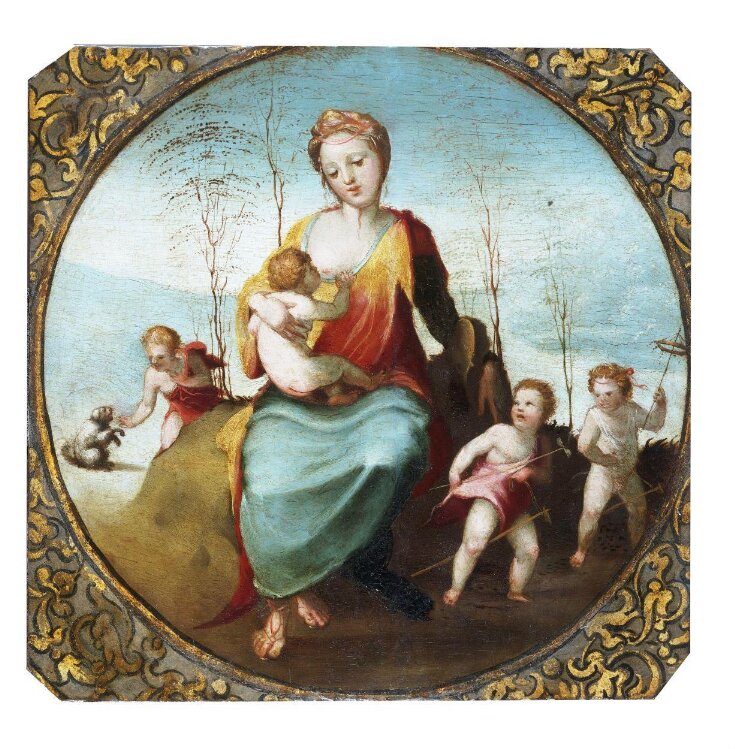
Charity suckling a Child and Surrounded by Three Children Playing with a Dog and Hobby Horses
Oil Painting
ca. 1525 (painted)
ca. 1525 (painted)
| Artist/Maker | |
| Place of origin |
Domenico Beccafumi (1484?- 1551) was a Sienese painter, sculptor, draughtsman, printmaker and illuminator. He was a maniera painter closely attuned to contemporary developments in Florence and Rome but who continued to paint with a strong sense of the artistic traditions developed during the fourteenth-century 'Golden-Age' of Sienese painting. He painted on panel and in fresco and his mature works are characterised by bold and sometimes acidic colours in pink, green and yellow which later give way to a greater interest in dramatic contrasts of light and shade. His figures demonstrate a natural or exaggerated grace in their poses and often contrast the smooth brilliance of the naked limbs with the intense colour, sinuous folds and decorative line of their draperies. He became Siena's primary artist, receiving the most prestigious civic, ecclesiastical and private commissions and ultimately transformed the city with his personal interpretation of the maniera style.
CAI.165 has been cut down and probably originally formed part of a piece of painted furniture. The main figure represents Charity and was likely originally accompanied by roundels representing the two other theological virtues of Hope and Faith. Charity was seen by the medieval church as a means of expressing one's love of God and of one's neighbour, a notion derived from Chapter 13 of the First Epistle to the Corinthians which describes Christian Charity as Love. Following artistic tradition, Beccafumi depicts Charity wearing a red dress (with yellow in the highlights) and suckling a child at her breast, an allusion to Charity's provision for the needy. The three playful children may be an allusion to a part of the epistle: 'When I was a child, I talked like a child, I thought like a child, I reasoned like a child. When I became a man, I put childish ways behind me.' (1Cor. 13:11)
CAI.165 has been cut down and probably originally formed part of a piece of painted furniture. The main figure represents Charity and was likely originally accompanied by roundels representing the two other theological virtues of Hope and Faith. Charity was seen by the medieval church as a means of expressing one's love of God and of one's neighbour, a notion derived from Chapter 13 of the First Epistle to the Corinthians which describes Christian Charity as Love. Following artistic tradition, Beccafumi depicts Charity wearing a red dress (with yellow in the highlights) and suckling a child at her breast, an allusion to Charity's provision for the needy. The three playful children may be an allusion to a part of the epistle: 'When I was a child, I talked like a child, I thought like a child, I reasoned like a child. When I became a man, I put childish ways behind me.' (1Cor. 13:11)
Object details
| Categories | |
| Object type | |
| Parts | This object consists of 3 parts.
|
| Title | Charity suckling a Child and Surrounded by Three Children Playing with a Dog and Hobby Horses (generic title) |
| Materials and techniques | oil on poplar panel |
| Brief description | Oil painting, 'Charity suckling a Child and Surrounded by Three Children Playing with a Dog and Hobby Horses', Domenico Beccafumi, ca. 1525 |
| Physical description | A woman wearing a red dress with lemon yellow highlights over a blue-green skirt, is seated upon a grassy mound suckling a child at her right breast; another child plays with a small dog at left while two other children play with hobby horses and whirligigs at right, enclosed within a fictive painted frame in blue and gold |
| Dimensions |
|
| Style | |
| Credit line | Bequeathed by Constantine Alexander Ionides |
| Object history | This object was part of the collection of Constantine Alexander Ionides, bequeathed to the museum in 1900. It was formerly probably in the Samuel Wooburn collection, sold at Christie's, 25 June 1853, lot 95. Historical significance: Domenico Beccafumi [also known as Mecherino] (1484?- 1551) was a Sienese painter, sculptor, draughtsman, printmaker and illuminator. He was a maniera painter closely attuned to contemporary developments in Florence and Rome but who continued to paint with a strong sense of the artistic traditions developed during the fourteenth-century 'Golden-Age' of Sienese painting. He painted on panel and in fresco and his mature works are characterised by bold and sometimes acidic colours in pink, green and yellow which later give way to a greater interest in dramatic contrasts of light and shade. His figures demonstrate a natural or exaggerated grace in their poses and often contrast the smooth brilliance of the naked limbs with the intense colour, sinuous folds and decorative line of their draperies. In addition to his paintings and sculptures, Beccafumi made innovative oil-sketches, experimented inventively with copper-plate engraving and woodcuts which he sometimes superimposed to create various different effects and developed a new technique of marble inlay or intarsia for the pavement of Siena Cathedral. He became Siena's primary artist, receiving the most prestigious civic, ecclesiastical and private commissions and ultimately transformed the city with his personal interpretation of the maniera style. CAI.165 has been cut down and probably originally formed part of a piece of painted furniture. The main figure represents Charity and was likely originally accompanied by roundels representing the two other theological virtues of Hope and Faith. Charity was seen by the medieval church as a means of expressing one's love of God and of one's neighbour, a notion derived from Chapter 13 of the First Epistle to the Corinthians which describes Christian Charity as Love. Following artistic tradition, Beccafumi depicts Charity wearing a red dress (with yellow in the highlights) and suckling a child at her breast, an allusion to Charity's provision for the needy. The three playful children may be an allusion to a part of the epistle: 'When I was a child, I talked like a child, I thought like a child, I reasoned like a child. When I became a man, I put childish ways behind me.' (1Cor. 13:11) |
| Historical context | During the fifteenth and sixteenth centuries in Italy, artists were often commissioned to create painted wooden furnishings for the domestic interior, and particularly for the camera (bedchamber) of wealthy private palaces. Such works were generally commissioned to celebrate a new marriage or the birth of a child and could include a lettiera (bed), spalliera or cornicioni (a painted frieze), a cassapanca (bench-chest) and a set of cassone (marriage chests) among other objects and furnishings. The decoration often included subjects associated with fertility, maternity, childbirth, marriage and fidelity and could include references to the patrons through inclusion of their coat of arms and heraldic colours, or of their personal motto or device. |
| Subjects depicted | |
| Summary | Domenico Beccafumi (1484?- 1551) was a Sienese painter, sculptor, draughtsman, printmaker and illuminator. He was a maniera painter closely attuned to contemporary developments in Florence and Rome but who continued to paint with a strong sense of the artistic traditions developed during the fourteenth-century 'Golden-Age' of Sienese painting. He painted on panel and in fresco and his mature works are characterised by bold and sometimes acidic colours in pink, green and yellow which later give way to a greater interest in dramatic contrasts of light and shade. His figures demonstrate a natural or exaggerated grace in their poses and often contrast the smooth brilliance of the naked limbs with the intense colour, sinuous folds and decorative line of their draperies. He became Siena's primary artist, receiving the most prestigious civic, ecclesiastical and private commissions and ultimately transformed the city with his personal interpretation of the maniera style. CAI.165 has been cut down and probably originally formed part of a piece of painted furniture. The main figure represents Charity and was likely originally accompanied by roundels representing the two other theological virtues of Hope and Faith. Charity was seen by the medieval church as a means of expressing one's love of God and of one's neighbour, a notion derived from Chapter 13 of the First Epistle to the Corinthians which describes Christian Charity as Love. Following artistic tradition, Beccafumi depicts Charity wearing a red dress (with yellow in the highlights) and suckling a child at her breast, an allusion to Charity's provision for the needy. The three playful children may be an allusion to a part of the epistle: 'When I was a child, I talked like a child, I thought like a child, I reasoned like a child. When I became a man, I put childish ways behind me.' (1Cor. 13:11) |
| Bibliographic references |
|
| Collection | |
| Accession number | CAI.165 |
About this object record
Explore the Collections contains over a million catalogue records, and over half a million images. It is a working database that includes information compiled over the life of the museum. Some of our records may contain offensive and discriminatory language, or reflect outdated ideas, practice and analysis. We are committed to addressing these issues, and to review and update our records accordingly.
You can write to us to suggest improvements to the record.
Suggest feedback
You can write to us to suggest improvements to the record.
Suggest feedback
| Record created | May 8, 2003 |
| Record URL |
Download as: JSONIIIF Manifest
