Bedpost
ca. 1520 (made)
| Artist/Maker | |
| Place of origin |
Object Type
Beds of this period - except for the most humble examples - usually had curtains and a tester, a form of roof supported by four posts. The more lavish the textiles, the grander the bed. Most of the woodwork was plain and functional but the front posts, which were visible, were sometimes lavishly carved.
Time
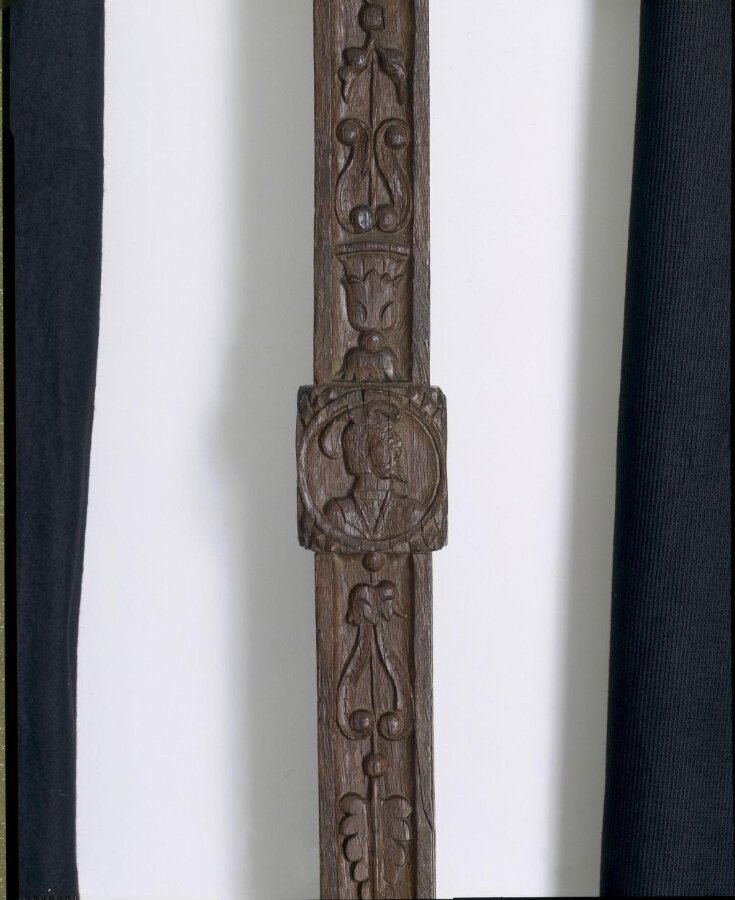
This bed post is a very important early example of the use of classical motifs in England, at a time when the Gothic style still dominated in furniture and architecture. The profile medallion heads, candelabra motifs and drops of fruit all indicate the new interest in classical decoration.
From about 1500, as conditions became more stable, rich households moved less from one property to another than they had done in the Middle Ages. This bed was probably intended to stay up in one house, rather than be moved on a regular basis. It is unlikely to be a travelling bed since there are no holes for the bolt or large peg at the base that kept the bed stable once it had been reassembled.
Owners
The blending of classical and Gothic would have been considered the height of fashion, almost verging on the avant garde, in about 1520. It is therefore likely that the bed would have been owned by a courtier, senior cleric or rich merchant.
Beds of this period - except for the most humble examples - usually had curtains and a tester, a form of roof supported by four posts. The more lavish the textiles, the grander the bed. Most of the woodwork was plain and functional but the front posts, which were visible, were sometimes lavishly carved.
Time
This bed post is a very important early example of the use of classical motifs in England, at a time when the Gothic style still dominated in furniture and architecture. The profile medallion heads, candelabra motifs and drops of fruit all indicate the new interest in classical decoration.
From about 1500, as conditions became more stable, rich households moved less from one property to another than they had done in the Middle Ages. This bed was probably intended to stay up in one house, rather than be moved on a regular basis. It is unlikely to be a travelling bed since there are no holes for the bolt or large peg at the base that kept the bed stable once it had been reassembled.
Owners
The blending of classical and Gothic would have been considered the height of fashion, almost verging on the avant garde, in about 1520. It is therefore likely that the bed would have been owned by a courtier, senior cleric or rich merchant.
Object details
| Categories | |
| Object type | |
| Materials and techniques | Carved oak |
| Dimensions |
|
| Gallery label | British Galleries:
The carver of this bed post has created crude, flat, classical ornament, similar to candelabra and profile heads, but has not succeeded in making a successful version of a classical pier. The base is still decorated with the traditional Gothic form of tracery rather than the fashionable classical mouldings.(27/03/2003) |
| Object history | Made in England. Bed posts purchased from Basil Dighton for £60 Notes from R.P. 20/311 15/1/20 Minute sheet, H Clifford Smith to Brackett reports that Dighton bought the pair of Henry VIII bedposts from a dealer in Norwich and offers them to the museum at cost. Dighton referred to them as "remarkable" and Smith finds them "interesting and important examples of Early English Renaissance decoration with arabesques and medallion heads combined with details of Gothic ornament". 19/1/20 Brackett Minute sheet recommends purchase of these "rare and distinguished carvings…unlike anything we possess". |
| Summary | Object Type Beds of this period - except for the most humble examples - usually had curtains and a tester, a form of roof supported by four posts. The more lavish the textiles, the grander the bed. Most of the woodwork was plain and functional but the front posts, which were visible, were sometimes lavishly carved. Time This bed post is a very important early example of the use of classical motifs in England, at a time when the Gothic style still dominated in furniture and architecture. The profile medallion heads, candelabra motifs and drops of fruit all indicate the new interest in classical decoration. From about 1500, as conditions became more stable, rich households moved less from one property to another than they had done in the Middle Ages. This bed was probably intended to stay up in one house, rather than be moved on a regular basis. It is unlikely to be a travelling bed since there are no holes for the bolt or large peg at the base that kept the bed stable once it had been reassembled. Owners The blending of classical and Gothic would have been considered the height of fashion, almost verging on the avant garde, in about 1520. It is therefore likely that the bed would have been owned by a courtier, senior cleric or rich merchant. |
| Associated object | |
| Bibliographic reference | Cescinsky, Herbert and Ernest Gribble, Early English Furniture and Woodwork. II vols. London: Waverley Books, 1922, vol. I, p. 357, fig. 389 |
| Collection | |
| Accession number | W.4A-1920 |
About this object record
Explore the Collections contains over a million catalogue records, and over half a million images. It is a working database that includes information compiled over the life of the museum. Some of our records may contain offensive and discriminatory language, or reflect outdated ideas, practice and analysis. We are committed to addressing these issues, and to review and update our records accordingly.
You can write to us to suggest improvements to the record.
Suggest feedback
You can write to us to suggest improvements to the record.
Suggest feedback
| Record created | May 2, 2003 |
| Record URL |
Download as: JSONIIIF Manifest
