Snuff Bottle
1750-1895 (made)
| Artist/Maker | |
| Place of origin |
Snuff is powdered tobacco, usually blended with aromatic herbs or spices. The habit of snuff-taking spread to China from the West during the 17th century and became established in the 18th century. People generally carried snuff in a small bottle. By the 20th century these bottles had become collectors' items, owing to the great variety of materials and decorative techniques used in their production.
Object details
| Categories | |
| Object type | |
| Parts | This object consists of 2 parts.
|
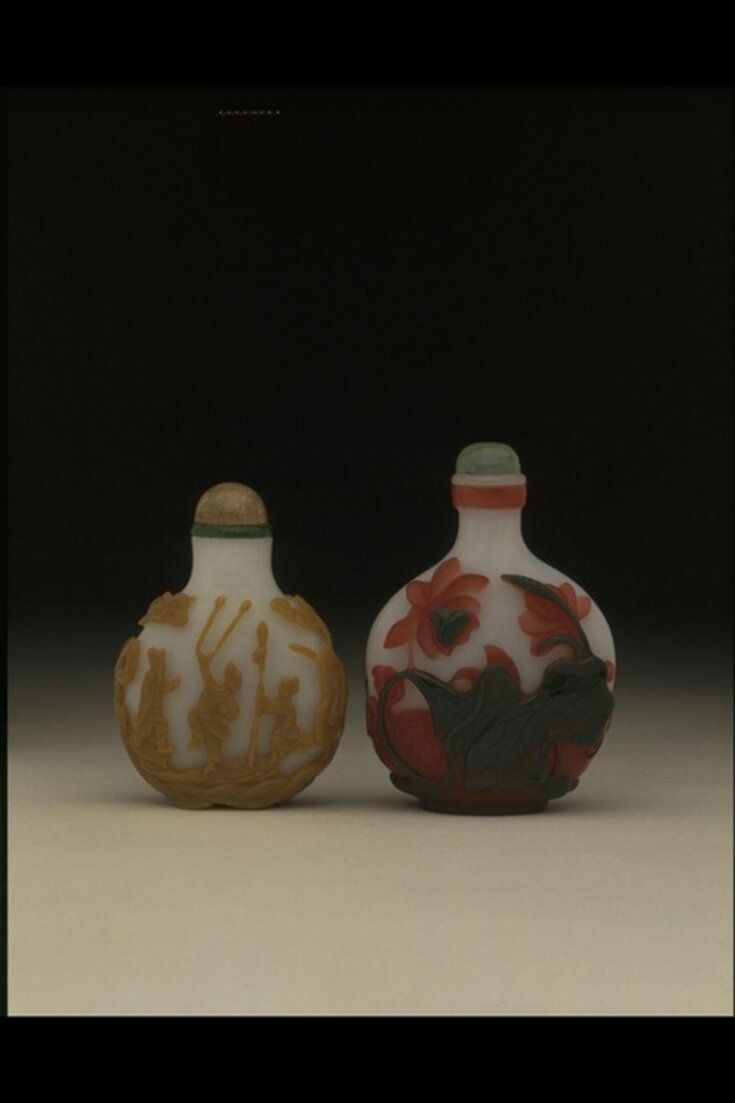
| Materials and techniques | Overlay carved glass |
| Brief description | Snuff bottle, overlay carved glass, China, Qing dynasty, 1750-1895 |
| Physical description | Snuff bottle, rounded flattened glask with cylindrical neck, made of opague white glass with overlay carved decoration of lotus flowers and a fish in red glass, superimposed by lotus leaves, stems and pods in dark green glass, similar design on the reverse with a continuous border of waves around the base and a band of red overlay round the neckrim. Dome-shaped stopper made of pale green glass. |
| Dimensions |
|
| Style | |
| Gallery label |
|
| Credit line | Salting Bequest |
| Object history | Bequeathed by Mr. George Salting, accessioned in 1910. This acquisition information reflects that found in the Asia Department registers, as part of a 2022 provenance research project. |
| Summary | Snuff is powdered tobacco, usually blended with aromatic herbs or spices. The habit of snuff-taking spread to China from the West during the 17th century and became established in the 18th century. People generally carried snuff in a small bottle. By the 20th century these bottles had become collectors' items, owing to the great variety of materials and decorative techniques used in their production. |
| Bibliographic references |
|
| Collection | |
| Accession number | C.1537&A-1910 |
About this object record
Explore the Collections contains over a million catalogue records, and over half a million images. It is a working database that includes information compiled over the life of the museum. Some of our records may contain offensive and discriminatory language, or reflect outdated ideas, practice and analysis. We are committed to addressing these issues, and to review and update our records accordingly.
You can write to us to suggest improvements to the record.
Suggest feedback
You can write to us to suggest improvements to the record.
Suggest feedback
| Record created | June 17, 1998 |
| Record URL |
Download as: JSONIIIF Manifest
