Henry Woodward
Figure
1750-1752 (made)
1750-1752 (made)
| Artist/Maker | |
| Place of origin |
Object Type
The English porcelain factories made many figures after well-known actors and actresses. They were probably intended to be displayed on wall brackets or larger pieces of furniture in domestic interiors. Advertisements placed by the Bow factory, where this one was made, mention their use on 'Mantel-pieces' and ladies' dressing tables. Porcelain figures were also set out on dining tables during the dessert course of grand dinners, but there is no firm evidence that English theatrical figures were used in this way. Both this figure and a companion piece made for it of the actress Kitty Clive are frontally posed, so they were probably displayed against a wall.
People
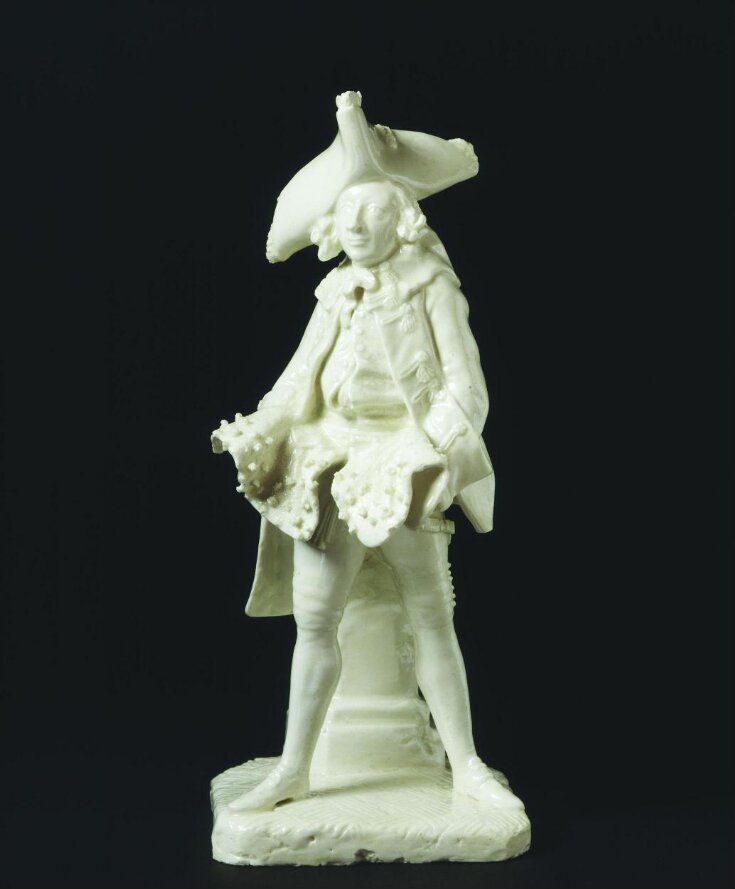
The figure shows the actor Henry Woodward (1714-1777) in the role of the 'Fine Gentleman' in David Garrick's popular farce Lethe. In the first production of Lethe in 1740 Woodward played a different character, 'the Beau', but took the part of the 'Fine Gentleman' when Lethe was revived at London's Drury Lane in 1748. The companion figure made for it shows Kitty Clive performing in the same play as the 'Fine Lady'.
Design & Designing
This porcelain figure is copied from a mezzotint by James McArdell (1728-1765), which was in turn based on a drawing by Francis Hayman (1708-1776), a painter with close connections to the Drury Lane Theatre.
The English porcelain factories made many figures after well-known actors and actresses. They were probably intended to be displayed on wall brackets or larger pieces of furniture in domestic interiors. Advertisements placed by the Bow factory, where this one was made, mention their use on 'Mantel-pieces' and ladies' dressing tables. Porcelain figures were also set out on dining tables during the dessert course of grand dinners, but there is no firm evidence that English theatrical figures were used in this way. Both this figure and a companion piece made for it of the actress Kitty Clive are frontally posed, so they were probably displayed against a wall.
People
The figure shows the actor Henry Woodward (1714-1777) in the role of the 'Fine Gentleman' in David Garrick's popular farce Lethe. In the first production of Lethe in 1740 Woodward played a different character, 'the Beau', but took the part of the 'Fine Gentleman' when Lethe was revived at London's Drury Lane in 1748. The companion figure made for it shows Kitty Clive performing in the same play as the 'Fine Lady'.
Design & Designing
This porcelain figure is copied from a mezzotint by James McArdell (1728-1765), which was in turn based on a drawing by Francis Hayman (1708-1776), a painter with close connections to the Drury Lane Theatre.
Object details
| Categories | |
| Object type | |
| Title | Henry Woodward (generic title) |
| Materials and techniques | Soft-paste porcelain and incised |
| Brief description | Figure in soft-paste porcelain of actor Henry Woodward, standing with legs astride and hands in pockets, made by Bow Porcelain Factory, London, 1750-1752. |
| Physical description | Figure in soft-paste porcelain of actor Henry Woodward, standing beside a pedestal, incised with a check pattern, with legs astride and hands in pockets, and he wears a three-cornered hat, a frock coat over a long figured waistcoat, skirts tucked up over his arms, and knee breeches. |
| Dimensions |
|
| Gallery label | British Galleries:
The design here is taken from a print, as with many English porcelain figures. In this instance the print was an undated mezzotint by James McArdell (1728-1765) after Francis Hayman (1708-1776). Henry Woodward is shown as the 'Fine Gentleman' in David Garrick's play 'Lethe', a role he first performed in 1748.(27/03/2003) |
| Credit line | Given by Lady Charlotte Schreiber |
| Object history | Bought by Lady Charlotte Schreiber to form a pair with actress Kitty Clive 414:135/A-1885 (Sch. I 1A) One of these figures was bought by Lady Charlotte Schreiber from Wareham, London, for £12 in May 1873 and the other from Brown, London, for £3 in April 1867 Acquired as Chelsea porcelain. Henry Woodward is in the character of the Fine Gentleman in David Garrick's farce Lethe, and is modelled from an engraving by James McArdell and after the painting by Francis Hayman. |
| Subjects depicted | |
| Summary | Object Type The English porcelain factories made many figures after well-known actors and actresses. They were probably intended to be displayed on wall brackets or larger pieces of furniture in domestic interiors. Advertisements placed by the Bow factory, where this one was made, mention their use on 'Mantel-pieces' and ladies' dressing tables. Porcelain figures were also set out on dining tables during the dessert course of grand dinners, but there is no firm evidence that English theatrical figures were used in this way. Both this figure and a companion piece made for it of the actress Kitty Clive are frontally posed, so they were probably displayed against a wall. People The figure shows the actor Henry Woodward (1714-1777) in the role of the 'Fine Gentleman' in David Garrick's popular farce Lethe. In the first production of Lethe in 1740 Woodward played a different character, 'the Beau', but took the part of the 'Fine Gentleman' when Lethe was revived at London's Drury Lane in 1748. The companion figure made for it shows Kitty Clive performing in the same play as the 'Fine Lady'. Design & Designing This porcelain figure is copied from a mezzotint by James McArdell (1728-1765), which was in turn based on a drawing by Francis Hayman (1708-1776), a painter with close connections to the Drury Lane Theatre. |
| Bibliographic reference | Mallet, J.V.G. in Snodin, Michael (ed.), Rococo: Art and Design in Hogarth’s England. Victoria and Albert Museum, 1984, cat. O15-16 |
| Other number | Sch. I 1 - Schreiber number |
| Collection | |
| Accession number | 414:135-1885 |
About this object record
Explore the Collections contains over a million catalogue records, and over half a million images. It is a working database that includes information compiled over the life of the museum. Some of our records may contain offensive and discriminatory language, or reflect outdated ideas, practice and analysis. We are committed to addressing these issues, and to review and update our records accordingly.
You can write to us to suggest improvements to the record.
Suggest feedback
You can write to us to suggest improvements to the record.
Suggest feedback
| Record created | April 7, 2003 |
| Record URL |
Download as: JSONIIIF Manifest
