George II
Bust
1757-1760 (made)
1757-1760 (made)
| Artist/Maker | |
| Place of origin |
Object Type
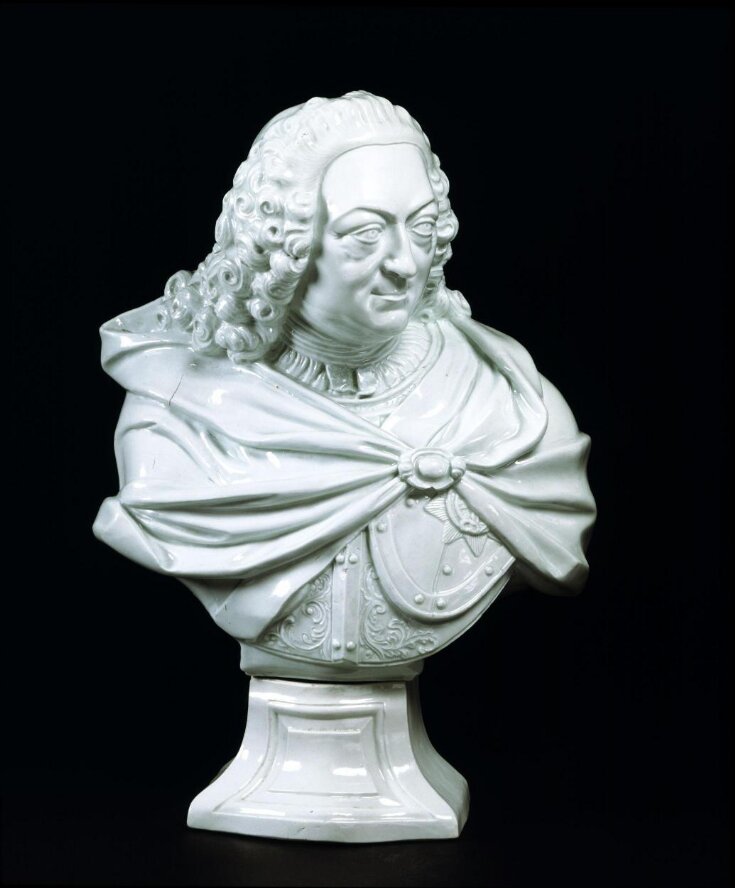
The bust is comparatively large, and was probably made for display in an entrance hall or other spacious domestic or civic interior. Such busts would have been used to display their owners' patriotic support for the monarch.
Time
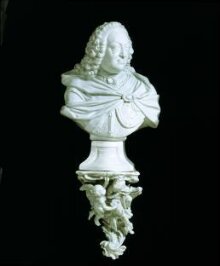
George II (reigned 1727-1760) is shown in his later years. This, and the patriotic and victorious elements on the bracket made to accompany the bust, suggest that it was made at a time of victories, such as those of 1757-59 - Clive at Plassey in India; Wolfe at Quebec - during the Seven Years War against France.
Design & Designing
The bust was probably copied from one cast in plaster. Such commercially-produced plasters were occasionally used at British porcelain factories as prototypes for production, especially for figures and busts. Some plaster-makers knew that their production lines were being reproduced by the ceramics factories (and they charged them accordingly), but others were on their guard against plagiarists.
Materials & Making
The bust is one of a group of sculptural porcelains that have been chemically tested and found to contain soaprock. This mineral was mined under licence in Cornwall. From documents we know that Richard Chaffers (1731-1765) of Liverpool was among those who used it as an ingredient in making porcelain, and he currently seems the most likely manufacturer of the several versions of this bust.
The bust is comparatively large, and was probably made for display in an entrance hall or other spacious domestic or civic interior. Such busts would have been used to display their owners' patriotic support for the monarch.
Time
George II (reigned 1727-1760) is shown in his later years. This, and the patriotic and victorious elements on the bracket made to accompany the bust, suggest that it was made at a time of victories, such as those of 1757-59 - Clive at Plassey in India; Wolfe at Quebec - during the Seven Years War against France.
Design & Designing
The bust was probably copied from one cast in plaster. Such commercially-produced plasters were occasionally used at British porcelain factories as prototypes for production, especially for figures and busts. Some plaster-makers knew that their production lines were being reproduced by the ceramics factories (and they charged them accordingly), but others were on their guard against plagiarists.
Materials & Making
The bust is one of a group of sculptural porcelains that have been chemically tested and found to contain soaprock. This mineral was mined under licence in Cornwall. From documents we know that Richard Chaffers (1731-1765) of Liverpool was among those who used it as an ingredient in making porcelain, and he currently seems the most likely manufacturer of the several versions of this bust.
Object details
| Categories | |
| Object type | |
| Title | George II (generic title) |
| Materials and techniques | Soft-paste porcelain |
| Brief description | Bust in white soft-paste porcelain of King George II on a pedestal with a bowed front with a moulded panel, sculpted by John Cheere, probably Vauxhall porcelain factory, previously attributed to Richard Chaffers factory, Liverpool, ca. 1757-1760. |
| Physical description | Bust in white soft-paste porcelain of King George II wearing a large wig, a loose cloak clasped in front over an embossed cuirass, and the star of the Order of the Garter is partly concealed by the cloak, and his head is turned towards the left, and he is on a pedestal with a bowed front with a moulded panel. |
| Dimensions |
|
| Gallery label | British Galleries:
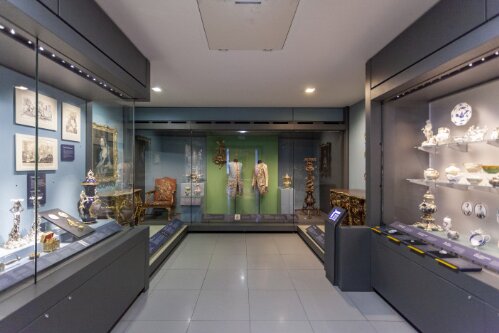
These pieces show how styles were used alongside one another. George II wears armour embossed with Rococo scrollwork, but otherwise his portrait has few Rococo elements. The bracket however, is strongly asymmetric and emphatically Rococo in design. Britannia and Fame are seated on a slain dragon.(27/03/2003) |
| Credit line | Given by Lady Charlotte Schreiber |
| Object history | Purchased by Lady Charlotte Schreiber from Butti, Edinburgh, for £5 in October 1869. In her Journals (vol. I, p. 57) she recorded: 'Lady Hopetown took us into Edinburgh to the shop of one Butti in Queen Street. The first thing that met the gaze of the delighted C.S. was a Plymouth bust (with pedestal) of King George II. exactly the same as that which belonged to the late Dr. Cookworthy of Plymouth, which came to him from the manufacturers and which he has left as an heirloom in the family. Butti (knowing nothing of its extreme value) sold it to us for £5.' Acquired as Chelsea porcelain. |
| Subjects depicted | |
| Summary | Object Type The bust is comparatively large, and was probably made for display in an entrance hall or other spacious domestic or civic interior. Such busts would have been used to display their owners' patriotic support for the monarch. Time George II (reigned 1727-1760) is shown in his later years. This, and the patriotic and victorious elements on the bracket made to accompany the bust, suggest that it was made at a time of victories, such as those of 1757-59 - Clive at Plassey in India; Wolfe at Quebec - during the Seven Years War against France. Design & Designing The bust was probably copied from one cast in plaster. Such commercially-produced plasters were occasionally used at British porcelain factories as prototypes for production, especially for figures and busts. Some plaster-makers knew that their production lines were being reproduced by the ceramics factories (and they charged them accordingly), but others were on their guard against plagiarists. Materials & Making The bust is one of a group of sculptural porcelains that have been chemically tested and found to contain soaprock. This mineral was mined under licence in Cornwall. From documents we know that Richard Chaffers (1731-1765) of Liverpool was among those who used it as an ingredient in making porcelain, and he currently seems the most likely manufacturer of the several versions of this bust. |
| Associated object | C.53-1931 (Plinth) |
| Bibliographic references |
|
| Other number | Sch I 126 - Schreiber number |
| Collection | |
| Accession number | 414:134-1885 |
About this object record
Explore the Collections contains over a million catalogue records, and over half a million images. It is a working database that includes information compiled over the life of the museum. Some of our records may contain offensive and discriminatory language, or reflect outdated ideas, practice and analysis. We are committed to addressing these issues, and to review and update our records accordingly.
You can write to us to suggest improvements to the record.
Suggest feedback
You can write to us to suggest improvements to the record.
Suggest feedback
| Record created | April 7, 2003 |
| Record URL |
Download as: JSONIIIF Manifest
