Tea Urn
1816-17 (made)
| Artist/Maker | |
| Place of origin |
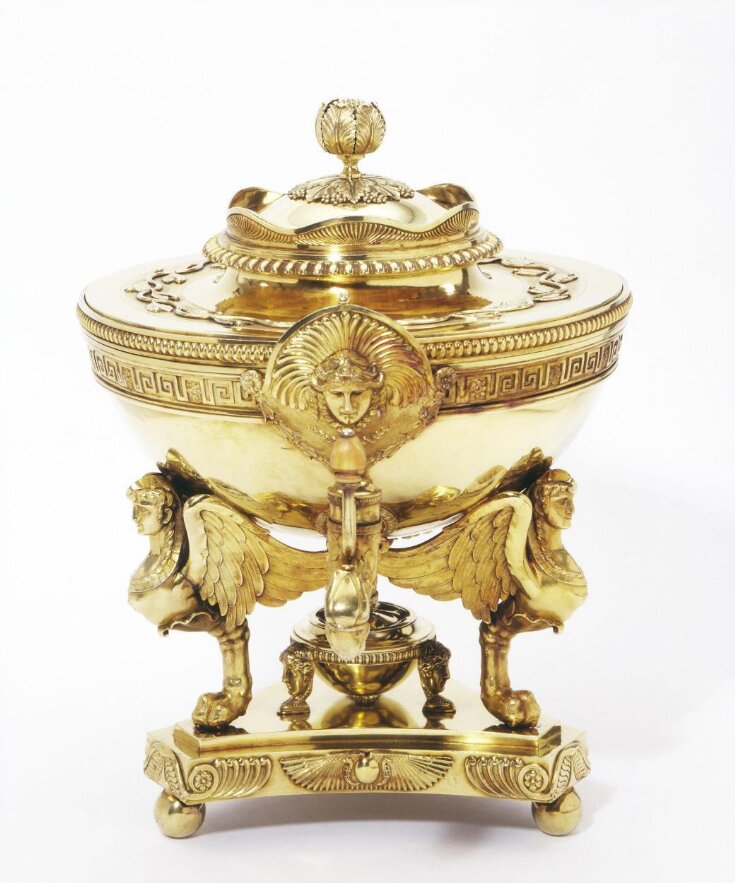
Tea urns were used to provide hot water when tea was drunk after dinner. The oil lamp beneath the main body of the urn kept the water hot. The handles for the urn are concealed as part of the decorative frieze, and are hinged behind the classical masks. This gilt tea urn is exceptionally grand and would have been made for a very wealthy and fashion-conscious client.
The urn was made by Digby Scott (born about 1763, died 1816) and Benjamin Smith II (1764-1823), who managed a workshop for the Royal Goldsmiths Rundell, Bridge & Rundell. They used a design by the French designer Jean-Jacques Boileau (active in England 1787-1851). The identification of the designer is based upon drawings thought to be by Boileau in the Print Room of the V&A, which use similar ornament.
This tea urn exemplifies fashionable design of the period. The Egyptian style of the tea urn was adopted for several items in the Grand Service that belonged to the Prince Regent (1762-1830). Rundells' ability to market costly and sophisticated silver in numerous styles was unmatched by any of their competitors. They could afford to maintain a large design studio. They employed the most prestigious and accomplished designers, such as the artist and sculptor John Flaxman (1755-1826). Their lead in the reintroduction and reinterpretation of historic style was often decisive.
The urn was made by Digby Scott (born about 1763, died 1816) and Benjamin Smith II (1764-1823), who managed a workshop for the Royal Goldsmiths Rundell, Bridge & Rundell. They used a design by the French designer Jean-Jacques Boileau (active in England 1787-1851). The identification of the designer is based upon drawings thought to be by Boileau in the Print Room of the V&A, which use similar ornament.
This tea urn exemplifies fashionable design of the period. The Egyptian style of the tea urn was adopted for several items in the Grand Service that belonged to the Prince Regent (1762-1830). Rundells' ability to market costly and sophisticated silver in numerous styles was unmatched by any of their competitors. They could afford to maintain a large design studio. They employed the most prestigious and accomplished designers, such as the artist and sculptor John Flaxman (1755-1826). Their lead in the reintroduction and reinterpretation of historic style was often decisive.
Object details
| Category | |
| Object type | |
| Parts | This object consists of 4 parts.
|
| Brief description | Silver-gilt, London hallmarks for 1816-17, mark of Digby Scott and Benjamin Smith, after a design by Jean-Jacques Boileau |
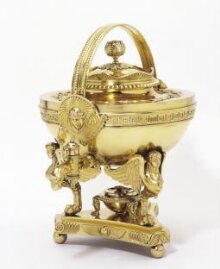
| Physical description | The urn of hemispherical form on a triangular stand. The base on three ball feet is ornamented with Egyptian motifs, palmettes and three sphinxes as supports to the urn. A shallow circular lamp within a tripod stand is attached. The lower section of the urn body is plain, with beneath the shoulder a Greek key pattern and over which two masks are attached with gadroons above.The waisted neck has an applied band of laurel with a beaded border which can be raised to form a double swing handle. The cover has a bud finial and the spout has an ivory finial and is decorated with relief ornament foliage and terminates in an eagle's head. |
| Object history | Lamp and cover by Benjamin Smith II & III designed by Jean-Jacques Boileau (active in England 1787-1851); made in London by Digby Scott and Benjamin Smith II for Rundell, Bridge and Rundell; lamp and cover by Benjamin Smith II & III. |
| Historical context | For a similar urn see Timothy B. Schroder, The Gilbert Collection of Gold and Silver Los Angeles County Museum, 1988 pp. 338-341 |
| Summary | Tea urns were used to provide hot water when tea was drunk after dinner. The oil lamp beneath the main body of the urn kept the water hot. The handles for the urn are concealed as part of the decorative frieze, and are hinged behind the classical masks. This gilt tea urn is exceptionally grand and would have been made for a very wealthy and fashion-conscious client. The urn was made by Digby Scott (born about 1763, died 1816) and Benjamin Smith II (1764-1823), who managed a workshop for the Royal Goldsmiths Rundell, Bridge & Rundell. They used a design by the French designer Jean-Jacques Boileau (active in England 1787-1851). The identification of the designer is based upon drawings thought to be by Boileau in the Print Room of the V&A, which use similar ornament. This tea urn exemplifies fashionable design of the period. The Egyptian style of the tea urn was adopted for several items in the Grand Service that belonged to the Prince Regent (1762-1830). Rundells' ability to market costly and sophisticated silver in numerous styles was unmatched by any of their competitors. They could afford to maintain a large design studio. They employed the most prestigious and accomplished designers, such as the artist and sculptor John Flaxman (1755-1826). Their lead in the reintroduction and reinterpretation of historic style was often decisive. |
| Collection | |
| Accession number | M.2:1-2004 |
About this object record
Explore the Collections contains over a million catalogue records, and over half a million images. It is a working database that includes information compiled over the life of the museum. Some of our records may contain offensive and discriminatory language, or reflect outdated ideas, practice and analysis. We are committed to addressing these issues, and to review and update our records accordingly.
You can write to us to suggest improvements to the record.
Suggest feedback
You can write to us to suggest improvements to the record.
Suggest feedback
| Record created | April 4, 2003 |
| Record URL |
Download as: JSONIIIF Manifest
