
Pier Table
ca. 1785 (made)
| Artist/Maker | |
| Place of origin |
Object Type
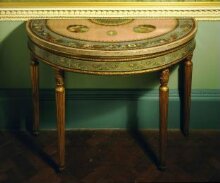
By the 1780s, simple and elegant semi-elliptical side tables were fashionable and thought well suited to the Neo-classical style. They were placed against a wall, with one candelabra or more placed on the top, so that the light could be reflected in a mirror. Such tables were mostly ornamental and reserved for the most important rooms of the house.
Materials & Making
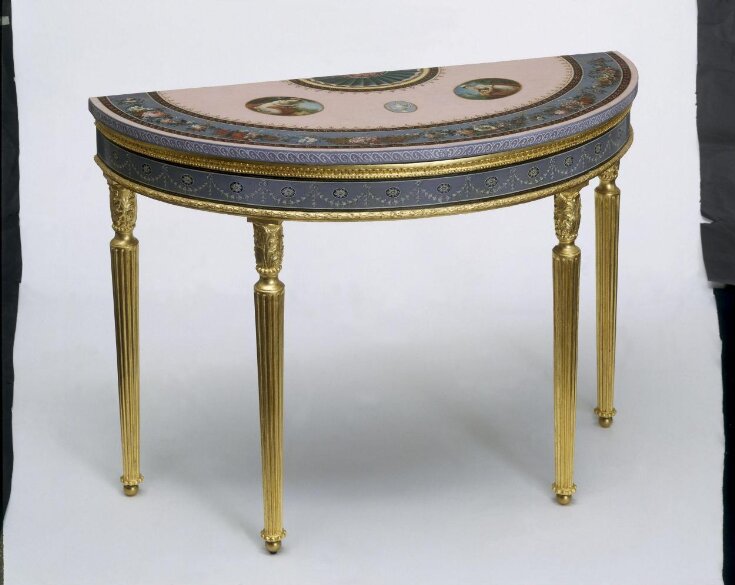
The table is decorated with floral decorations and pastoral themes. These have been painted by the encaustic method, in which dry pigments mixed with molten wax are applied to the surface and then heated to 'burn in' the colours.
People
The table has been attributed to George Brookshaw (1751-1823), who described himself as a 'peintre ébéniste' (painter-cabinetmaker) and a specialist in encaustic or 'burnt-in' paintings on copper surfaces. He borrowed ideas from the prints of Angelica Kauffmann, but he himself wrote and illustrated botanical books, such as the New Treatise on Flower Painting (1816) and Pomona Britannica (1804-1808), an illustrated survey of fruit grown in Britain.
Subjects Depicted
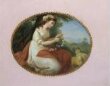
The table is decorated with paintings from Angelica Kauffmann's engravings Abra, published in 1782 (right), and Innocence, published in 1783 (left). These and other engravings by Kauffmann were issued until around 1800 and were repeated on furniture, embroidery and porcelain during that time. Delicate garlands and swags were widely used Neo-classical motifs, but the naturalistic style indicates the hand of a botanical expert like George Brookshaw.
By the 1780s, simple and elegant semi-elliptical side tables were fashionable and thought well suited to the Neo-classical style. They were placed against a wall, with one candelabra or more placed on the top, so that the light could be reflected in a mirror. Such tables were mostly ornamental and reserved for the most important rooms of the house.
Materials & Making
The table is decorated with floral decorations and pastoral themes. These have been painted by the encaustic method, in which dry pigments mixed with molten wax are applied to the surface and then heated to 'burn in' the colours.
People
The table has been attributed to George Brookshaw (1751-1823), who described himself as a 'peintre ébéniste' (painter-cabinetmaker) and a specialist in encaustic or 'burnt-in' paintings on copper surfaces. He borrowed ideas from the prints of Angelica Kauffmann, but he himself wrote and illustrated botanical books, such as the New Treatise on Flower Painting (1816) and Pomona Britannica (1804-1808), an illustrated survey of fruit grown in Britain.
Subjects Depicted
The table is decorated with paintings from Angelica Kauffmann's engravings Abra, published in 1782 (right), and Innocence, published in 1783 (left). These and other engravings by Kauffmann were issued until around 1800 and were repeated on furniture, embroidery and porcelain during that time. Delicate garlands and swags were widely used Neo-classical motifs, but the naturalistic style indicates the hand of a botanical expert like George Brookshaw.
Object details
| Categories | |
| Object type | |
| Materials and techniques | Softwood mounted with stove-japanned copper plaques, and partly painted (on the wood); turned, carved and gilt softwood legs; cast and gilt composition; brass feet; the frame constructed with mortise-and-tenone joints, half-lap jointed and screws. |
| Brief description | Semi-circular pier table of gilded and painted wood with panels on the top and frieze of stove-japanned copper. The top is painted with and edging of flowers on a blue ground, surrounding a pink ground with oval panels in reserve showing women in classical dress. |
| Physical description | A semi-circular pier table with painted (mainly stove-japanned) top and frieze, on four gilded, turned and fluted tapering legs, with gilt moulded composition ornament. The decoration of the top emphasizes its semi-circular form, and is designed to be reflected in a pier glass, reading as a fully circular composition. The top is decorated with two figurative bead-edged medallions after Angelica Kauffman, flanking a smaller bead-edged medallion containing a draped urn in grisaille, on a pink ground bordered with stylized flowers. At the back is a central fan patera bordered with coloured bands, beads and stylized honeysuckle. At the outside is a large band of naturalistic floral swags, tied up with yellow ribbon bows, on a blue ground, bordered with further bands of stylized honeysuckle at each side, and an outermost pink band (and extension of the main pink ground). The outer edge of the top is painted (not japanned) with an attenuated Vitruvian scroll, in white on blue; and the frieze below is bordered with gilt moulded ornament, above (lotus beads and beads) and below (laurel). Each of the gilt legs has an urn-shaped top decorated with erect acanthus and bay leaves (in moulded composition), above a circlet of beads and a waisted band, and long fluted shaft below, ending in a further circlet of beads above a brass ball foot. One of the principal medallion is derived from the engraving Abra after Angelica Kauffman, which was first published on 15 July 1783. The table-top and the main band of the frieze are stove-japanned on copper (?) plaques. The japanned plaques are pinned, or possible screwed, to the softwood frame, near their outer edges. The gilt mouldings at top and bottom of the frieze appear to be in cast composition, apart from the square beading in the upper moulding, which seems to be wood. The front edge of the table-top (above the top gilt moulding) is painted cold (not stoved), directly on the wood. The legs are turned, carved and gilded (the gilding renewed). but the acanthus ornament at the top of the legs must be in cast composition to judge by its very random craquelure. The ball feet are of lacquered brass. |
| Dimensions |
|
| Style | |
| Gallery label | British Galleries:
The prolific use of colour in Adam interiors, especially on ceilings, helped to promote a taste for painted furniture. This table combines realistic botanical painting, Adam-style formal motifs and colouring with paintings of sentimental subjects in the style popularised by Angelica Kauffmann prints (1741-1807).(27/03/2003) |
| Object history | Probably made in London by George Brookshaw (born in Birmingham,1751, died in Greenwich, 1823). Made not before 1783, the date of publication of Abra by Thomas Burke, after Angelica Kauffman (15 July 1783). Innocence is in reverse to the engraving by Robert Samuel Marcuard after Angelica Kauffman (1782) in the British Museum. In the 1931 catalogue of furniture in the V&A (vol. V) it is noted that one of this pair of table 'bears the word ANGELICA on one of the painted ovals' but this appears to have been lost in restoration after the Second World War. |
| Production | One of the painted medallions on the top is derived from the engraving Abra after Angelica Kauffman, which was first published on 15 July 1783. So this table and its companion, 349-1871, must have been made after this date. |
| Summary | Object Type By the 1780s, simple and elegant semi-elliptical side tables were fashionable and thought well suited to the Neo-classical style. They were placed against a wall, with one candelabra or more placed on the top, so that the light could be reflected in a mirror. Such tables were mostly ornamental and reserved for the most important rooms of the house. Materials & Making The table is decorated with floral decorations and pastoral themes. These have been painted by the encaustic method, in which dry pigments mixed with molten wax are applied to the surface and then heated to 'burn in' the colours. People The table has been attributed to George Brookshaw (1751-1823), who described himself as a 'peintre ébéniste' (painter-cabinetmaker) and a specialist in encaustic or 'burnt-in' paintings on copper surfaces. He borrowed ideas from the prints of Angelica Kauffmann, but he himself wrote and illustrated botanical books, such as the New Treatise on Flower Painting (1816) and Pomona Britannica (1804-1808), an illustrated survey of fruit grown in Britain. Subjects Depicted The table is decorated with paintings from Angelica Kauffmann's engravings Abra, published in 1782 (right), and Innocence, published in 1783 (left). These and other engravings by Kauffmann were issued until around 1800 and were repeated on furniture, embroidery and porcelain during that time. Delicate garlands and swags were widely used Neo-classical motifs, but the naturalistic style indicates the hand of a botanical expert like George Brookshaw. |
| Associated object | 349-1871 (Set) |
| Bibliographic references |
|
| Collection | |
| Accession number | 349A-1871 |
About this object record
Explore the Collections contains over a million catalogue records, and over half a million images. It is a working database that includes information compiled over the life of the museum. Some of our records may contain offensive and discriminatory language, or reflect outdated ideas, practice and analysis. We are committed to addressing these issues, and to review and update our records accordingly.
You can write to us to suggest improvements to the record.
Suggest feedback
You can write to us to suggest improvements to the record.
Suggest feedback
| Record created | April 4, 2003 |
| Record URL |
Download as: JSONIIIF Manifest
