Tile Frieze
ca. 1215 (made)
| Artist/Maker | |
| Place of origin |
The Mongol invasions of Iran in the early 13th century created a close link between the Middle East and China, since both regions came to be ruled by Mongol viceroys. The Ilkhanids (1256–1353) ruled Iran at the same time as the Yuan dynasty (1271–1368) ruled China. These dynasties maintained close cultural links with each other through trade by sea and, along the Silk Route, by land, and there was an influx of Chinese artefacts and designs into the Middle East.
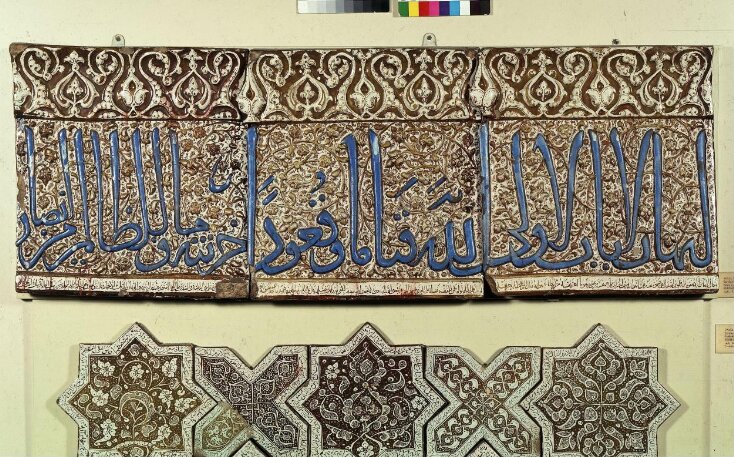
The production of tiles in Iran increased under the Ilkhanids, as they supervised repairs to monuments damaged during the Mongol invasions. These three tiles are identical to a frieze that still remains in the shrine of Imam Reza at Mashhad in north-east Iran, an important pilgrimage site for Shi'i Muslims, which was first refurbished in 1215. The lotus flowers in the projecting upper border of the tiles were one of the Chinese motifs introduced into the Islamic Middle East at this time.
The production of tiles in Iran increased under the Ilkhanids, as they supervised repairs to monuments damaged during the Mongol invasions. These three tiles are identical to a frieze that still remains in the shrine of Imam Reza at Mashhad in north-east Iran, an important pilgrimage site for Shi'i Muslims, which was first refurbished in 1215. The lotus flowers in the projecting upper border of the tiles were one of the Chinese motifs introduced into the Islamic Middle East at this time.
Object details
| Categories | |
| Object type | |
| Parts | This object consists of 3 parts.
|
| Materials and techniques | Fritware with overglaze lustre decoration |
| Brief description | Frieze of three tiles, fritware with lustre-painted decoration on an opaque white glaze, Iran (probably Kashan), about 1215. |
| Physical description | Panel of three tiles from frieze. Fritware with lustre-painted and cobalt blue decoration on an opaque white glaze, moulded and decorated with part of a Qur'anic inscription (which is not continuous, as these tiles were not originally contiguous). |
| Dimensions |
|
| Styles | |
| Marks and inscriptions | النَّهَارِ لآيَاتٍ لِّأُوْلِي ا
اللّهَ قِيَامًا وَقُعُودًا
أَخْزَيْتَهُ وَمَا لِلظَّالِمِينَ مِنْ أَنصَارٍ (Qur’anic inscriptions, parts of surah 3:190-192) |
| Gallery label |
|
| Summary | The Mongol invasions of Iran in the early 13th century created a close link between the Middle East and China, since both regions came to be ruled by Mongol viceroys. The Ilkhanids (1256–1353) ruled Iran at the same time as the Yuan dynasty (1271–1368) ruled China. These dynasties maintained close cultural links with each other through trade by sea and, along the Silk Route, by land, and there was an influx of Chinese artefacts and designs into the Middle East. The production of tiles in Iran increased under the Ilkhanids, as they supervised repairs to monuments damaged during the Mongol invasions. These three tiles are identical to a frieze that still remains in the shrine of Imam Reza at Mashhad in north-east Iran, an important pilgrimage site for Shi'i Muslims, which was first refurbished in 1215. The lotus flowers in the projecting upper border of the tiles were one of the Chinese motifs introduced into the Islamic Middle East at this time. |
| Bibliographic references |
|
| Collection | |
| Accession number | 1481 to B-1876 |
About this object record
Explore the Collections contains over a million catalogue records, and over half a million images. It is a working database that includes information compiled over the life of the museum. Some of our records may contain offensive and discriminatory language, or reflect outdated ideas, practice and analysis. We are committed to addressing these issues, and to review and update our records accordingly.
You can write to us to suggest improvements to the record.
Suggest feedback
You can write to us to suggest improvements to the record.
Suggest feedback
| Record created | April 2, 2003 |
| Record URL |
Download as: JSONIIIF Manifest
