Bowl
ca. 1545 (made)
| Artist/Maker | |
| Place of origin |
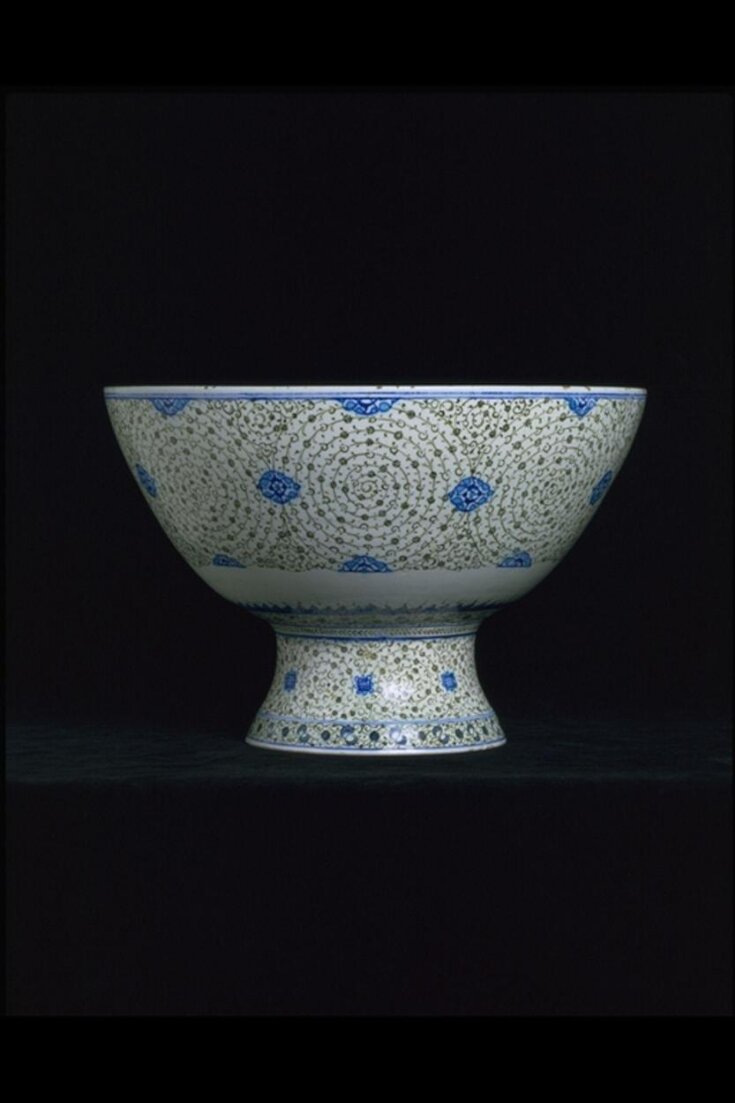
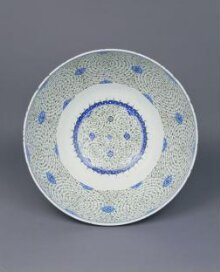
This magnificent footed basin was produced at Iznik in north-west Turkey and has been dated to the late 1540s. It is an unusually large example of Iznik ware. The body is of white fritware, a compound material based on finely ground quartz powder made from sand or pebbles. This has been painted under the glaze with a pattern of tight concentric scrolls bearing tiny leaves and flowers, executed in greenish-black and set off with small ornamental devices in blue and turquoise. This type of decoration came to be known as the Golden Horn style when examples were excavated in Istanbul, close to the Golden Horn (the inlet of the sea to the north of the city). It was later realised that these wares were produced not in Istanbul but at Iznik.
The abilities of the Iznik potters in this period are exemplified by the extraordinarily large and sophisticated basins they produced. The scale and quality of these pieces, and the costs their production must have incurred, suggest that they were made for patrons at the highest level, although evidence for this is lacking. From about 1500, the range of colours employed in decorating Iznik wares increased, eventually encompassing shades of blue, turquoise, green and purple, all set off by a brilliant white ground. In the second half of the century, the colours increased in clarity, and their range expanded further to include a vibrant red: this was obtained by using a special clay, which was diluted and applied to the ceramic as a slip before glazing and firing.
The abilities of the Iznik potters in this period are exemplified by the extraordinarily large and sophisticated basins they produced. The scale and quality of these pieces, and the costs their production must have incurred, suggest that they were made for patrons at the highest level, although evidence for this is lacking. From about 1500, the range of colours employed in decorating Iznik wares increased, eventually encompassing shades of blue, turquoise, green and purple, all set off by a brilliant white ground. In the second half of the century, the colours increased in clarity, and their range expanded further to include a vibrant red: this was obtained by using a special clay, which was diluted and applied to the ceramic as a slip before glazing and firing.
Object details
| Categories | |
| Object type | |
| Materials and techniques | Fritware, underglaze polychrome painted in green and blue, glazed |
| Brief description | Fritware basin with 'Golden Horn' design, Turkey (probably Iznik), about 1545. |
| Physical description | Footed bowl, stonepaste with underglaze decoration in cobalt and turquoise blue, featuring concentric roundels of foliate scrolls in the so-called 'Golden Horn' style inside and out. |
| Dimensions |
|
| Style | |
| Gallery label |
|
| Object history | Compare with C.1980-1910 |
| Historical context | Once created, the Iznik fritware industry seems to have taken on a life of its own, reacting to ups and down in court demand by producing wares for a wider market. Over the eighty years following Mehmed II’s death in 1481, the range of shapes increased, and new decorative schemes were adopted. The abilities of the Iznik potters in this period are exemplified by the extraordinarily large and sophisticated basins they produced. The scale and quality of these pieces, and the costs their production must have incurred, suggest that they were made for patrons at the highest level, although evidence for this is lacking. In the early sixteenth century, the range of colours employed in decorating Iznik wares increased, eventually encompassing shades of blue, turquoise, green and purple, all set off by a brilliant white ground. In the second half of the century, the colours increased in clarity, and their range expanded further to include a vibrant red: this was obtained by using a special clay, which was diluted and applied to the ceramic as a slip before glazing and firing. |
| Subject depicted | |
| Summary | This magnificent footed basin was produced at Iznik in north-west Turkey and has been dated to the late 1540s. It is an unusually large example of Iznik ware. The body is of white fritware, a compound material based on finely ground quartz powder made from sand or pebbles. This has been painted under the glaze with a pattern of tight concentric scrolls bearing tiny leaves and flowers, executed in greenish-black and set off with small ornamental devices in blue and turquoise. This type of decoration came to be known as the Golden Horn style when examples were excavated in Istanbul, close to the Golden Horn (the inlet of the sea to the north of the city). It was later realised that these wares were produced not in Istanbul but at Iznik. The abilities of the Iznik potters in this period are exemplified by the extraordinarily large and sophisticated basins they produced. The scale and quality of these pieces, and the costs their production must have incurred, suggest that they were made for patrons at the highest level, although evidence for this is lacking. From about 1500, the range of colours employed in decorating Iznik wares increased, eventually encompassing shades of blue, turquoise, green and purple, all set off by a brilliant white ground. In the second half of the century, the colours increased in clarity, and their range expanded further to include a vibrant red: this was obtained by using a special clay, which was diluted and applied to the ceramic as a slip before glazing and firing. |
| Bibliographic references |
|
| Collection | |
| Accession number | 243-1876 |
About this object record
Explore the Collections contains over a million catalogue records, and over half a million images. It is a working database that includes information compiled over the life of the museum. Some of our records may contain offensive and discriminatory language, or reflect outdated ideas, practice and analysis. We are committed to addressing these issues, and to review and update our records accordingly.
You can write to us to suggest improvements to the record.
Suggest feedback
You can write to us to suggest improvements to the record.
Suggest feedback
| Record created | April 2, 2003 |
| Record URL |
Download as: JSONIIIF Manifest
