
Medallion
1596 (made)
| Artist/Maker | |
| Place of origin |
Object Type
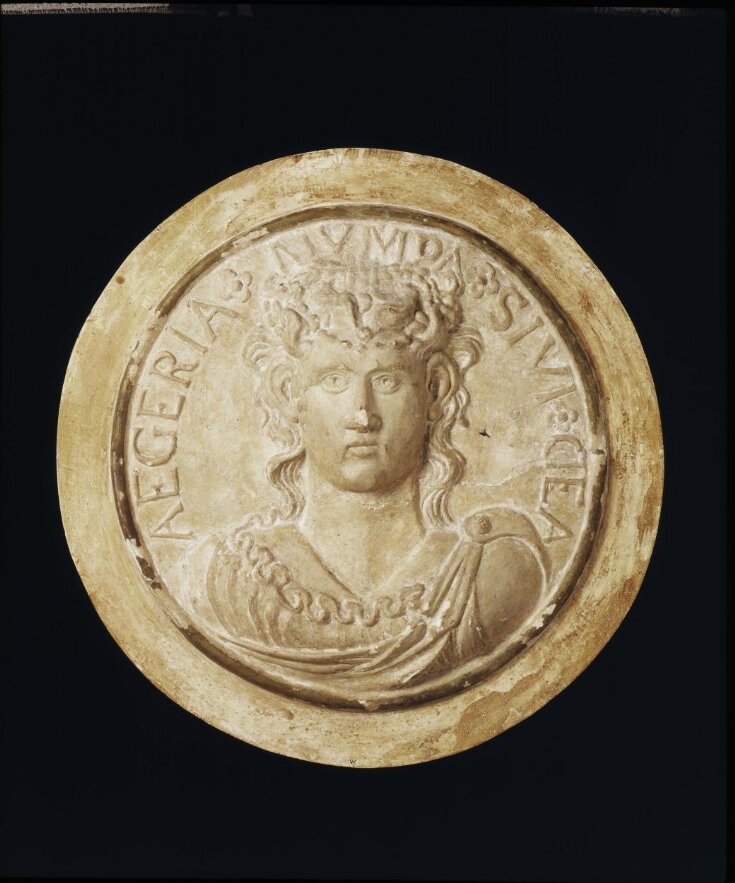
This plaster medallion depicts the nymph Egeria, reputedly the consort of Numa, an early king of ancient Rome. It formed part of the decoration of Essex House, Putney, London, the residence of Robert Devereux, 2nd Earl of Essex (1566-1601).
People
The Earl of Essex was a favourite of Elizabeth I from about 1586 until he fell from grace in 1600, after his brief and unsuccessful posting as Lord Lieutenant of Ireland. He then instigated a rebellion against the Queen which resulted in his execution in 1601. The ceilings of Essex House, built when he was very much in favour, were decorated with royal symbols, such as 'ER' monograms and the Queen's emblem of a falcon carrying a sceptre.
Place
Putney House was built in about 1590 and demolished in 1872. It would have provided a convenient rural base, close to London and the court. The medallion is modelled in a sophisticated style that reflects the tastes of the court.
This plaster medallion depicts the nymph Egeria, reputedly the consort of Numa, an early king of ancient Rome. It formed part of the decoration of Essex House, Putney, London, the residence of Robert Devereux, 2nd Earl of Essex (1566-1601).
People
The Earl of Essex was a favourite of Elizabeth I from about 1586 until he fell from grace in 1600, after his brief and unsuccessful posting as Lord Lieutenant of Ireland. He then instigated a rebellion against the Queen which resulted in his execution in 1601. The ceilings of Essex House, built when he was very much in favour, were decorated with royal symbols, such as 'ER' monograms and the Queen's emblem of a falcon carrying a sceptre.
Place
Putney House was built in about 1590 and demolished in 1872. It would have provided a convenient rural base, close to London and the court. The medallion is modelled in a sophisticated style that reflects the tastes of the court.
Object details
| Categories | |
| Object type | |
| Materials and techniques | Plaster, mounted on a later plaster panel |
| Dimensions |
|
| Marks and inscriptions | (Latin)
|
| Gallery label | British Galleries:
This medallion was part of a ceiling at Essex House, Putney, London. The house was said to have been a home of Robert Devereux, 2nd Earl of Essex (1566-1601), a favourite of Queen Elizabeth. The ceiling decoration also included Tudor coats of arms and Elizabeth's personal device, the falcon and sceptre.(27/03/2003) |
| Credit line | Given by Messrs S. Sanders & Co. Ltd., through G. P. Long |
| Object history | Made in London. Plasterwork from the ceiling of Essex House given as a gift by Messrs S Sanders & Co. per G P Long. Notes from R.P. 19/545 7th January 1919 letter, Miss A C Hare to the Museum offers "a fine old Elizabethan ceiling studded with medallions with E.R. on them". She explains that the ceiling is from Essex House, High Street, Putney - said to have been built and occupied by Robert Devereux, Earl of Essex. When the house was taken down (more than 30 years earlier) the ceiling was used a jewellers shop that was built on the site at 127 High Street. When the shop was altered "a few years ago" the ceiling was stored in the jewellers basement. The proprietor wishes to dispose of it. 11th January 1919 letter, Miss A C Hare to the Museum explaining that the ceiling is no longer intact; only the medallions remain. There is no wood in them; they are all plaster. 17th January 1919, Oliver Brackett minute paper Brackett inspected one of the 8 medallions which had a head and inscription. The others were in store and might possibly bear a date. He reports that there were no photos taken before demolition of the ceiling but the proprietor (Mr Long) remembers it in position and could explain the arrangement. Long told Brackett that the ceiling was described in Taylor's "Putney Past & Present" (1910?), a guide published by estate agents. Brackett attempted to locate a copy of Taylor's but it was out of print. 7th February 1919, Cecil Smith minute paper describes the medallions as bearing the Royal Arms, the date 1596, the Tudor Rose and other heraldic devices. "They have a considerable amount of interest and would be acceptable for the Museum". The design of the ground-floor ceiling from which this roundel came is recorded in a drawing of 1872 from the Dryden Collection, Northampton Central Library). See Dr Claire Gapper, British Renaissance Plasterwork, fig. 73 A narrow-rib quatrepetal design on the ground-floor ceiling at Essex House, Putney. From Claire Gapper Notes: Although this is the only surviving item from the original donation of items W.6-W.6l-1919, illustrations of the remainder can be found in drawings in the Dryden Collection held by Northampton Central Library. These include plans of the ground and first floors of the house, as well as details of many of the motifs. The presence of Elizabeth’s coat-of-arms and initials gives a date before 1603. Thanks to Dorian Gerhold, FRS (pers comm 2015) it is now known that the house was built in the 1590s for John Parr, citizen and embroiderer (d. 1607); and has nothing to do with the Earl of Essex. In 1600 Parr was given permission by the manor court to erect a pale before his house lately built in Putney. Gerhold’s research has yet to be published (2019). Many of the motifs at Essex House were repeated in the plasterwork of other houses of the period both in London and by London plasterers beyond the city. |
| Summary | Object Type This plaster medallion depicts the nymph Egeria, reputedly the consort of Numa, an early king of ancient Rome. It formed part of the decoration of Essex House, Putney, London, the residence of Robert Devereux, 2nd Earl of Essex (1566-1601). People The Earl of Essex was a favourite of Elizabeth I from about 1586 until he fell from grace in 1600, after his brief and unsuccessful posting as Lord Lieutenant of Ireland. He then instigated a rebellion against the Queen which resulted in his execution in 1601. The ceilings of Essex House, built when he was very much in favour, were decorated with royal symbols, such as 'ER' monograms and the Queen's emblem of a falcon carrying a sceptre. Place Putney House was built in about 1590 and demolished in 1872. It would have provided a convenient rural base, close to London and the court. The medallion is modelled in a sophisticated style that reflects the tastes of the court. |
| Bibliographic reference | Dr Claire Gapper, British Renaissance Plasterwork, fig. 73 A narrow-rib quatrepetal design on the ground-floor ceiling at Essex House, Putney:
http://web.archive.org/web/20230118101350/https://clairegapper.info/the-london-evidence.html
Many of the motifs at Essex House were repeated in the plasterwork of other houses of the period both in London and by London plasterers beyond the city. A discussion of this context, Chapter V, The London Evidence:
http://web.archive.org/web/20230118101626/https://clairegapper.info/ |
| Collection | |
| Accession number | W.6C-1919 |
About this object record
Explore the Collections contains over a million catalogue records, and over half a million images. It is a working database that includes information compiled over the life of the museum. Some of our records may contain offensive and discriminatory language, or reflect outdated ideas, practice and analysis. We are committed to addressing these issues, and to review and update our records accordingly.
You can write to us to suggest improvements to the record.
Suggest feedback
You can write to us to suggest improvements to the record.
Suggest feedback
| Record created | March 27, 2003 |
| Record URL |
Download as: JSONIIIF Manifest
