
Armchair
1630-1680 (made)
| Artist/Maker | |
| Place of origin |
Object Type
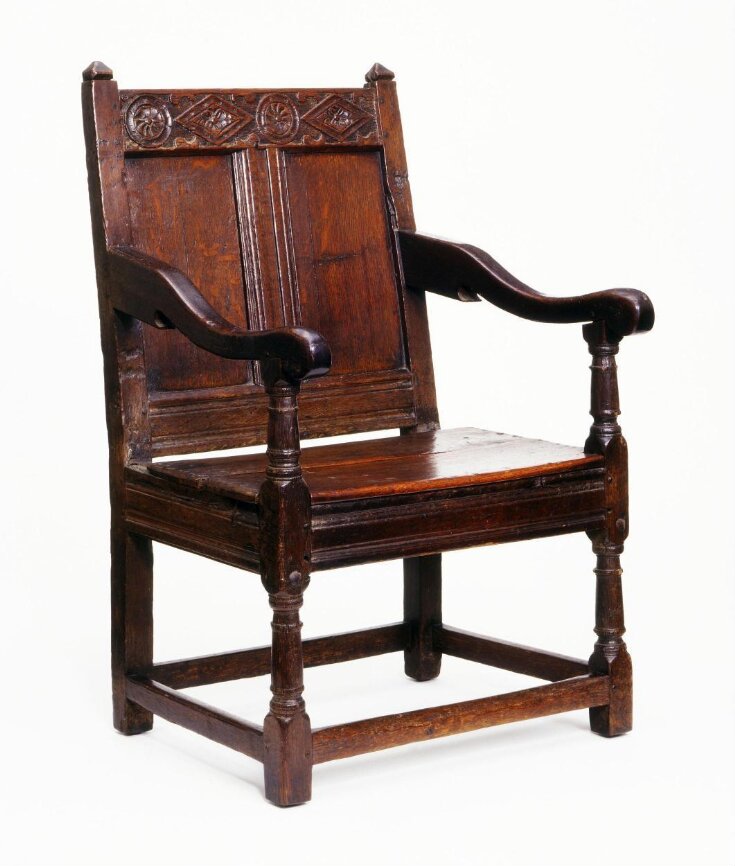
This simple and strong armchair was a common type in the 16th century. Chairs of this type would be used in large farms or manor houses. There would only be one or two of these chairs in the house; other household members would sit on benches, stools or simpler chairs. This chair is made entirely of oak, with decoration in the form of relief carving and turning.
Materials & Making
The construction of the chair is extremely robust. Oak is a strong and hard-wearing wood native to Britain. The chair frame is constructed with strong mortise and tenon joints and the plain panels of the chair back are held within a sturdy frame. The legs are connected and strengthened by rectangular stretchers.
Design & Designing
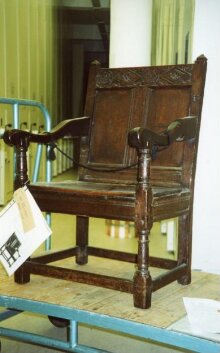
The plain outline is enlivened by simple features such as the rounded front legs, which were turned on a lathe before construction. The top rail of the chair-back is ornamented with shallow relief carving of stylised flowers within circles and diamond shapes. The arms have a slight downward sweep for comfort.
This simple and strong armchair was a common type in the 16th century. Chairs of this type would be used in large farms or manor houses. There would only be one or two of these chairs in the house; other household members would sit on benches, stools or simpler chairs. This chair is made entirely of oak, with decoration in the form of relief carving and turning.
Materials & Making
The construction of the chair is extremely robust. Oak is a strong and hard-wearing wood native to Britain. The chair frame is constructed with strong mortise and tenon joints and the plain panels of the chair back are held within a sturdy frame. The legs are connected and strengthened by rectangular stretchers.
Design & Designing
The plain outline is enlivened by simple features such as the rounded front legs, which were turned on a lathe before construction. The top rail of the chair-back is ornamented with shallow relief carving of stylised flowers within circles and diamond shapes. The arms have a slight downward sweep for comfort.
Object details
| Categories | |
| Object type | |
| Materials and techniques | Oak, carved and joined; cushion is a modern reproduction |
| Brief description | English, 17th c. 75/1346 |
| Physical description | Carved oak arm-chair. The back has two plain panels divided by a moulded upright, the top rail being carved with lozenges and rosettes, the front legs and arm supports are turned, the back legs and stretchers are rectangular. |
| Dimensions |
|
| Gallery label | British Galleries:
Armchairs were a sign of status and were usually only provided for the master of the house or important guests. Most people sat on stools or benches, known as forms. The room at Bromley-by-Bow would almost certainly have contained at least one carved oak chair, but this one was probably made in Cheshire or Lancashire. The small, pyramidal finials at the top of the back uprights were a popular motif with carvers working in that area.(27/03/2003) |
| Credit line | Bequeathed by Mr W. W. Simpson through Art Fund |
| Object history | Probably made in Cheshire or south-west Lancashire From: H. Clifford Smith, Catalogue of English Furniture & Woodwork (London 1930), cat. 518. "Arm-Chair; the back has two plain panels divided by a moulded upright, the top rail being carved with lozenges and rosettes; the front legs and arm supports are turned, the back legs and stretchers are rectangular. 17th century. from catalogue: H. 3 ft. 1 in., W. 2 ft., D. 1 ft. 8in. (H. 94 cm, W. 61 cm, D. 50.8 cm) Given by the National Art-Collections Fund from the Bequest of Mr. W. W. Simpson." |
| Historical context | For comparable chairs, see Victor Chinnery, Oak Furniture: The British Tradition. A History of Early Furniture in the British Isles and New England, rev. ed. (Woodbridge: ACC Art Books, 2016), p.438 ff. Other examples Norwich Cathedral (single back panel) with the carved letters IB |
| Summary | Object Type This simple and strong armchair was a common type in the 16th century. Chairs of this type would be used in large farms or manor houses. There would only be one or two of these chairs in the house; other household members would sit on benches, stools or simpler chairs. This chair is made entirely of oak, with decoration in the form of relief carving and turning. Materials & Making The construction of the chair is extremely robust. Oak is a strong and hard-wearing wood native to Britain. The chair frame is constructed with strong mortise and tenon joints and the plain panels of the chair back are held within a sturdy frame. The legs are connected and strengthened by rectangular stretchers. Design & Designing The plain outline is enlivened by simple features such as the rounded front legs, which were turned on a lathe before construction. The top rail of the chair-back is ornamented with shallow relief carving of stylised flowers within circles and diamond shapes. The arms have a slight downward sweep for comfort. |
| Collection | |
| Accession number | W.53-1917 |
About this object record
Explore the Collections contains over a million catalogue records, and over half a million images. It is a working database that includes information compiled over the life of the museum. Some of our records may contain offensive and discriminatory language, or reflect outdated ideas, practice and analysis. We are committed to addressing these issues, and to review and update our records accordingly.
You can write to us to suggest improvements to the record.
Suggest feedback
You can write to us to suggest improvements to the record.
Suggest feedback
| Record created | March 27, 2003 |
| Record URL |
Download as: JSONIIIF Manifest
