The Walpole Cabinet
Cabinet
1743 (made)
1743 (made)
| Artist/Maker | |
| Place of origin |
Object Type
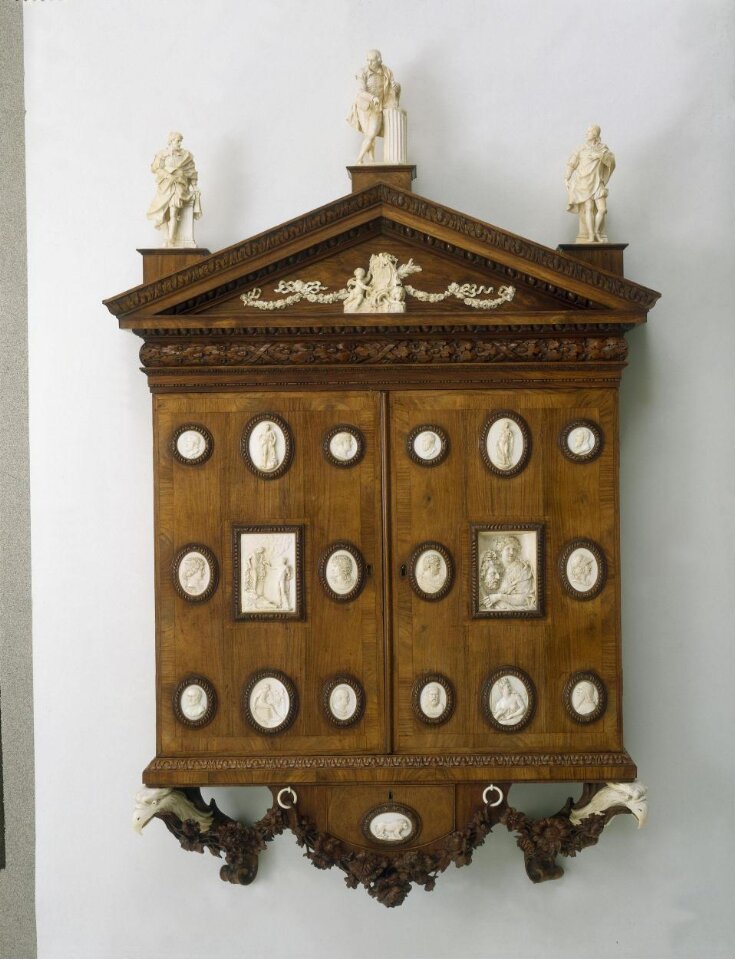
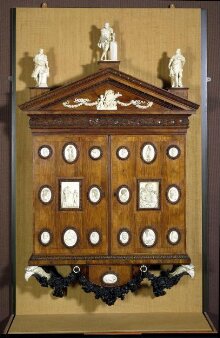
This cabinet with its pedimented top and lower drawer was designed to house Horace Walpole's collection of miniatures and enamels. It was conceived as a miniature 'Classical Temple of Worthies' supporting ivory figures of three of Walpole's artistic heroes, the architects Andrea Palladio (1518-1580) and Inigo Jones (1573-1652) and the sculptor François Duquesnoy (about 1594-1643).
Materials & Making
The cabinet was commissioned by Horace Walpole on his return from the Grand Tour to incorporate a series of ivory plaques representing classical authors or derived from antique gems. The pediment top is unusual for a small-scale cabinet and was inspired by contemporary Palladian architecture. J.F. Verskovis, a Flemish sculptor, supplied the ivory statuettes and also carved the ivory eagle heads and the adjacent festoons of fruit and flowers in padouk wood.
Places
The cabinet was originally displayed in Horace Walpole's house in Arlington Street, London. In the early 1760s it was moved to his country residence, Strawberry Hill in Twickenham, where it formed the centrepiece of the Tribune, a room in which some of the most precious small objects in his collection were displayed.
This cabinet with its pedimented top and lower drawer was designed to house Horace Walpole's collection of miniatures and enamels. It was conceived as a miniature 'Classical Temple of Worthies' supporting ivory figures of three of Walpole's artistic heroes, the architects Andrea Palladio (1518-1580) and Inigo Jones (1573-1652) and the sculptor François Duquesnoy (about 1594-1643).
Materials & Making
The cabinet was commissioned by Horace Walpole on his return from the Grand Tour to incorporate a series of ivory plaques representing classical authors or derived from antique gems. The pediment top is unusual for a small-scale cabinet and was inspired by contemporary Palladian architecture. J.F. Verskovis, a Flemish sculptor, supplied the ivory statuettes and also carved the ivory eagle heads and the adjacent festoons of fruit and flowers in padouk wood.
Places
The cabinet was originally displayed in Horace Walpole's house in Arlington Street, London. In the early 1760s it was moved to his country residence, Strawberry Hill in Twickenham, where it formed the centrepiece of the Tribune, a room in which some of the most precious small objects in his collection were displayed.
Object details
| Categories | |
| Object type | |
| Parts | This object consists of 2 parts.
|
| Title | The Walpole Cabinet (popular title) |
| Materials and techniques | Padouk veneered onto a pine carcase and set with carved ivory plaques, figures and mounts |
| Brief description | Walpole Cabinet, padouk with ivory, designed by Horace Walpole, perhaps in collaboration with William Kent, England, 1743 |
| Physical description | The Walpole Cabinet, veneered with padouk on a pine carcase, and set with ivory plaques, figures and mounts, 152.4 x 91.5 x 21.6 cm. It is decorated with the Walpole's arms and surmounted by ivory figures of the Flemish sculptor François Duquesnoy, flanked by the architect Inigo Jones and the painter Rubens by the sculptor James Francis Verskovis (Jacob Frans Vescovers) (fl. 1743) after John Michael Rysbrack (1694-1770). The eagles and the arms of Horace Walpole in the pediment are by Verskovis. The doors are decorated with various reliefs, including one illustrating Judith and the head of Holofernes by an anonymous carver after Francis van Bossuit (d.1692), reliefs by Giovanni Battista Pozzo (1670-1752). All other ivories by anonymous carvers. |
| Dimensions |
|
| Marks and inscriptions | The arms of Horace Walpole in the pediment |
| Gallery label | British Galleries:
Walpole commissioned this cabinet to store part of his fine collection of portrait miniatures. It was originally made for his house in Arlington Street, London but later became the main piece of furniture in the Tribune at Strawberry Hill. The figures on top are three of Walpole's artistic heroes. They show the architects Andrea Palladio (1518-1580) and Inigo Jones (1573-1652) and the sculptor François Duquesnoy (about 1594-1643). Walpole collected the ivory plaques for this cabinet while on his Grand Tour in Italy.(27/03/2003) |
| Credit line | Purchased with the assistance of the Murray Bequest |
| Object history | Designed by Horace Walpole (born in London, 1717 died there in 1797) in collaboration with William Kent (born in Bridlington, East Yorkshire, 1685, died in London, 1748) Cabinet made in London by William Hallett (1707-1781); ivories by J.F. Verskovis (active 1743) and Andrea Pozzo (born in Trento, Italy, 1642, died in Vienna, 1709) the ivory figures carved in London; ivory reliefs carved in Rome. Horace Walpole, ''A Description of the Villa of Horace Walpole, Youngest Son of Sir Robert Walpole, Earl of Orford, at Strawberry-Hill, near Twickenham. With an inventory of the furniture, pictures, curiosities &c', Strawberry Hill Press, 1784 (expanded edition, about 1791): 'A cabinet of rose-wood, designed by Mr Walpole; on the pediment, statues in ivory of Fiamingo, Inigo Jones, and Palladio (sic), by Verskovis, aftr the models of Rysbrach. In the pediment, Mr Walpole's arms, a cupid and lion, by the same: on the doors, bas-reliefs in ivory, Herodias with the head of the baptist, by Gibbons,; a lady, half-length, by the same; Perseus and Andromeda; the Hercules Farnese; the Flora; Diomede with the Palladium; the Medusa of Strozzi; the Perseus of ditto; Caracalla and Alexander, by Pozzo; and eight other heads. On the drawer, the Barberini lion, by Pozzo; and heads of eagles, by Verskovis.' Object sampling carried out by Jo Darrah, V&A Science; drawer/slide reference 4/17. An almost identical cabinet, made at the same time for Walpole's friend Thomas Brand, of The Hoo, Hertfordshire, was sold by Christie's London, 5 July 2012 lot 5, and acquired by the Art Institute of Chicago in 2015. Shown at Strawberry Hill for the exhibition 'Lost Treasures of Strawberry Hill: Masterpieces from Horace Walpole's Collection', 20 October 2018 - 24 February 2019. See below for reference to catalogue. |
| Subjects depicted | |
| Summary | Object Type This cabinet with its pedimented top and lower drawer was designed to house Horace Walpole's collection of miniatures and enamels. It was conceived as a miniature 'Classical Temple of Worthies' supporting ivory figures of three of Walpole's artistic heroes, the architects Andrea Palladio (1518-1580) and Inigo Jones (1573-1652) and the sculptor François Duquesnoy (about 1594-1643). Materials & Making The cabinet was commissioned by Horace Walpole on his return from the Grand Tour to incorporate a series of ivory plaques representing classical authors or derived from antique gems. The pediment top is unusual for a small-scale cabinet and was inspired by contemporary Palladian architecture. J.F. Verskovis, a Flemish sculptor, supplied the ivory statuettes and also carved the ivory eagle heads and the adjacent festoons of fruit and flowers in padouk wood. Places The cabinet was originally displayed in Horace Walpole's house in Arlington Street, London. In the early 1760s it was moved to his country residence, Strawberry Hill in Twickenham, where it formed the centrepiece of the Tribune, a room in which some of the most precious small objects in his collection were displayed. |
| Bibliographic references |
|
| Collection | |
| Accession number | W.52:1, 2-1925 |
About this object record
Explore the Collections contains over a million catalogue records, and over half a million images. It is a working database that includes information compiled over the life of the museum. Some of our records may contain offensive and discriminatory language, or reflect outdated ideas, practice and analysis. We are committed to addressing these issues, and to review and update our records accordingly.
You can write to us to suggest improvements to the record.
Suggest feedback
You can write to us to suggest improvements to the record.
Suggest feedback
| Record created | March 27, 2003 |
| Record URL |
Download as: JSONIIIF Manifest
