
Twelve Wonders of the World
Set of Roundels
1600-1630 (made)
1600-1630 (made)
| Artist/Maker | |
| Place of origin |
Object Type
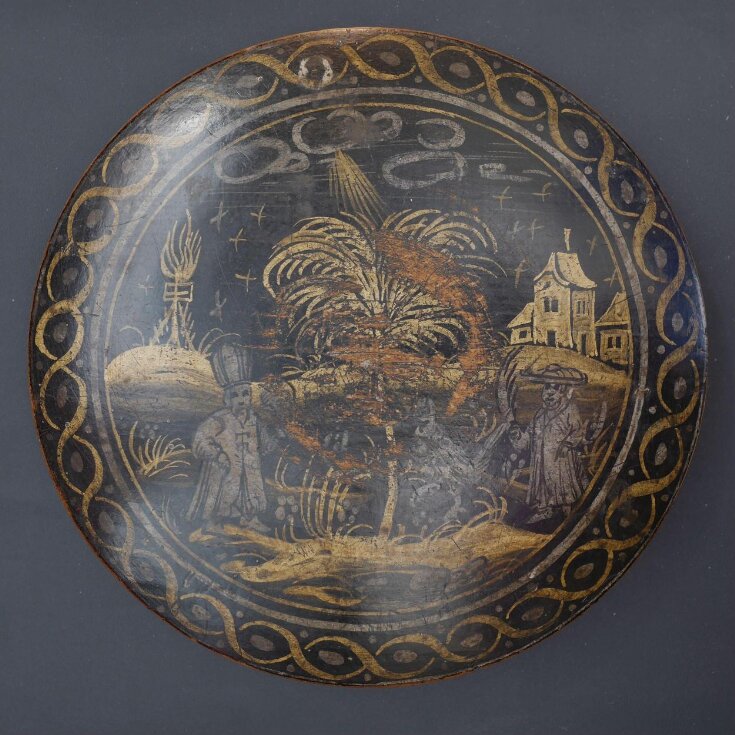
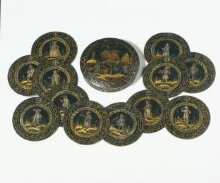
This set of 12 round wooden plates, or trenchers, in their original box, was made for special dinners, especially at New Year. The plain side would have been used for eating delicacies such as marzipan or sugar plums, before being turned over to reveal the paintings and poems. Rather like Christmas crackers today, each carries a verse to be read out and enjoyed by guests.
Subjects Depicted
Each roundel shows a character such as a soldier or a richly dressed lady, with a satirical verse about their habits. The verses, entitled The Twelve Wonders of the World, were written by John Davies, especially for trenchers at a New Year party given around 1600 by Thomas Sackville, Ist Earl of Dorset. They were published in 1608 and were then available for other trencher makers to copy. This set was probably made around 1620. Other sets show flowers, biblical texts and proverbs.
Ownership & Use
Only wealthy people could afford to use such luxury objects. The fact that they have survived means that they were carefully looked after through the generations. Surviving sets such as this one show no sign of use. The initials 'E.W.' on the box seem likely to have been added by a later owner.
This set of 12 round wooden plates, or trenchers, in their original box, was made for special dinners, especially at New Year. The plain side would have been used for eating delicacies such as marzipan or sugar plums, before being turned over to reveal the paintings and poems. Rather like Christmas crackers today, each carries a verse to be read out and enjoyed by guests.
Subjects Depicted
Each roundel shows a character such as a soldier or a richly dressed lady, with a satirical verse about their habits. The verses, entitled The Twelve Wonders of the World, were written by John Davies, especially for trenchers at a New Year party given around 1600 by Thomas Sackville, Ist Earl of Dorset. They were published in 1608 and were then available for other trencher makers to copy. This set was probably made around 1620. Other sets show flowers, biblical texts and proverbs.
Ownership & Use
Only wealthy people could afford to use such luxury objects. The fact that they have survived means that they were carefully looked after through the generations. Surviving sets such as this one show no sign of use. The initials 'E.W.' on the box seem likely to have been added by a later owner.
Object details
| Category | |
| Object type | |
| Parts | This object consists of 14 parts.
|
| Title | Twelve Wonders of the World (popular title) |
| Materials and techniques | Sycamore or beech, painted and with silver and gold detail |
| Brief description | Set of roundels in a box, 'Twelve Wonders of the World' |
| Physical description | Twelve Circular Platters (Roundels) of wood, painted with gold and silver on black. In a box decorated on the cover with two male figures, a cock and a tree, with a building and a beacon in the background. Around is a band of guilloche ornament, on the sides leafy ornament. The roundels have each a figure in the centre surrounded by a band of guilloche ornament, outside which is an inscription. |
| Dimensions |
|
| Marks and inscriptions | E W [?] (Painted in white on underside of box, probably not original) |
| Gallery label |
|
| Object history | Bought for £30 from Mrs Marshall, 32 Alderney Street, Eccleston Square, London SW (RF 12/1447M) Condition 'rubbed' |
| Historical context | For contextual information, see Victoria Yeoman, ‘Speaking plates: text, performance, and banqueting trenchers in Early Modern Europe’, in Renaissance Studies Vol. 31 No. 5, pp. 755-779 |
| Summary | Object Type This set of 12 round wooden plates, or trenchers, in their original box, was made for special dinners, especially at New Year. The plain side would have been used for eating delicacies such as marzipan or sugar plums, before being turned over to reveal the paintings and poems. Rather like Christmas crackers today, each carries a verse to be read out and enjoyed by guests. Subjects Depicted Each roundel shows a character such as a soldier or a richly dressed lady, with a satirical verse about their habits. The verses, entitled The Twelve Wonders of the World, were written by John Davies, especially for trenchers at a New Year party given around 1600 by Thomas Sackville, Ist Earl of Dorset. They were published in 1608 and were then available for other trencher makers to copy. This set was probably made around 1620. Other sets show flowers, biblical texts and proverbs. Ownership & Use Only wealthy people could afford to use such luxury objects. The fact that they have survived means that they were carefully looked after through the generations. Surviving sets such as this one show no sign of use. The initials 'E.W.' on the box seem likely to have been added by a later owner. |
| Bibliographic references |
|
| Collection | |
| Accession number | W.30 to M-1912 |
About this object record
Explore the Collections contains over a million catalogue records, and over half a million images. It is a working database that includes information compiled over the life of the museum. Some of our records may contain offensive and discriminatory language, or reflect outdated ideas, practice and analysis. We are committed to addressing these issues, and to review and update our records accordingly.
You can write to us to suggest improvements to the record.
Suggest feedback
You can write to us to suggest improvements to the record.
Suggest feedback
| Record created | March 27, 2003 |
| Record URL |
Download as: JSONIIIF Manifest
