Teapoy
1825-1830 (made)
| Artist/Maker | |
| Place of origin |
Object Type
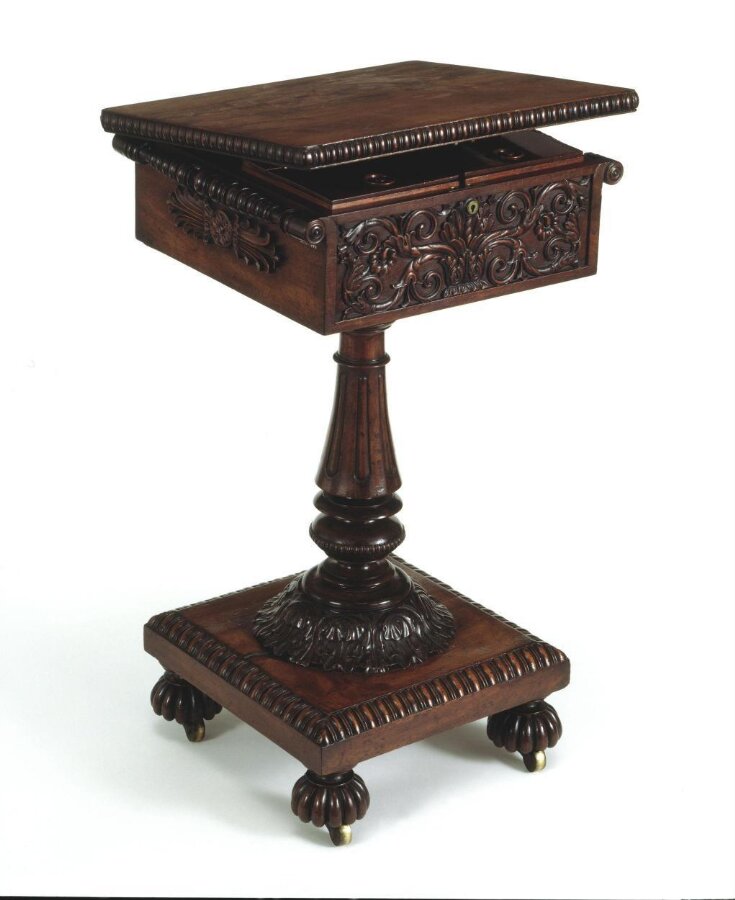
This pedestal table has a lifting top which reveals two lidded compartments for storing tea and two others containing cut-glass bowls for mixing the dried tea. (The latter do not appear to be original to the piece.) It was both a practical object and a means of displaying the hostess's modish taste in furniture as she presided over tea and gossip.
Originally a teapoy was a small three-legged occasional table. The word originates from the Persian and Hindi for 'three'. In George Smith's Household Furniture (1808), teapoys are illustrated as small stands with tray tops supported on a central pillar, 'used in drawing-rooms to prevent the company rising from their seats when taking refreshments'. However, over time the name made people associate them with tea, and therefore the phrase was also applied to tea chests on legs, such as this piece.
Design & Designing
The front of the chest is carved with a panel of scrolling foliage in a style loosely derived from ancient Greece. The sides are decorated with rosettes flanked by palmettes of a type common in Etruscan art from ancient Italy.
This pedestal table has a lifting top which reveals two lidded compartments for storing tea and two others containing cut-glass bowls for mixing the dried tea. (The latter do not appear to be original to the piece.) It was both a practical object and a means of displaying the hostess's modish taste in furniture as she presided over tea and gossip.
Originally a teapoy was a small three-legged occasional table. The word originates from the Persian and Hindi for 'three'. In George Smith's Household Furniture (1808), teapoys are illustrated as small stands with tray tops supported on a central pillar, 'used in drawing-rooms to prevent the company rising from their seats when taking refreshments'. However, over time the name made people associate them with tea, and therefore the phrase was also applied to tea chests on legs, such as this piece.
Design & Designing
The front of the chest is carved with a panel of scrolling foliage in a style loosely derived from ancient Greece. The sides are decorated with rosettes flanked by palmettes of a type common in Etruscan art from ancient Italy.
Object details
| Categories | |
| Object type | |
| Parts | This object consists of 6 parts.
|
| Materials and techniques | |
| Brief description | Teapoy, 1825-1830, British, carved mahogany |
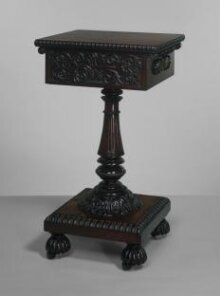
| Physical description | Teapoy, with a carved mahogany rectangular base, pedestal, and rectangular tea caddy |
| Dimensions |
|
| Gallery label | British Galleries:
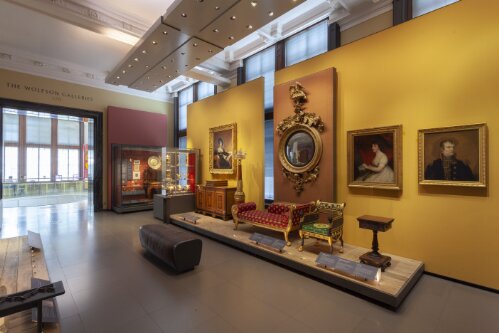
The teapoy became popular in about 1800 as a table with receptacles for tea. This example is close to the design included in Peter and Michael Angelo Nicholson's 'Practical Cabinet-maker', published in 1826. A copy is displayed nearby. Such pattern books not only provided designs for cabinet-makers but also influenced popular taste.(27/03/2003) |
| Credit line | Purchased with the assistance of the Brigadier Clark Fund through Art Fund |
| Object history | By an unknown British maker |
| Summary | Object Type This pedestal table has a lifting top which reveals two lidded compartments for storing tea and two others containing cut-glass bowls for mixing the dried tea. (The latter do not appear to be original to the piece.) It was both a practical object and a means of displaying the hostess's modish taste in furniture as she presided over tea and gossip. Originally a teapoy was a small three-legged occasional table. The word originates from the Persian and Hindi for 'three'. In George Smith's Household Furniture (1808), teapoys are illustrated as small stands with tray tops supported on a central pillar, 'used in drawing-rooms to prevent the company rising from their seats when taking refreshments'. However, over time the name made people associate them with tea, and therefore the phrase was also applied to tea chests on legs, such as this piece. Design & Designing The front of the chest is carved with a panel of scrolling foliage in a style loosely derived from ancient Greece. The sides are decorated with rosettes flanked by palmettes of a type common in Etruscan art from ancient Italy. |
| Collection | |
| Accession number | W.16:1 to 6-1973 |
About this object record
Explore the Collections contains over a million catalogue records, and over half a million images. It is a working database that includes information compiled over the life of the museum. Some of our records may contain offensive and discriminatory language, or reflect outdated ideas, practice and analysis. We are committed to addressing these issues, and to review and update our records accordingly.
You can write to us to suggest improvements to the record.
Suggest feedback
You can write to us to suggest improvements to the record.
Suggest feedback
| Record created | March 27, 2003 |
| Record URL |
Download as: JSONIIIF Manifest
