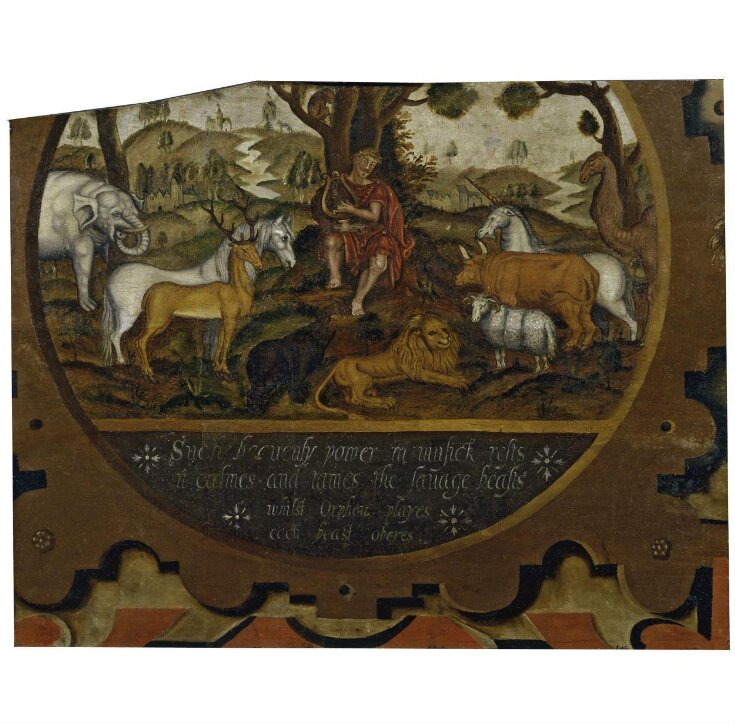
Orpheus and the Beasts
Wall Panel
1630-1640 (painted)
1630-1640 (painted)
| Artist/Maker | |
| Place of origin |
Object Type
Many 17th-century houses were decorated with mural paintings, ranging in technique from colourful painted wood panels as here, to crude monochrome designs painted directly on to the plaster. Changes in fashion have meant that few houses now have such paintings visible, though there are undoubtedly more to be discovered under layers of paint or newer panelling.
Subjects Depicted
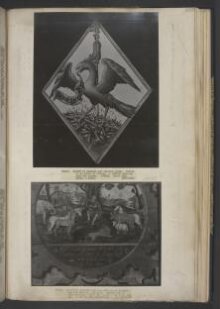
Orpheus, in Greek mythology, was the son of the god Apollo. He was able to charm the wild beasts with his music and by its magic power even move trees and rocks. This story was a favourite theme for poets, painters, printmakers and musicians in the 17th century. For example, the first successful opera, performed in Mantua in 1607, was Monteverdi's Orfeo. The anonymous artist here has copied closely his composition from a print in a natural history book, the frontispiece to A Book of Beasts, published anonymously in 1630 by Thomas Johnson. Book illustrations and other prints were frequently used as image sources for embroidery and tapestry weaving, which decorated rooms and furniture.
Text
The inscription reads:
Such Heavenly power in musick rests
It calmes and tames the savage beasts
Whilst Orpheus playes
Each beast obeyes.
Many 17th-century houses were decorated with mural paintings, ranging in technique from colourful painted wood panels as here, to crude monochrome designs painted directly on to the plaster. Changes in fashion have meant that few houses now have such paintings visible, though there are undoubtedly more to be discovered under layers of paint or newer panelling.
Subjects Depicted
Orpheus, in Greek mythology, was the son of the god Apollo. He was able to charm the wild beasts with his music and by its magic power even move trees and rocks. This story was a favourite theme for poets, painters, printmakers and musicians in the 17th century. For example, the first successful opera, performed in Mantua in 1607, was Monteverdi's Orfeo. The anonymous artist here has copied closely his composition from a print in a natural history book, the frontispiece to A Book of Beasts, published anonymously in 1630 by Thomas Johnson. Book illustrations and other prints were frequently used as image sources for embroidery and tapestry weaving, which decorated rooms and furniture.
Text
The inscription reads:
Such Heavenly power in musick rests
It calmes and tames the savage beasts
Whilst Orpheus playes
Each beast obeyes.
Object details
| Categories | |
| Object type | |
| Parts | This object consists of 2 parts.
|
| Title | Orpheus and the Beasts |
| Materials and techniques | tempera on panel |
| Brief description | WALL PANEL Orpheus charming the Beasts with his Lyre |
| Physical description | Wall panel with a roundel depicting Orpheus charming the beasts with his lyre. The design is based on the frontispiece to A Book of Beasts by Thomas Johnson. |
| Dimensions |
|
| Style | |
| Gallery label | British Galleries:
The painter of this panel based the painting on a print published in 1630 (see photograph, right).The artist left out some of the smaller creatures in the foreground of the original print, such as the snake, rabbits, cat and dog. This panel is probably only a small fragment of a larger scheme, intended to decorate a room.(27/03/2003) |
| Credit line | Given by Lady Sackville |
| Object history | Given by Lady Sackville, 1923 Painted in England by an unidentified artist (active 1630-1640); the design based on the frontispiece to 'A Book of Beasts', published by Thomas Johnson |
| Production | Design based on the frontispiece to 'A Book of Beasts', published by Thomas Johnson |
| Summary | Object Type Many 17th-century houses were decorated with mural paintings, ranging in technique from colourful painted wood panels as here, to crude monochrome designs painted directly on to the plaster. Changes in fashion have meant that few houses now have such paintings visible, though there are undoubtedly more to be discovered under layers of paint or newer panelling. Subjects Depicted Orpheus, in Greek mythology, was the son of the god Apollo. He was able to charm the wild beasts with his music and by its magic power even move trees and rocks. This story was a favourite theme for poets, painters, printmakers and musicians in the 17th century. For example, the first successful opera, performed in Mantua in 1607, was Monteverdi's Orfeo. The anonymous artist here has copied closely his composition from a print in a natural history book, the frontispiece to A Book of Beasts, published anonymously in 1630 by Thomas Johnson. Book illustrations and other prints were frequently used as image sources for embroidery and tapestry weaving, which decorated rooms and furniture. Text The inscription reads: Such Heavenly power in musick rests It calmes and tames the savage beasts Whilst Orpheus playes Each beast obeyes. |
| Collection | |
| Accession number | W.156&:1-1923 |
About this object record
Explore the Collections contains over a million catalogue records, and over half a million images. It is a working database that includes information compiled over the life of the museum. Some of our records may contain offensive and discriminatory language, or reflect outdated ideas, practice and analysis. We are committed to addressing these issues, and to review and update our records accordingly.
You can write to us to suggest improvements to the record.
Suggest feedback
You can write to us to suggest improvements to the record.
Suggest feedback
| Record created | March 27, 2003 |
| Record URL |
Download as: JSONIIIF Manifest
