Bureau Bookcase
1808-1810 (made), 1808 (painted)
| Artist/Maker | |
| Place of origin |
Object Type
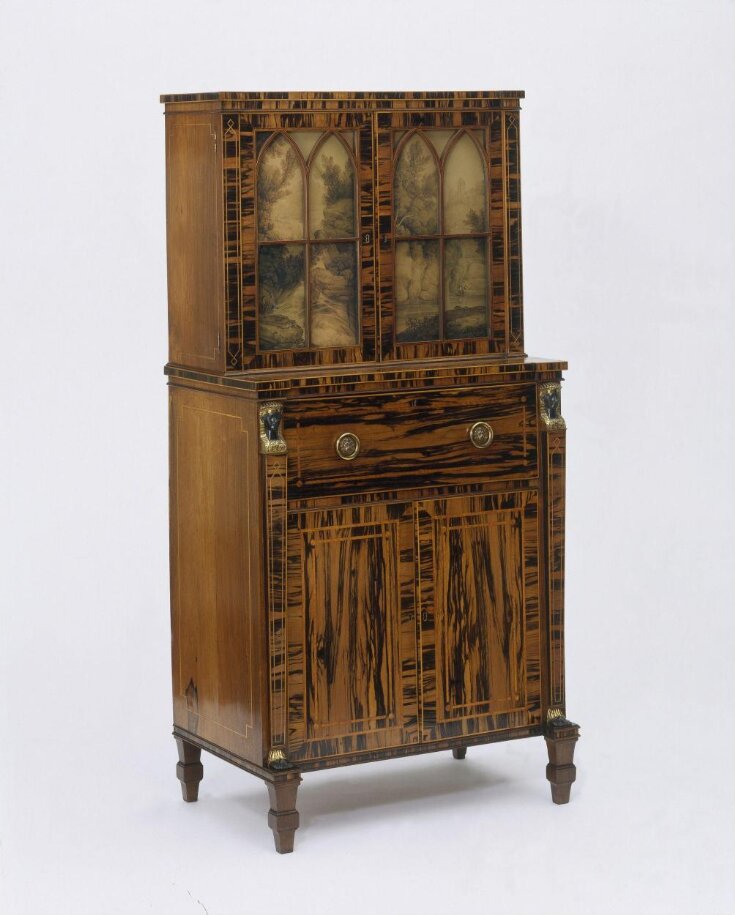
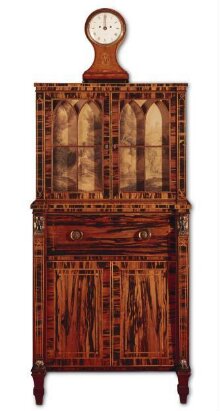
A bureau bookcase combined two functions, storage for books and a writing desk. Shelves for books are fitted inside the upper and lower cupboards of this example. Below the upper doors, there is a false drawer, which drops down, supported on brass quadrants, to form a writing surface. The interior is fitted with small drawers and pigeonholes.
People
George Oakley was a very fashionable cabinetmaker with a shop at 8 Old Bond Street, London. The bureau bookcase is very similar in design to other pieces of furniture that were made by his firm, Oakley & Evans. In 1801, the London correspondent of Journal der Luxus und der Moden, a German magazine, wrote that 'all people with taste buy their furniture at Oakeleys [sic], the most tasteful of the London cabinetmakers'.
Materials & Making
By 1810, when this bureau bookcase was made, combinations of different styles and contrasting materials had become fashionable. The mounts are Egyptian figures while the glazing bars in the doors are Gothic. The exterior is covered with zebrawood, a dark and patterned wood from Brazil, while the interior is veneered in satinwood, which is light in colour and came from Ceylon.
A bureau bookcase combined two functions, storage for books and a writing desk. Shelves for books are fitted inside the upper and lower cupboards of this example. Below the upper doors, there is a false drawer, which drops down, supported on brass quadrants, to form a writing surface. The interior is fitted with small drawers and pigeonholes.
People
George Oakley was a very fashionable cabinetmaker with a shop at 8 Old Bond Street, London. The bureau bookcase is very similar in design to other pieces of furniture that were made by his firm, Oakley & Evans. In 1801, the London correspondent of Journal der Luxus und der Moden, a German magazine, wrote that 'all people with taste buy their furniture at Oakeleys [sic], the most tasteful of the London cabinetmakers'.
Materials & Making
By 1810, when this bureau bookcase was made, combinations of different styles and contrasting materials had become fashionable. The mounts are Egyptian figures while the glazing bars in the doors are Gothic. The exterior is covered with zebrawood, a dark and patterned wood from Brazil, while the interior is veneered in satinwood, which is light in colour and came from Ceylon.
Object details
| Categories | |
| Object type | |
| Parts | This object consists of 14 parts.
|
| Materials and techniques | Mahogany, veneered with zebrawood and other woods, with gilt-bronze mounts |
| Brief description | Bureau bookcase, zebrawood and satinwood with gilt bronze mounts, probably made by George Oakley, with watercolours of the River Clyde by James Baynes, British, 1808-1810 |
| Physical description | The following description has been transcribed from the department register: Mahogany secretaire veneered with zebra wood. The upper part in the form of a cabinet with moulded cornice and two doors, each glazed and with astragals forming two pointed arches, behind which are framed watercolour drawings: 'Casa Lynn a Fall on the Clyde' signed 'J. Baynes 1808'. In the interior, two adjustable shelves. The lower portion projects and has a secretaire drawer containing small drawers and pigeon holes of satinwood and the front lets down on a quadrant and has two circular ring handles, lion masks forming the back plates. Below are two cupboard doors enclosing two small mahogany drawers and a shelf. At the corners are pilasters formed as Egyptian female terminals with ormolu heads and feet, which rest on projecting tapered supports. The secretaire is banded with satinwood. |
| Dimensions |
|
| Gallery label | British Galleries:
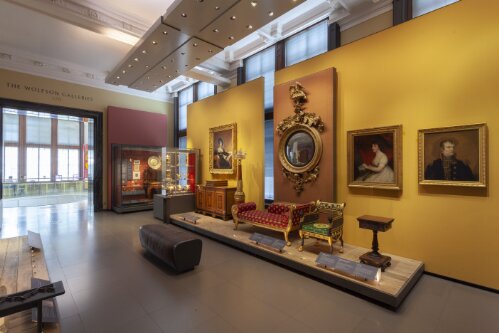
This bureau bookcase illustrates the mixing of styles that was common in Regency objects. The overall form is Classical but the glazing bars of the doors are pointed in the Gothic fashion, while the corners of the cabinet carry mounts in the form of Egyptian figures.(27/03/2003) |
| Object history | Probably designed and made in London by George Oakley (died in 1841) of Oakley & Evans, Old Bond Street, London; watercolours of the River Clyde signed by James Baynes (born in 1766, died in 1837) |
| Production | Watercolours of the River Clyde signed by James Baynes (born in 1766, died in 1837) |
| Summary | Object Type A bureau bookcase combined two functions, storage for books and a writing desk. Shelves for books are fitted inside the upper and lower cupboards of this example. Below the upper doors, there is a false drawer, which drops down, supported on brass quadrants, to form a writing surface. The interior is fitted with small drawers and pigeonholes. People George Oakley was a very fashionable cabinetmaker with a shop at 8 Old Bond Street, London. The bureau bookcase is very similar in design to other pieces of furniture that were made by his firm, Oakley & Evans. In 1801, the London correspondent of Journal der Luxus und der Moden, a German magazine, wrote that 'all people with taste buy their furniture at Oakeleys [sic], the most tasteful of the London cabinetmakers'. Materials & Making By 1810, when this bureau bookcase was made, combinations of different styles and contrasting materials had become fashionable. The mounts are Egyptian figures while the glazing bars in the doors are Gothic. The exterior is covered with zebrawood, a dark and patterned wood from Brazil, while the interior is veneered in satinwood, which is light in colour and came from Ceylon. |
| Collection | |
| Accession number | W.15:1 to 14-1930 |
About this object record
Explore the Collections contains over a million catalogue records, and over half a million images. It is a working database that includes information compiled over the life of the museum. Some of our records may contain offensive and discriminatory language, or reflect outdated ideas, practice and analysis. We are committed to addressing these issues, and to review and update our records accordingly.
You can write to us to suggest improvements to the record.
Suggest feedback
You can write to us to suggest improvements to the record.
Suggest feedback
| Record created | March 27, 2003 |
| Record URL |
Download as: JSONIIIF Manifest
