
Cushion Cover
ca. 1600 (made)
| Artist/Maker | |
| Place of origin |
Object Type
Long cushion covers were specifically made to fit wooden benches. Numerous small furnishings in either tapestry or embroidery added comfort and a touch of colour in well-to-do households.
Materials & Making
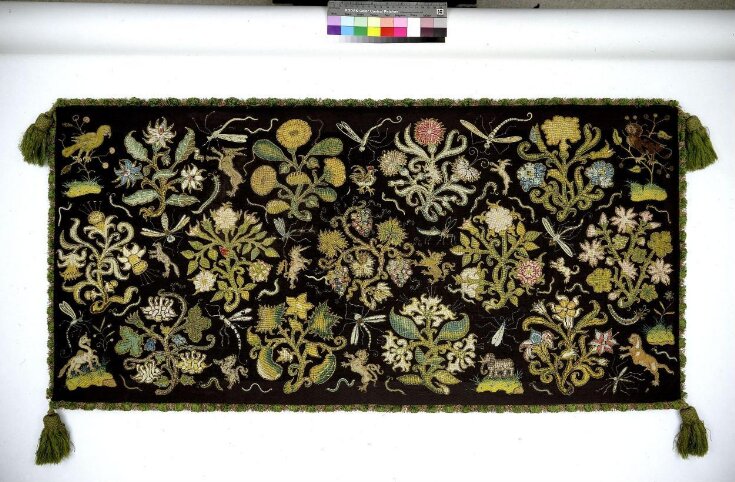
Although it is made of rich materials including velvet, silk and metal thread, it is possible that this cushion was worked in a household rather than a professional workshop. More than one woman or young girl might have been involved in making the separate motifs, which were then applied to the velvet ground. These small individual motifs were known as slips. They could be sewn onto a cushion cover or larger hanging or furnishing as desired. In a domestic setting, it was much easier for a skilled embroider to work them than to embroider directly onto a large piece of material.
Subject Depicted
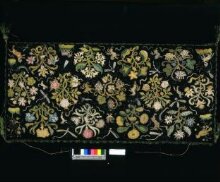
The 13 slips depict favoured motifs of the time, including naturalistic plants. In order to suit the overall pattern, these have been formed into stylised shapes. The composition of a pattern formed from isolated motifs is an almost exclusively English style. In the top row, from left to right, the plants represented are borage, marigold, pink and cornflower; in the middle row, daffodil, rose, grapes, rose, and an unidentified plant, possibly marrow; and in the bottom row, aquilegia (columbine), gourds, honeysuckle, and an unidentified plant.
Long cushion covers were specifically made to fit wooden benches. Numerous small furnishings in either tapestry or embroidery added comfort and a touch of colour in well-to-do households.
Materials & Making
Although it is made of rich materials including velvet, silk and metal thread, it is possible that this cushion was worked in a household rather than a professional workshop. More than one woman or young girl might have been involved in making the separate motifs, which were then applied to the velvet ground. These small individual motifs were known as slips. They could be sewn onto a cushion cover or larger hanging or furnishing as desired. In a domestic setting, it was much easier for a skilled embroider to work them than to embroider directly onto a large piece of material.
Subject Depicted
The 13 slips depict favoured motifs of the time, including naturalistic plants. In order to suit the overall pattern, these have been formed into stylised shapes. The composition of a pattern formed from isolated motifs is an almost exclusively English style. In the top row, from left to right, the plants represented are borage, marigold, pink and cornflower; in the middle row, daffodil, rose, grapes, rose, and an unidentified plant, possibly marrow; and in the bottom row, aquilegia (columbine), gourds, honeysuckle, and an unidentified plant.
Object details
| Categories | |
| Object type | |
| Materials and techniques | Silk velvet, with applied linen canvas embroidered with silk and metal thread in tent stitch and laid and couched work |
| Brief description | LONG CUSHION COVER |
| Physical description | Cushion cover |
| Dimensions |
|
| Gallery label | British Galleries:
Richly embroidered cushion covers were considerably more expensive than the wooden chairs and benches they were used with. They also made hard seats more comfortable before the development of fixed upholstery in the 17th century. Patterns composed of isolated motifs like these were almost exclusively English and owed little to outside influences.(27/03/2003) |
| Object history | Embroidered in England |
| Summary | Object Type Long cushion covers were specifically made to fit wooden benches. Numerous small furnishings in either tapestry or embroidery added comfort and a touch of colour in well-to-do households. Materials & Making Although it is made of rich materials including velvet, silk and metal thread, it is possible that this cushion was worked in a household rather than a professional workshop. More than one woman or young girl might have been involved in making the separate motifs, which were then applied to the velvet ground. These small individual motifs were known as slips. They could be sewn onto a cushion cover or larger hanging or furnishing as desired. In a domestic setting, it was much easier for a skilled embroider to work them than to embroider directly onto a large piece of material. Subject Depicted The 13 slips depict favoured motifs of the time, including naturalistic plants. In order to suit the overall pattern, these have been formed into stylised shapes. The composition of a pattern formed from isolated motifs is an almost exclusively English style. In the top row, from left to right, the plants represented are borage, marigold, pink and cornflower; in the middle row, daffodil, rose, grapes, rose, and an unidentified plant, possibly marrow; and in the bottom row, aquilegia (columbine), gourds, honeysuckle, and an unidentified plant. |
| Collection | |
| Accession number | T.80-1946 |
About this object record
Explore the Collections contains over a million catalogue records, and over half a million images. It is a working database that includes information compiled over the life of the museum. Some of our records may contain offensive and discriminatory language, or reflect outdated ideas, practice and analysis. We are committed to addressing these issues, and to review and update our records accordingly.
You can write to us to suggest improvements to the record.
Suggest feedback
You can write to us to suggest improvements to the record.
Suggest feedback
| Record created | March 27, 2003 |
| Record URL |
Download as: JSONIIIF Manifest
