Waistcoat
1860-1870 (made)
| Artist/Maker | |
| Place of origin |
Object Type
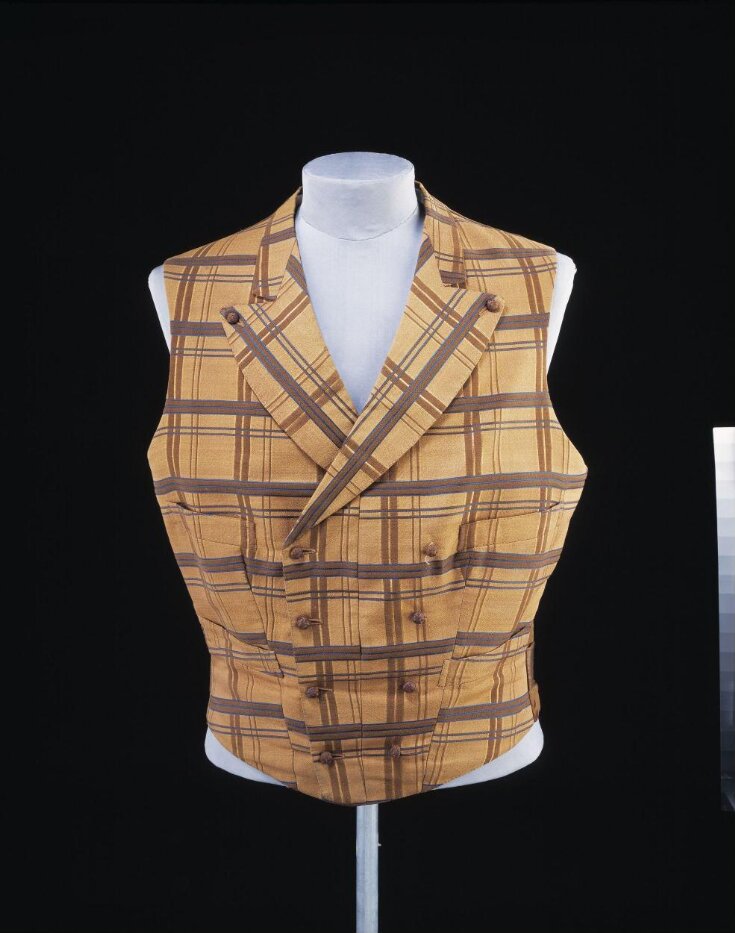
In the middle of the 19th century waistcoats were often colourful. They were made in a variety of fabrics, from checked and striped materials to delicate woven or embroidered patterns. The fabrics were often similar to those used for women's fashionable dresses.
Materials & Making
Tartans and checks with polychromatic effects were favoured in the late 1850s and early 1860s, but such bold patterns were not to everyone's taste. Photographs of the period show that many men preferred to wear a waistcoat made of similar materials to the coat or trousers. Some people wore 'dittos', where the suit was made of one material throughout.
Ownership & Use
Different styles of waistcoat were worn, according to the time of day and occasion. In the 1850s day waistcoats were often double-breasted, whereas those worn during the evening were single-breasted. They also tended to be made of more delicate materials, including satin and rich silks. A variety of special day waistcoats for sporting wear also came into fashion, including the 'Golf Vest', the 'Newmarket Vest', and the 'Tattershall Vest.'
In the middle of the 19th century waistcoats were often colourful. They were made in a variety of fabrics, from checked and striped materials to delicate woven or embroidered patterns. The fabrics were often similar to those used for women's fashionable dresses.
Materials & Making
Tartans and checks with polychromatic effects were favoured in the late 1850s and early 1860s, but such bold patterns were not to everyone's taste. Photographs of the period show that many men preferred to wear a waistcoat made of similar materials to the coat or trousers. Some people wore 'dittos', where the suit was made of one material throughout.
Ownership & Use
Different styles of waistcoat were worn, according to the time of day and occasion. In the 1850s day waistcoats were often double-breasted, whereas those worn during the evening were single-breasted. They also tended to be made of more delicate materials, including satin and rich silks. A variety of special day waistcoats for sporting wear also came into fashion, including the 'Golf Vest', the 'Newmarket Vest', and the 'Tattershall Vest.'
Object details
| Categories | |
| Object type | |
| Materials and techniques | Woven silk and wool, lined with wool, and satin |
| Brief description | Plaid waistcoat of woven silk and wool, Great Britain, 1860-1870 |
| Physical description | Plaid waistcoat of beige woven silk and wool, lined with striped wool. Satin back panel with buckle for size adjustment. Hand-sewn. |
| Dimensions |
|
| Gallery label | British Galleries:
This striking, double-breasted waistcoat was meant to be seen. It would have been worn with an open frock or morning coat. Later, during the 1870s and 1880s, many coats were made to button up high on the chest. As a result the waistcoat was almost hidden and became much plainer.(27/03/2003) |
| Credit line | Given by the Earl and Countess of Avon |
| Object history | Worn by Sir William Eden Made in Britain |
| Summary | Object Type In the middle of the 19th century waistcoats were often colourful. They were made in a variety of fabrics, from checked and striped materials to delicate woven or embroidered patterns. The fabrics were often similar to those used for women's fashionable dresses. Materials & Making Tartans and checks with polychromatic effects were favoured in the late 1850s and early 1860s, but such bold patterns were not to everyone's taste. Photographs of the period show that many men preferred to wear a waistcoat made of similar materials to the coat or trousers. Some people wore 'dittos', where the suit was made of one material throughout. Ownership & Use Different styles of waistcoat were worn, according to the time of day and occasion. In the 1850s day waistcoats were often double-breasted, whereas those worn during the evening were single-breasted. They also tended to be made of more delicate materials, including satin and rich silks. A variety of special day waistcoats for sporting wear also came into fashion, including the 'Golf Vest', the 'Newmarket Vest', and the 'Tattershall Vest.' |
| Bibliographic reference | Fashion : An Anthology by Cecil Beaton. London : H.M.S.O., 1971
no. 261 |
| Collection | |
| Accession number | T.722-1974 |
About this object record
Explore the Collections contains over a million catalogue records, and over half a million images. It is a working database that includes information compiled over the life of the museum. Some of our records may contain offensive and discriminatory language, or reflect outdated ideas, practice and analysis. We are committed to addressing these issues, and to review and update our records accordingly.
You can write to us to suggest improvements to the record.
Suggest feedback
You can write to us to suggest improvements to the record.
Suggest feedback
| Record created | March 27, 2003 |
| Record URL |
Download as: JSONIIIF Manifest
