Walking Cane
1919 (made)
| Artist/Maker | |
| Place of origin |
Object Type
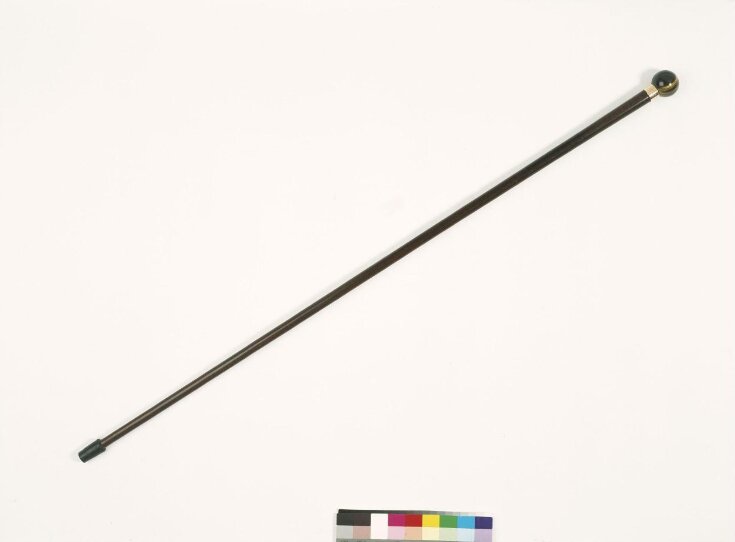
Walking sticks came in a variety of styles and exotic materials. This example is made of partridgewood, a hard red wood with darker parallel stripes, which was much used in cabinet-making. It came from the West Indies. The knob is of tiger's eye, a yellowish brown quartz with a brilliant lustre used as a gem. This gives the stick a very elegant appearance.
Trading
Industrialisation and mass manufacturing in the 19th century meant that walking sticks were produced in large quantities. Millions of canes were imported from the Far East and shops that specialised in walking sticks and umbrellas flourished.
Materials & Making
The knobs and handles of walking sticks were made of a wide range of materials, from silver and ivory to porcelain and quartz. They were often carved or cast in the form of animals, birds, skulls and even naked women. The shafts were often made from malacca, although glass, hippopotamus, horn and snakeskin were sometimes used.
Time
After about 1920 the walking stick began to disappear as a fashion accessory. It was largely replaced by the umbrella. Today walking sticks are primarily regarded as orthopaedic aids and supports for the elderly.
Walking sticks came in a variety of styles and exotic materials. This example is made of partridgewood, a hard red wood with darker parallel stripes, which was much used in cabinet-making. It came from the West Indies. The knob is of tiger's eye, a yellowish brown quartz with a brilliant lustre used as a gem. This gives the stick a very elegant appearance.
Trading
Industrialisation and mass manufacturing in the 19th century meant that walking sticks were produced in large quantities. Millions of canes were imported from the Far East and shops that specialised in walking sticks and umbrellas flourished.
Materials & Making
The knobs and handles of walking sticks were made of a wide range of materials, from silver and ivory to porcelain and quartz. They were often carved or cast in the form of animals, birds, skulls and even naked women. The shafts were often made from malacca, although glass, hippopotamus, horn and snakeskin were sometimes used.
Time
After about 1920 the walking stick began to disappear as a fashion accessory. It was largely replaced by the umbrella. Today walking sticks are primarily regarded as orthopaedic aids and supports for the elderly.
Object details
| Categories | |
| Object type | |
| Materials and techniques | Partridge wood with quartz |
| Brief description | Walking cane of partridge wood with a quartz knob, Great Britain, 1919 |
| Physical description | Walking cane of partridge wood with a tiger's eye quartz knob. Gold top. |
| Dimensions |
|
| Marks and inscriptions | (Hall mark for 1919) |
| Gallery label | British Galleries:
WALKING STICKS Walking sticks were not just used for support but were an essential element of fashionable dress, giving a man an elegant air. He could swagger and swing his cane in line with his step, or use it to strike an alluring pose. These sticks were made in a huge variety of styles and materials, often to display the wealth of their owner.(27/03/2003) |
| Credit line | Bequeathed by Mrs Joyce Margaret Hole |
| Object history | Registered File number 1987/136. |
| Summary | Object Type Walking sticks came in a variety of styles and exotic materials. This example is made of partridgewood, a hard red wood with darker parallel stripes, which was much used in cabinet-making. It came from the West Indies. The knob is of tiger's eye, a yellowish brown quartz with a brilliant lustre used as a gem. This gives the stick a very elegant appearance. Trading Industrialisation and mass manufacturing in the 19th century meant that walking sticks were produced in large quantities. Millions of canes were imported from the Far East and shops that specialised in walking sticks and umbrellas flourished. Materials & Making The knobs and handles of walking sticks were made of a wide range of materials, from silver and ivory to porcelain and quartz. They were often carved or cast in the form of animals, birds, skulls and even naked women. The shafts were often made from malacca, although glass, hippopotamus, horn and snakeskin were sometimes used. Time After about 1920 the walking stick began to disappear as a fashion accessory. It was largely replaced by the umbrella. Today walking sticks are primarily regarded as orthopaedic aids and supports for the elderly. |
| Collection | |
| Accession number | T.60-1987 |
About this object record
Explore the Collections contains over a million catalogue records, and over half a million images. It is a working database that includes information compiled over the life of the museum. Some of our records may contain offensive and discriminatory language, or reflect outdated ideas, practice and analysis. We are committed to addressing these issues, and to review and update our records accordingly.
You can write to us to suggest improvements to the record.
Suggest feedback
You can write to us to suggest improvements to the record.
Suggest feedback
| Record created | March 27, 2003 |
| Record URL |
Download as: JSONIIIF Manifest
