Box
1600-1625 (made)
| Artist/Maker | |
| Place of origin |
Object Type
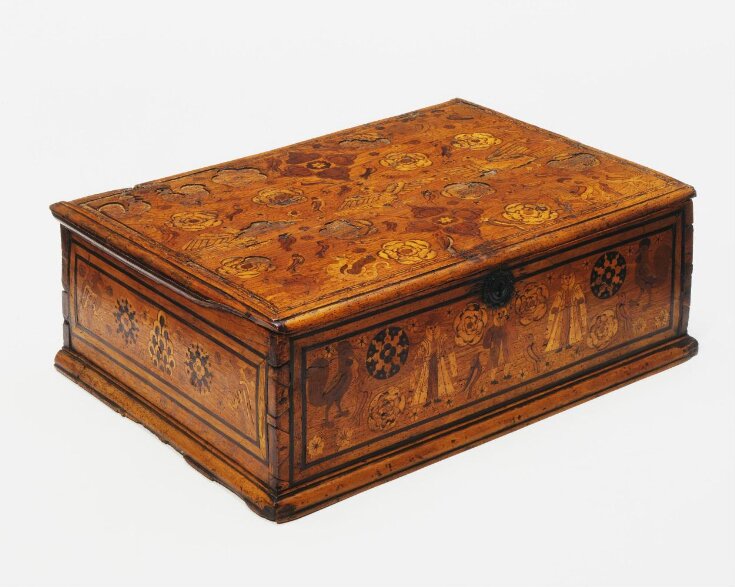
The lid, sides and front of this writing box are inlaid with various woods. The inlay is characteristic of the work undertaken by Flemish immigrants in Southwark, south London, in the late 16th century, as exemplified in chests inlaid with architectural and geometrical ornament, and sometimes including figures in contemporary dress. The best-known example is the Offley chest in Southwark Cathedral, dated 1588.
Materials & Making
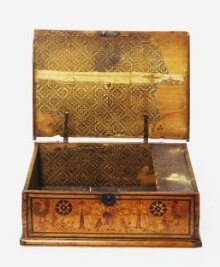
The box is constructed of elm and joined at the corners by large dovetails (fan-shaped projections at the end of one piece of wood that fit into similar-shaped slots at the end of another at right angles, to form a secure and tight joint). The base consists of three boards joined in the centre with tongue and groove (a projection along the length of one board fits into a groove along the next board, giving a firm join). The underside of the box shows evidence of hand sawing. Three holes at each of the corners indicate that it originally had feet. The interior is fitted with a till (compartment with lid) on one side. It is entirely lined with a paper, dated on the reverse 1615. This lining paper consists of re-used pulls (proof copies) for an edition of the antiquarian William Camden's Remaines of a Greater Worke, Concerning Britaine. The box retains its original fixings and later hinges. The lock is a later replacement although the escutcheon (metal lock plate) may be original.
Subjects Depicted
The box is decorated with heraldic ornament symmetrically disposed, including Tudor roses. The front of the box has three figures in late 16th-century dress. The ornamental birds and beasts derive from Edward Topsell's Historie of Foure-Footed Beasts (1607) and Historie of Serpents (1608).
The lid, sides and front of this writing box are inlaid with various woods. The inlay is characteristic of the work undertaken by Flemish immigrants in Southwark, south London, in the late 16th century, as exemplified in chests inlaid with architectural and geometrical ornament, and sometimes including figures in contemporary dress. The best-known example is the Offley chest in Southwark Cathedral, dated 1588.
Materials & Making
The box is constructed of elm and joined at the corners by large dovetails (fan-shaped projections at the end of one piece of wood that fit into similar-shaped slots at the end of another at right angles, to form a secure and tight joint). The base consists of three boards joined in the centre with tongue and groove (a projection along the length of one board fits into a groove along the next board, giving a firm join). The underside of the box shows evidence of hand sawing. Three holes at each of the corners indicate that it originally had feet. The interior is fitted with a till (compartment with lid) on one side. It is entirely lined with a paper, dated on the reverse 1615. This lining paper consists of re-used pulls (proof copies) for an edition of the antiquarian William Camden's Remaines of a Greater Worke, Concerning Britaine. The box retains its original fixings and later hinges. The lock is a later replacement although the escutcheon (metal lock plate) may be original.
Subjects Depicted
The box is decorated with heraldic ornament symmetrically disposed, including Tudor roses. The front of the box has three figures in late 16th-century dress. The ornamental birds and beasts derive from Edward Topsell's Historie of Foure-Footed Beasts (1607) and Historie of Serpents (1608).
Object details
| Categories | |
| Object type | |
| Parts | This object consists of 2 parts.
|
| Materials and techniques | Elm, inlaid with maple, cedar, bog oak and Andaman padouk |
| Brief description | Elm box. The lid, front and sides are inlaid with various woods with heraldic ornament symmetrically disposed. English, 1600-1625. |
| Physical description | The lid, sides and front of the box are inlaid with various woods with heraldic ornament symmetrically disposed. This consists of Tudor roses; pairs of cocks; pairs of griffins; martlets; doves and geometrical ornament. The front of the box has three figures in late 16th century dress; the central figure is bearded. The interior is fitted with a till on the proper left side. It is entirely lined with a paper, dated on the reverse 1615, apparently re-used pulls for an edition of William Camden's Remaines of a greater Worke, concerning Britaine. The paper is wood block printed in black with a diaper of roses and stylized bell flowers. That on the lid has been patched re-using a sheet inscribed with a late 18th or early 19th century hand. The box retains its original fixings and later hinges which have been moved once to accommodate the shrinkage of the lid. The lock is a later replacement although the escutcheon may be original. The box is constructed of elm, and joined at the corners by large dovetails, the base consists of three boards joined with tongue and groove in the centre. The underside shows evidence of hand sawing and three holes at each of the corners indicate that it originally had feet. The lid has lipped mouldings at the sides. |
| Dimensions |
|
| Marks and inscriptions | The box is lined with re-used test sheets for an edition of William Camden's (1515-1623) 'Remaines of a greater Worke, concerning Britain' (1615) |
| Gallery label |
|
| Object history | Object purchased for £35 from F. H. Carlton, Pine Cottage, Claygate, Surrey. RP: M526/1910; M1910/1598 Object sampling carried out by Jo Darrah, V&A Science; drawer/slide reference 1/12. Historical significance: The inlay is characteristic of the work undertaken by Flemish immigrants in Southwark in the late 16th century as exemplified in chests inlaid with architectural and geometrical ornament. These sometimes include figures in contemporary dress. The best known example is the Offley chest in Southwark Cathedral, dated 1588. The ornamental birds and beasts are derived from Edward Topsell's Historie of Foure-footed Beasts (1607) and Historie of Serpents (1608). |
| Subjects depicted | |
| Summary | Object Type The lid, sides and front of this writing box are inlaid with various woods. The inlay is characteristic of the work undertaken by Flemish immigrants in Southwark, south London, in the late 16th century, as exemplified in chests inlaid with architectural and geometrical ornament, and sometimes including figures in contemporary dress. The best-known example is the Offley chest in Southwark Cathedral, dated 1588. Materials & Making The box is constructed of elm and joined at the corners by large dovetails (fan-shaped projections at the end of one piece of wood that fit into similar-shaped slots at the end of another at right angles, to form a secure and tight joint). The base consists of three boards joined in the centre with tongue and groove (a projection along the length of one board fits into a groove along the next board, giving a firm join). The underside of the box shows evidence of hand sawing. Three holes at each of the corners indicate that it originally had feet. The interior is fitted with a till (compartment with lid) on one side. It is entirely lined with a paper, dated on the reverse 1615. This lining paper consists of re-used pulls (proof copies) for an edition of the antiquarian William Camden's Remaines of a Greater Worke, Concerning Britaine. The box retains its original fixings and later hinges. The lock is a later replacement although the escutcheon (metal lock plate) may be original. Subjects Depicted The box is decorated with heraldic ornament symmetrically disposed, including Tudor roses. The front of the box has three figures in late 16th-century dress. The ornamental birds and beasts derive from Edward Topsell's Historie of Foure-Footed Beasts (1607) and Historie of Serpents (1608). |
| Bibliographic references |
|
| Collection | |
| Accession number | W.17:1-1910 |
About this object record
Explore the Collections contains over a million catalogue records, and over half a million images. It is a working database that includes information compiled over the life of the museum. Some of our records may contain offensive and discriminatory language, or reflect outdated ideas, practice and analysis. We are committed to addressing these issues, and to review and update our records accordingly.
You can write to us to suggest improvements to the record.
Suggest feedback
You can write to us to suggest improvements to the record.
Suggest feedback
| Record created | June 11, 1998 |
| Record URL |
Download as: JSONIIIF Manifest
