
Slip
ca. 1600 (made)
| Artist/Maker | |
| Place of origin |
Object Type
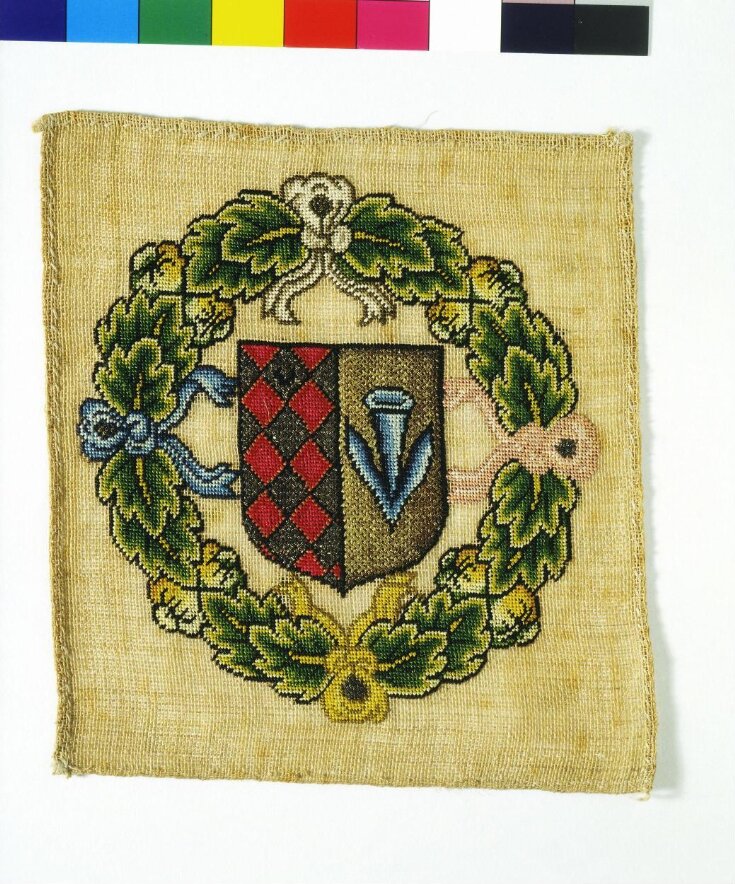
This slip, one of a small group, depicts the coat of arms of Fitzwilliam impaling Sydney (impaling means that the two coats of arms appear on a shield divided vertically into two).
Materials & Making
Slips were small, usually floral motifs drawn onto canvas, then embroidered and cut out. They would be applied to a rich backing fabric such as velvet or satin. They were used in various types of furnishing, particularly bed hangings. It was more manageable for the domestic embroiderer to work a small piece of canvas that could be held in the hand than to tackle a large embroidery in a single piece. It was also easier, if necessary, to detach the slips and reapply them to another backing.
People
Two manuscript notes in the V&A relate to the commissioning of these slips. They were apparently written by Anne Sydney, daughter of Sir William Sydney of Penshurst, Kent, who married Sir William Fitzwilliam (1526-1599). They seem to indicate that the slips were worked to commission, but almost certainly by household servants, Mrs Fisher and Mrs Lyell, rather than in a workshop.
This slip, one of a small group, depicts the coat of arms of Fitzwilliam impaling Sydney (impaling means that the two coats of arms appear on a shield divided vertically into two).
Materials & Making
Slips were small, usually floral motifs drawn onto canvas, then embroidered and cut out. They would be applied to a rich backing fabric such as velvet or satin. They were used in various types of furnishing, particularly bed hangings. It was more manageable for the domestic embroiderer to work a small piece of canvas that could be held in the hand than to tackle a large embroidery in a single piece. It was also easier, if necessary, to detach the slips and reapply them to another backing.
People
Two manuscript notes in the V&A relate to the commissioning of these slips. They were apparently written by Anne Sydney, daughter of Sir William Sydney of Penshurst, Kent, who married Sir William Fitzwilliam (1526-1599). They seem to indicate that the slips were worked to commission, but almost certainly by household servants, Mrs Fisher and Mrs Lyell, rather than in a workshop.
Object details
| Categories | |
| Object type | |
| Materials and techniques | Embroidered canvas with silver and silver-gilt thread, silk and linen |
| Brief description | Embroidered slip of canvas with a coat of arms in silver, sliver-gilt thread, silk and linen, Great Britain, ca. 1600 |
| Physical description | Embroidered slip of canvas with a coat of arms in silver and silver-gilt thread with silk in shades of green, yellow, red, blue, pink, brown, black and white in tent and plaited goblein stitches. The ground is unworked. The edges are turned in and hemmed with linen thread. In the centre is a wreath of leaves and buds, interspersed with four bows, surrounding a shield emblazoned with red lozenges and crescent sable on the right and a phem azure on the left. |
| Dimensions |
|
| Gallery label | British Galleries:
The coat of arms represents the marriage of Anne Sidney to Sir William Fitzwilliam (1526-1599). Slips were small motifs that were embroidered onto canvas, then cut out and stitched onto larger pieces of fabric. Floral motifs were particularly popular for domestic embroidery. A manuscript records that these slips were intended for hangings, probably for a bed.(27/03/2003) |
| Object history | Made in England |
| Summary | Object Type This slip, one of a small group, depicts the coat of arms of Fitzwilliam impaling Sydney (impaling means that the two coats of arms appear on a shield divided vertically into two). Materials & Making Slips were small, usually floral motifs drawn onto canvas, then embroidered and cut out. They would be applied to a rich backing fabric such as velvet or satin. They were used in various types of furnishing, particularly bed hangings. It was more manageable for the domestic embroiderer to work a small piece of canvas that could be held in the hand than to tackle a large embroidery in a single piece. It was also easier, if necessary, to detach the slips and reapply them to another backing. People Two manuscript notes in the V&A relate to the commissioning of these slips. They were apparently written by Anne Sydney, daughter of Sir William Sydney of Penshurst, Kent, who married Sir William Fitzwilliam (1526-1599). They seem to indicate that the slips were worked to commission, but almost certainly by household servants, Mrs Fisher and Mrs Lyell, rather than in a workshop. |
| Associated object | |
| Collection | |
| Accession number | T.46-1972 |
About this object record
Explore the Collections contains over a million catalogue records, and over half a million images. It is a working database that includes information compiled over the life of the museum. Some of our records may contain offensive and discriminatory language, or reflect outdated ideas, practice and analysis. We are committed to addressing these issues, and to review and update our records accordingly.
You can write to us to suggest improvements to the record.
Suggest feedback
You can write to us to suggest improvements to the record.
Suggest feedback
| Record created | March 27, 2003 |
| Record URL |
Download as: JSONIIIF Manifest
