Napkin
1708 (made)
| Artist/Maker | |
| Place of origin |
Object Type
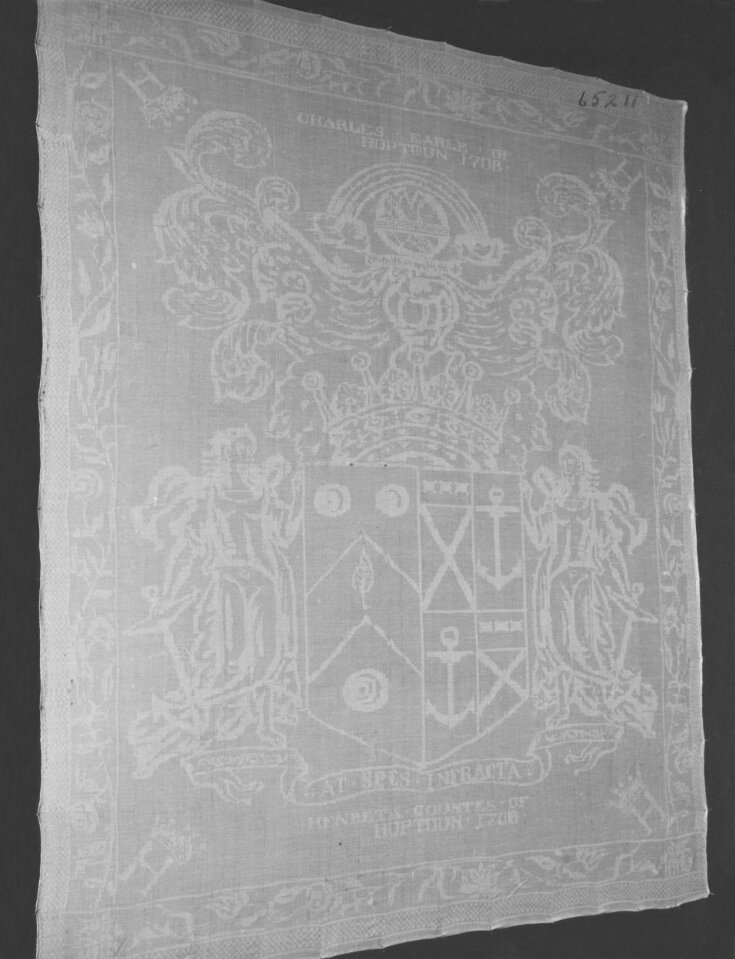
This napkin is from the household of Charles Hope, 1st Earl of Hopetoun (1681-1742) and his wife, born Lady Henrietta Johnstone. It would have been part of a set of napkins matching a tablecloth. The Earl and Countess had married in 1699, so the linen was not woven to commemorate the wedding, but its quality suggests that by 1708 they were maintaining an affluent household in which fashionable luxuries were used.
Ownership & Use
Late 17th and early 18th-century Scottish inventories emphasise the importance of table linen, known as napery, in households. Often there were more napkins and tablecloths than there were sheets and pillowcases. Stocks of napery could be built up over many years, and were bequeathed in wills.
Making & Trading
The first record confirming the weaving of linen damask in Scotland is an Act of 1693 stating 'it shall be lawful to make all sorts of damask for table linen'. But Scotland had an important coarse linen-weaving industry, providing a manufacturing base out of which it could be developed. Linen damask appears to have been attempted earlier in the century. Damask table linen had been legally imported, or smuggled, from Flanders and The Netherlands, and the home industry tried to earn a share of this market. The weaving of custom-made damask like this, incorporating the client's name and, where appropriate, coat of arms seems to have been a significant part of the industry.
This napkin is from the household of Charles Hope, 1st Earl of Hopetoun (1681-1742) and his wife, born Lady Henrietta Johnstone. It would have been part of a set of napkins matching a tablecloth. The Earl and Countess had married in 1699, so the linen was not woven to commemorate the wedding, but its quality suggests that by 1708 they were maintaining an affluent household in which fashionable luxuries were used.
Ownership & Use
Late 17th and early 18th-century Scottish inventories emphasise the importance of table linen, known as napery, in households. Often there were more napkins and tablecloths than there were sheets and pillowcases. Stocks of napery could be built up over many years, and were bequeathed in wills.
Making & Trading
The first record confirming the weaving of linen damask in Scotland is an Act of 1693 stating 'it shall be lawful to make all sorts of damask for table linen'. But Scotland had an important coarse linen-weaving industry, providing a manufacturing base out of which it could be developed. Linen damask appears to have been attempted earlier in the century. Damask table linen had been legally imported, or smuggled, from Flanders and The Netherlands, and the home industry tried to earn a share of this market. The weaving of custom-made damask like this, incorporating the client's name and, where appropriate, coat of arms seems to have been a significant part of the industry.
Object details
| Categories | |
| Object type | |
| Materials and techniques | Linen damask |
| Brief description | Linen damask napkin; Scotland; 1708. |
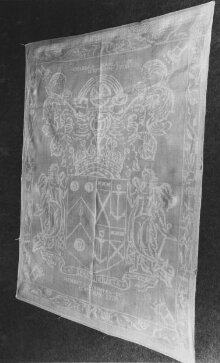
| Physical description | Linen damask, depicting arms of Hope impaling Johnstone within a narrow floral border, with the motto 'AT SPES INFRACTA.' Inscribed above is 'CHARLES EARLE OF HOPTOUN 1708, 'and below is 'HENRETA COUNTES OF HOPTOUN 1708.' In each angle appears the letter 'H' and a coronet. Woven at 100 threads to the inch. |
| Dimensions |
|
| Marks and inscriptions | Inscribed 'CHARLES EARLE OF HOPTOUN 1708' and 'HENRETA COUNTES OF HOPTOUN 1708', with their Latin motto 'AT SPES INFRACTA' |
| Gallery label | British Galleries:
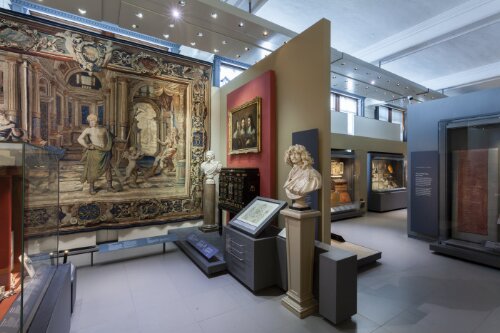
By the early 18th century the Scottish linen industry was noted for its customised table linen, that was made to order. This was produced to compete with imported linen from Flanders (now Belgium) and The Netherlands. This napkin is woven with the arms of Charles, 1st Earl of Hopetoun (1681-1742) and his wife, Henrietta. The linen thread may have been spun in the Earl's household, and supplied directly to the damask weaver. Designs woven in damask are subtle and can be difficult to distinguish (see photograph), but such linens were intended to be seen and appreciated as luxury objects.(27/03/2003) |
| Credit line | Given by Maj. G. F. B. E. Massy MC |
| Object history | Almost certainly woven in Scotland. Registered File no. 1931/21. |
| Production | Dated 1708 |
| Subjects depicted | |
| Summary | Object Type This napkin is from the household of Charles Hope, 1st Earl of Hopetoun (1681-1742) and his wife, born Lady Henrietta Johnstone. It would have been part of a set of napkins matching a tablecloth. The Earl and Countess had married in 1699, so the linen was not woven to commemorate the wedding, but its quality suggests that by 1708 they were maintaining an affluent household in which fashionable luxuries were used. Ownership & Use Late 17th and early 18th-century Scottish inventories emphasise the importance of table linen, known as napery, in households. Often there were more napkins and tablecloths than there were sheets and pillowcases. Stocks of napery could be built up over many years, and were bequeathed in wills. Making & Trading The first record confirming the weaving of linen damask in Scotland is an Act of 1693 stating 'it shall be lawful to make all sorts of damask for table linen'. But Scotland had an important coarse linen-weaving industry, providing a manufacturing base out of which it could be developed. Linen damask appears to have been attempted earlier in the century. Damask table linen had been legally imported, or smuggled, from Flanders and The Netherlands, and the home industry tried to earn a share of this market. The weaving of custom-made damask like this, incorporating the client's name and, where appropriate, coat of arms seems to have been a significant part of the industry. |
| Collection | |
| Accession number | T.3-1931 |
About this object record
Explore the Collections contains over a million catalogue records, and over half a million images. It is a working database that includes information compiled over the life of the museum. Some of our records may contain offensive and discriminatory language, or reflect outdated ideas, practice and analysis. We are committed to addressing these issues, and to review and update our records accordingly.
You can write to us to suggest improvements to the record.
Suggest feedback
You can write to us to suggest improvements to the record.
Suggest feedback
| Record created | March 27, 2003 |
| Record URL |
Download as: JSONIIIF Manifest
