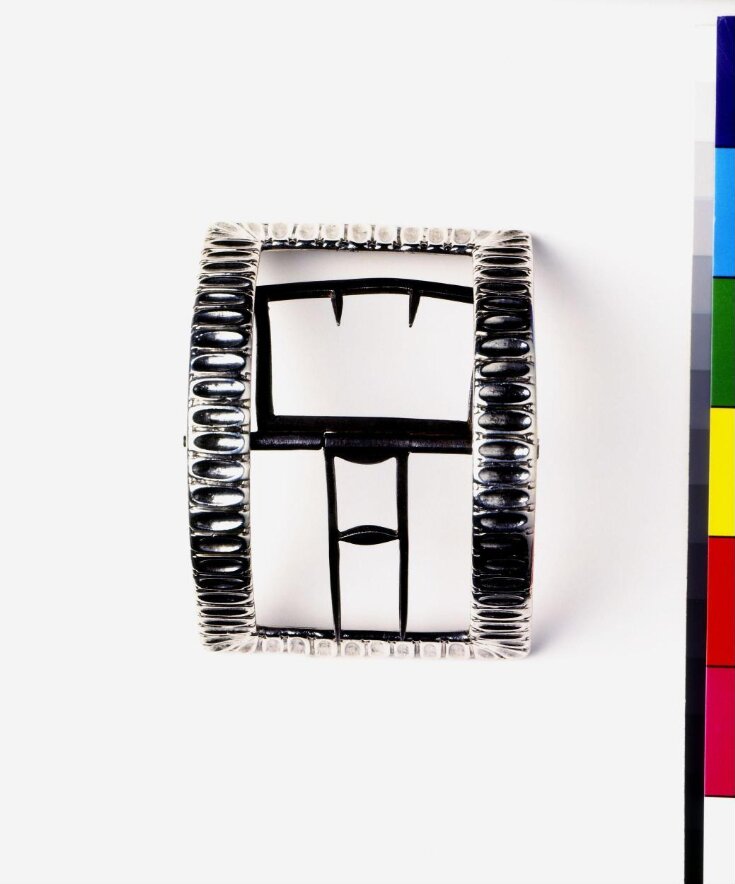

Shoe Buckle
1770-1784 (made)
| Artist/Maker | |
| Place of origin |
Object Type
Shoe buckles first appeared in the 1660s, replacing elaborate shoe ribbons (known as 'roses') to fasten men's shoes. At first plain and utilitarian, shoe buckles became more elaborate as the 18th century progressed.
Materials & Making
Like most silver buckles, this one was cast and chased to produce its decoration. The rectangular shape and cusped design of this shoe buckle are typical of the Neo-classical influence at work on late-18th-century men's clothing.
Ownership & Use
Large shoe buckles and high heels were only part of the exaggerated styles of a certain group of fashionable young men in the 1770s. They also wore very high wigs, tightly cut coats and breeches in pastel shades and too much perfume (according to their critics). Such fashions were considered very effeminate. The term 'macaroni' was coined by young men on the Grand Tour for anything stylish and elegant. As many also adopted this new style of dressing, the expression was applied to them.
Shoe buckles first appeared in the 1660s, replacing elaborate shoe ribbons (known as 'roses') to fasten men's shoes. At first plain and utilitarian, shoe buckles became more elaborate as the 18th century progressed.
Materials & Making
Like most silver buckles, this one was cast and chased to produce its decoration. The rectangular shape and cusped design of this shoe buckle are typical of the Neo-classical influence at work on late-18th-century men's clothing.
Ownership & Use
Large shoe buckles and high heels were only part of the exaggerated styles of a certain group of fashionable young men in the 1770s. They also wore very high wigs, tightly cut coats and breeches in pastel shades and too much perfume (according to their critics). Such fashions were considered very effeminate. The term 'macaroni' was coined by young men on the Grand Tour for anything stylish and elegant. As many also adopted this new style of dressing, the expression was applied to them.
Object details
| Categories | |
| Object type | |
| Materials and techniques | Silver and steel |
| Brief description | Silver shoe buckle, England, 1770-1784 |
| Physical description | Silver shoe buckle, high-arched, rectangular and with cusped decoration. Steel chape. |
| Dimensions |
|
| Marks and inscriptions | Lion passant and 'IB' |
| Gallery label | British Galleries:
The decorative effect of this silver buckle imitates that of cut steel. The shape of the buckle suggests that it may have been used on a shoe with a high heel, as worn by 'macaronis' or fops of the 1770s.(27/03/2003) |
| Object history | Made in England |
| Summary | Object Type Shoe buckles first appeared in the 1660s, replacing elaborate shoe ribbons (known as 'roses') to fasten men's shoes. At first plain and utilitarian, shoe buckles became more elaborate as the 18th century progressed. Materials & Making Like most silver buckles, this one was cast and chased to produce its decoration. The rectangular shape and cusped design of this shoe buckle are typical of the Neo-classical influence at work on late-18th-century men's clothing. Ownership & Use Large shoe buckles and high heels were only part of the exaggerated styles of a certain group of fashionable young men in the 1770s. They also wore very high wigs, tightly cut coats and breeches in pastel shades and too much perfume (according to their critics). Such fashions were considered very effeminate. The term 'macaroni' was coined by young men on the Grand Tour for anything stylish and elegant. As many also adopted this new style of dressing, the expression was applied to them. |
| Collection | |
| Accession number | T.319-1982 |
About this object record
Explore the Collections contains over a million catalogue records, and over half a million images. It is a working database that includes information compiled over the life of the museum. Some of our records may contain offensive and discriminatory language, or reflect outdated ideas, practice and analysis. We are committed to addressing these issues, and to review and update our records accordingly.
You can write to us to suggest improvements to the record.
Suggest feedback
You can write to us to suggest improvements to the record.
Suggest feedback
| Record created | March 27, 2003 |
| Record URL |
Download as: JSONIIIF Manifest
