Sewing Box
1800-1850 (made)
| Artist/Maker | |
| Place of origin |
Object Type
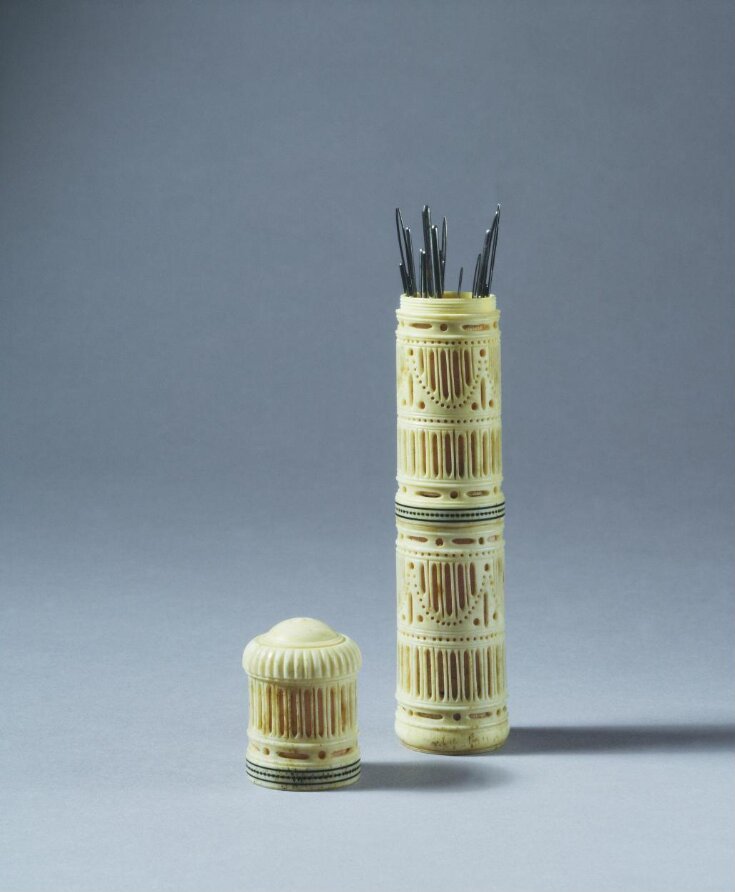
Making net by hand is one of the oldest textile techniques, its earliest uses the practical ones of hunting and fishing. When the basic tools of shuttle and size gauge were refined to make a smaller mesh, the use of net for decorative purposes became possible. In the 18th and early 19th centuries, netting was a popular pastime for amateurs, as well as a commercial craft. The tools needed for it - netting needles and gauges of different sizes, and sometimes bodkins and hooks - were often kept in decorated cases. This cut bone case is in the most usual, cylindrical form.
Ownership & Use
Netting was carried out at home in different materials and scale for a variety of uses, including protecting crops and trapping wildlife, as well as decorative accessories like purses. In 1783 the Duchess of Portland was found by a visitor to be making a net to protect a cherry tree, and this utilitarian aspect made netting one of the few drawing-room occupations permitted to men. The steel tools contained in this case belonging to the V&A would have been used to make net with a small mesh.
Making net by hand is one of the oldest textile techniques, its earliest uses the practical ones of hunting and fishing. When the basic tools of shuttle and size gauge were refined to make a smaller mesh, the use of net for decorative purposes became possible. In the 18th and early 19th centuries, netting was a popular pastime for amateurs, as well as a commercial craft. The tools needed for it - netting needles and gauges of different sizes, and sometimes bodkins and hooks - were often kept in decorated cases. This cut bone case is in the most usual, cylindrical form.
Ownership & Use
Netting was carried out at home in different materials and scale for a variety of uses, including protecting crops and trapping wildlife, as well as decorative accessories like purses. In 1783 the Duchess of Portland was found by a visitor to be making a net to protect a cherry tree, and this utilitarian aspect made netting one of the few drawing-room occupations permitted to men. The steel tools contained in this case belonging to the V&A would have been used to make net with a small mesh.
Object details
| Categories | |
| Object type | |
| Parts | This object consists of 3 parts.
|
| Materials and techniques | Cut bone lined with cotton, and steel |
| Brief description | Box and lids of cut bone containing steel netting tools, England, 1800-1850 |
| Physical description | Box made of bone and containing steel netting tools. The box is cylindrical and made of cut bone. Divided into three sections by bands of blue decoration. The upper section which includes the domed lid of the container is half the length of the other two sections. The cut decoration consists mainly of vertical slits, some contained with a swag-like decoration, vertical slits and small round holes. The pink, glazed cotton, with which the container is lined, shows through the cut work. The lowest of the three sections unscrews. The box contains nine pairs of very fine steel netting needles and their gauges. The needles range in length from 5.5 inches (13.9cm) to 3 inches (7.6cm). The two smallest needles have only single eyes. The gauges range in length from 5.5 inches (13.9cm) to 3 inches (7.6cm) in diameter they range from 15 to 19 (as on the Bell needle gauge, see T.276-1979). |
| Dimensions |
|
| Gallery label | British Galleries:
NEEDLEWORKING SKILLS Ladies in polite society were expected to be proficient in a wide range of needleworking skills. The graceful rhythm of techniques such as knotting or netting was thought to show off the elegance of a lady's hands. Embroidery, knitting and crochet are still current today. Knotting produced a decorative thread, with rows of little knots, that was sewn onto fabric. Fine net, made with thread from a decorative shuttle, was often further embroidered.(27/03/2003) |
| Credit line | Given by Mrs J. Taylor |
| Summary | Object Type Making net by hand is one of the oldest textile techniques, its earliest uses the practical ones of hunting and fishing. When the basic tools of shuttle and size gauge were refined to make a smaller mesh, the use of net for decorative purposes became possible. In the 18th and early 19th centuries, netting was a popular pastime for amateurs, as well as a commercial craft. The tools needed for it - netting needles and gauges of different sizes, and sometimes bodkins and hooks - were often kept in decorated cases. This cut bone case is in the most usual, cylindrical form. Ownership & Use Netting was carried out at home in different materials and scale for a variety of uses, including protecting crops and trapping wildlife, as well as decorative accessories like purses. In 1783 the Duchess of Portland was found by a visitor to be making a net to protect a cherry tree, and this utilitarian aspect made netting one of the few drawing-room occupations permitted to men. The steel tools contained in this case belonging to the V&A would have been used to make net with a small mesh. |
| Bibliographic reference | Miller, Lesley Ellis, and Ana Cabrera Lafuente, with Claire Allen-Johnstone, eds. Silk: Fibre, Fabric and Fashion. London: Thames & Hudson Ltd in association with the Victoria and Albert Museum, 2021. ISBN 978-0-500-48065-6.
This object features in the publication Silk: Fibre, Fabric and Fashion (2021) |
| Collection | |
| Accession number | T.287 to B-1979 |
About this object record
Explore the Collections contains over a million catalogue records, and over half a million images. It is a working database that includes information compiled over the life of the museum. Some of our records may contain offensive and discriminatory language, or reflect outdated ideas, practice and analysis. We are committed to addressing these issues, and to review and update our records accordingly.
You can write to us to suggest improvements to the record.
Suggest feedback
You can write to us to suggest improvements to the record.
Suggest feedback
| Record created | March 27, 2003 |
| Record URL |
Download as: JSONIIIF Manifest
