
Children's Shoes
ca. 1851 (made)
| Artist/Maker | |
| Place of origin |
Object Type
These shoes were part of a group of women's and children's footwear shown by C.S. Gilman at the Great Exhibition of 1851. This pair is quite practical, but some of the examples, such as a velvet boot trimmed with swansdown, were more likely to have been specially made to show that he could produce styles in rich materials and create unusual effects.
Design
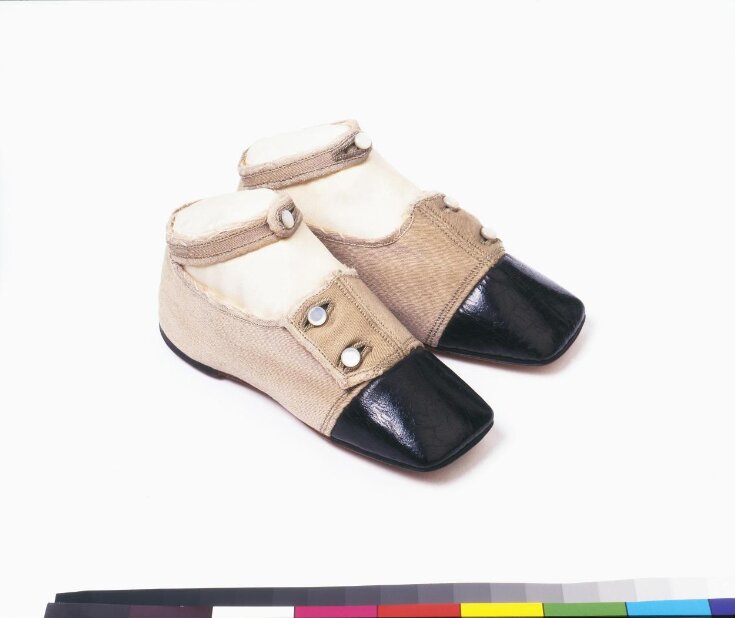
In contrast with shoes today, these are what were called 'straights': they do not have different shapes for the left and right foot. These shoes are for young children: they have flat soles with no heels,so that a child could maintain balance more, and straps which give some support to the foot and ankle.
Social Class
With the growth of the shoe industry during the 19th century, parents could buy a greater variety of children's styles like these, but this was of no help to poor children. They wore old and badly fitting shoes, sometimes padded out with paper. Many went barefoot. When education became compulsory and schools required the children to wear shoes, many faced a stark choice. If they went to school barefoot they would receive a punishment, but if they stayed away their parents would be fined.
These shoes were part of a group of women's and children's footwear shown by C.S. Gilman at the Great Exhibition of 1851. This pair is quite practical, but some of the examples, such as a velvet boot trimmed with swansdown, were more likely to have been specially made to show that he could produce styles in rich materials and create unusual effects.
Design
In contrast with shoes today, these are what were called 'straights': they do not have different shapes for the left and right foot. These shoes are for young children: they have flat soles with no heels,so that a child could maintain balance more, and straps which give some support to the foot and ankle.
Social Class
With the growth of the shoe industry during the 19th century, parents could buy a greater variety of children's styles like these, but this was of no help to poor children. They wore old and badly fitting shoes, sometimes padded out with paper. Many went barefoot. When education became compulsory and schools required the children to wear shoes, many faced a stark choice. If they went to school barefoot they would receive a punishment, but if they stayed away their parents would be fined.
Object details
| Categories | |
| Object type | |
| Parts | This object consists of 2 parts.
|
| Materials and techniques | Topstitched cloth, with leather sole and patent leather toecap |
| Brief description | pair of children's shoes - grey with buttons |
| Dimensions |
|
| Gallery label | British Galleries:
SHOES The exhibiting shoemakers emphasised the variety of styles and novelty of construction of the shoes they showed. The elastic panels of these women's boots eliminated the need for laces and button fastenings and allowed the foot to move freely. It was claimed that the Queen regularly wore this type of boot. The children's shoes are more traditional in design.(27/03/2003) |
| Credit line | Given by the maker |
| Object history | Made in England by the firm of C.S. Gilman for the Great Exhibition of 1851. Original acquisition numbers A.P.555 & A |
| Summary | Object Type These shoes were part of a group of women's and children's footwear shown by C.S. Gilman at the Great Exhibition of 1851. This pair is quite practical, but some of the examples, such as a velvet boot trimmed with swansdown, were more likely to have been specially made to show that he could produce styles in rich materials and create unusual effects. Design In contrast with shoes today, these are what were called 'straights': they do not have different shapes for the left and right foot. These shoes are for young children: they have flat soles with no heels,so that a child could maintain balance more, and straps which give some support to the foot and ankle. Social Class With the growth of the shoe industry during the 19th century, parents could buy a greater variety of children's styles like these, but this was of no help to poor children. They wore old and badly fitting shoes, sometimes padded out with paper. Many went barefoot. When education became compulsory and schools required the children to wear shoes, many faced a stark choice. If they went to school barefoot they would receive a punishment, but if they stayed away their parents would be fined. |
| Other number | AP.555 - Previous number |
| Collection | |
| Accession number | T.276&A-1963 |
About this object record
Explore the Collections contains over a million catalogue records, and over half a million images. It is a working database that includes information compiled over the life of the museum. Some of our records may contain offensive and discriminatory language, or reflect outdated ideas, practice and analysis. We are committed to addressing these issues, and to review and update our records accordingly.
You can write to us to suggest improvements to the record.
Suggest feedback
You can write to us to suggest improvements to the record.
Suggest feedback
| Record created | March 27, 2003 |
| Record URL |
Download as: JSONIIIF Manifest
