
Coif
1600-1625 (made)
| Artist/Maker | |
| Place of origin |
Object Type
Like a man's nightcap, a woman's coif was informal headwear. It would have been worn by itself indoors, or with a hat on top in public.
Ownership & Use
In Western Europe it was customary for both men and women to cover their heads in public up until the 1960s. A hat was an essential part of respectable dress and, from a health perspective, head coverings were considered necessary to protect against chills and disease. In literature and paintings, to be bareheaded often signified emotional distress or even insanity.
Designs & Designing
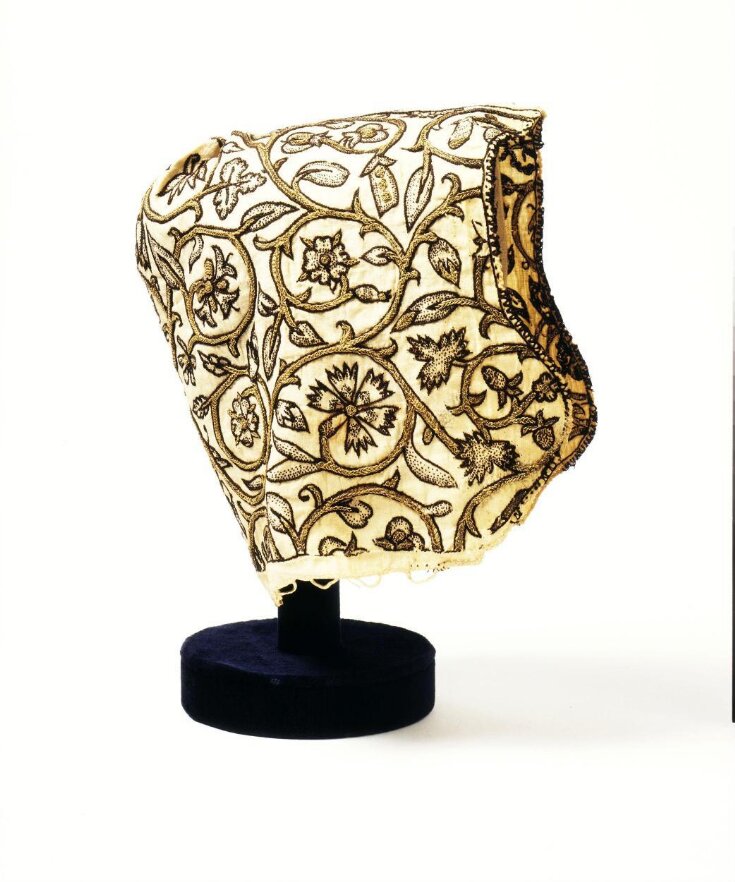
This coif is a fine example of blackwork, a style of needlework popular in England in the late 16th and early 17th centuries. It was worked with a single colour of silk (usually black, but also blue, red or green) on linen, and often highlighted with precious metal threads.
Like a man's nightcap, a woman's coif was informal headwear. It would have been worn by itself indoors, or with a hat on top in public.
Ownership & Use
In Western Europe it was customary for both men and women to cover their heads in public up until the 1960s. A hat was an essential part of respectable dress and, from a health perspective, head coverings were considered necessary to protect against chills and disease. In literature and paintings, to be bareheaded often signified emotional distress or even insanity.
Designs & Designing
This coif is a fine example of blackwork, a style of needlework popular in England in the late 16th and early 17th centuries. It was worked with a single colour of silk (usually black, but also blue, red or green) on linen, and often highlighted with precious metal threads.
Object details
| Categories | |
| Object type | |
| Materials and techniques | Linen, silk and silver-gilt thread |
| Brief description | Woman's coif, England, 1600-1625; linen embroidered with floral motifs in blackwork, silver-gilt scrolls |
| Physical description | Linen embroidered coif with black silk in stem, chain and speckling stitches and with silver-gilt thread in chain, vandyke, plaited braid, and ladder stitches with spider knots. The edges are turned and hemmed with linen thread and over sewn with black silk in open knotted buttonhole stitch. The neck edge is plain for the last half inch and has a series of button holed loops attached to the edge to take the draw-string. The original open-work crown seam has been replaced by a modern seam and the crown is simply gathered to take the fullness. Three and a half horizontal rows of coiling stem which are also linked vertically to produce a tightly-knit over-all pattern. The coils contain (left to right), peas, foxgloves, carnation, columbine, pea, foxglove (part): rose, borage, exotic, honeysuckle, rose; cornflower, strawberry, pear, rose, cornflower, strawberry (last row not clear). |
| Dimensions |
|
| Gallery label | British Galleries:
A woman's coif was informal headwear, but was usually elaborately decorated. This one is a fine example of blackwork. Speckling stitch, a random scattering of stitches, imitated the texture of woodblock prints. Many of the motifs used in embroidery were copied from woodblock-printed emblem books and needlework designs.(27/03/2003) |
| Credit line | Given by Miss Agnus A. Hepburn and Mrs Margaret Owen |
| Object history | Made in England |
| Summary | Object Type Like a man's nightcap, a woman's coif was informal headwear. It would have been worn by itself indoors, or with a hat on top in public. Ownership & Use In Western Europe it was customary for both men and women to cover their heads in public up until the 1960s. A hat was an essential part of respectable dress and, from a health perspective, head coverings were considered necessary to protect against chills and disease. In literature and paintings, to be bareheaded often signified emotional distress or even insanity. Designs & Designing This coif is a fine example of blackwork, a style of needlework popular in England in the late 16th and early 17th centuries. It was worked with a single colour of silk (usually black, but also blue, red or green) on linen, and often highlighted with precious metal threads. |
| Collection | |
| Accession number | T.27-1975 |
About this object record
Explore the Collections contains over a million catalogue records, and over half a million images. It is a working database that includes information compiled over the life of the museum. Some of our records may contain offensive and discriminatory language, or reflect outdated ideas, practice and analysis. We are committed to addressing these issues, and to review and update our records accordingly.
You can write to us to suggest improvements to the record.
Suggest feedback
You can write to us to suggest improvements to the record.
Suggest feedback
| Record created | March 27, 2003 |
| Record URL |
Download as: JSONIIIF Manifest
