
Smock
1615 - 1630 (made)
| Artist/Maker | |
| Place of origin |
Object Type
Smocks were made of linen and usually undecorated, so that they could be washed. A wealthy woman would own several dozens of smocks and wear a clean one each day.
Materials & Making
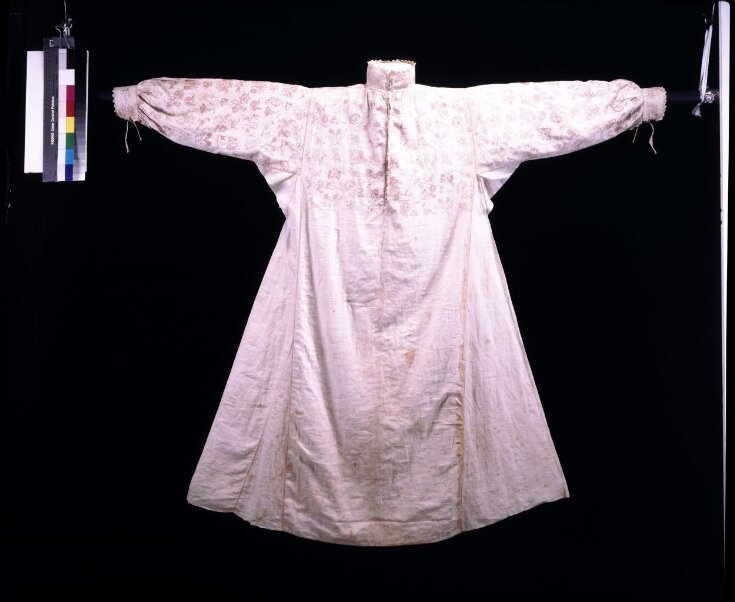
The smock is embroidered with deep carnation pink (now faded) silk thread in stem stitch. The seams were hand-sewn with a very fine needle and equally fine linen thread; the resulting stitches are almost invisible. Around the neck, these seams have been embellished with cross stitch to incorporate them with the rest of the embroidery. The smock is made from a single length of fine linen. All of the pieces, sleeves, collars, cuffs, gussets, are cut in rectangular or square shapes. The gores (the long triangular inserts) are made from rectangles cut in half diagonally. By constructing the smock this way, not a single scrap of linen was wasted.
Designs & Designing
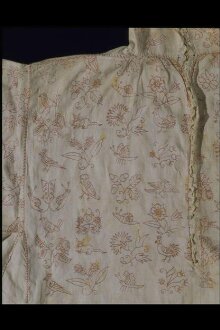
The embroidery features a repeating pattern of flowers, insects and animals, including both real and fantastic creatures. Four motifs were copied from a book called A Schole-House for the Needle by Richard Schorleyker. This was a very popular design book for both embroidery and lacemaking, first published in 1624 and reprinted in 1632.
Smocks were made of linen and usually undecorated, so that they could be washed. A wealthy woman would own several dozens of smocks and wear a clean one each day.
Materials & Making
The smock is embroidered with deep carnation pink (now faded) silk thread in stem stitch. The seams were hand-sewn with a very fine needle and equally fine linen thread; the resulting stitches are almost invisible. Around the neck, these seams have been embellished with cross stitch to incorporate them with the rest of the embroidery. The smock is made from a single length of fine linen. All of the pieces, sleeves, collars, cuffs, gussets, are cut in rectangular or square shapes. The gores (the long triangular inserts) are made from rectangles cut in half diagonally. By constructing the smock this way, not a single scrap of linen was wasted.
Designs & Designing
The embroidery features a repeating pattern of flowers, insects and animals, including both real and fantastic creatures. Four motifs were copied from a book called A Schole-House for the Needle by Richard Schorleyker. This was a very popular design book for both embroidery and lacemaking, first published in 1624 and reprinted in 1632.
Object details
| Categories | |
| Object type | |
| Materials and techniques | Linen, linen thread, silk thread; hand-woven, hand-sewn, hand-embroidered, hand-made bobbin lace. |
| Brief description | A woman's smock, 1615-1630, English; Linen embroidered with red silk in flower, bird motifs, edged with bobbin lace. |
| Physical description | The smock is made of linen with a high neck and collar, long sleeves, triangular gores at the sides. \the cuffs have a worked eyelet on each side and fasten with strips of openworlk tape (possible original). The front to the waist and the sleeves, collar and cuffs are embroidered with red silk in outline stitch showing various animals, birds, flowers, and mythical creatures. The seams joining the sleeves, gussets and side gores are decorated with cross stitch in red silk thread. |
| Dimensions |
|
| Marks and inscriptions | 'Lady Lawrence' (On label sewn to the back on the outside, near hem) |
| Gallery label | British Galleries:
The linen smock was an article of women's underwear similar to a man's shirt. It was one of the few items of clothing that could be washed. Most were undecorated, but this example may be a 'lying-in' smock. After childbirth, a woman rested in bed, receiving her female friends, and required a fancy version of her everyday smock.(27/03/2003) |
| Object history | Purchased from Arditti and Mayorcas, 38 Jermyn Street, London in 1955. |
| Subjects depicted | |
| Summary | Object Type Smocks were made of linen and usually undecorated, so that they could be washed. A wealthy woman would own several dozens of smocks and wear a clean one each day. Materials & Making The smock is embroidered with deep carnation pink (now faded) silk thread in stem stitch. The seams were hand-sewn with a very fine needle and equally fine linen thread; the resulting stitches are almost invisible. Around the neck, these seams have been embellished with cross stitch to incorporate them with the rest of the embroidery. The smock is made from a single length of fine linen. All of the pieces, sleeves, collars, cuffs, gussets, are cut in rectangular or square shapes. The gores (the long triangular inserts) are made from rectangles cut in half diagonally. By constructing the smock this way, not a single scrap of linen was wasted. Designs & Designing The embroidery features a repeating pattern of flowers, insects and animals, including both real and fantastic creatures. Four motifs were copied from a book called A Schole-House for the Needle by Richard Schorleyker. This was a very popular design book for both embroidery and lacemaking, first published in 1624 and reprinted in 1632. |
| Bibliographic reference | Janet Arnold, Jenny Tiramani & Santina M Levey, Patterns of Fashion 4: the cut and construction of linen shirts, smocks, neckwear, headwear and accessories for men and women c.1540-1660, London: Macmillan, 2008, pp.59, 116 |
| Collection | |
| Accession number | T.2-1956 |
About this object record
Explore the Collections contains over a million catalogue records, and over half a million images. It is a working database that includes information compiled over the life of the museum. Some of our records may contain offensive and discriminatory language, or reflect outdated ideas, practice and analysis. We are committed to addressing these issues, and to review and update our records accordingly.
You can write to us to suggest improvements to the record.
Suggest feedback
You can write to us to suggest improvements to the record.
Suggest feedback
| Record created | March 27, 2003 |
| Record URL |
Download as: JSONIIIF Manifest
