Tie
1897 (made)
| Artist/Maker | |
| Place of origin |
Object Type
The necktie was an essential part of a Victorian gentleman's dress. The variety of styles and colours must have offered some relief from the dark tones then fashionable for men's suits. In March 1895 the Tailor and Cutter referred to ties and scarves as being the 'saving touch from the monotony of sombreness ... Bows, scarves and ties seem to get more and more varied, and, in the majority of styles prettier and more artistic.'
Design & Designing
The high collars fashionable in the late 19th century often made it difficult to keep the neckband of the tie in place. The invention of tie clips and frames helped to solve this problem.
Time
During second half of the 19th century four distinct styles of necktie evolved. They were given a great many different names, which can be confusing. The main categories were: (i) bow tie; (ii) scarf or neckerchief; (iii) Ascot; and (iv) four-in-hand, or sailor's knot, generally referred to as the 'long tie'.
The necktie was an essential part of a Victorian gentleman's dress. The variety of styles and colours must have offered some relief from the dark tones then fashionable for men's suits. In March 1895 the Tailor and Cutter referred to ties and scarves as being the 'saving touch from the monotony of sombreness ... Bows, scarves and ties seem to get more and more varied, and, in the majority of styles prettier and more artistic.'
Design & Designing
The high collars fashionable in the late 19th century often made it difficult to keep the neckband of the tie in place. The invention of tie clips and frames helped to solve this problem.
Time
During second half of the 19th century four distinct styles of necktie evolved. They were given a great many different names, which can be confusing. The main categories were: (i) bow tie; (ii) scarf or neckerchief; (iii) Ascot; and (iv) four-in-hand, or sailor's knot, generally referred to as the 'long tie'.
Object details
| Categories | |
| Object type | |
| Materials and techniques | Woven silk, hand-sewn |
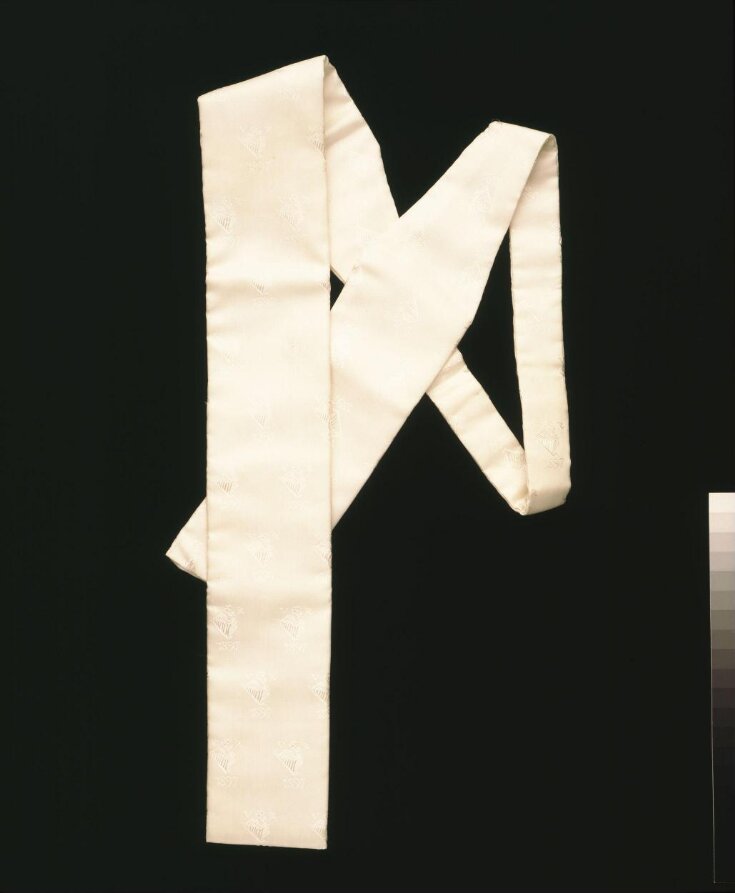
| Brief description | Silk tie, John Barker & Co., Ltd., Kensington and Chelsea, 1897 |
| Physical description | Tie of woven white silk with an over-all pattern of crowned griffons in profile flanked by 'VR' and surmounted by '1897' for Queen Victoria's Golden Jubilee. Slightly padded and is shaped to expand to two long squared off ends, one longer than the other. Stitched inside the neck is a printed label. |
| Dimensions |
|
| Marks and inscriptions | 'JOHN BARKER & CO. LTD., Hosiers & Shirt Makers Kensington' (Printed on a label stitched inside the neck) |
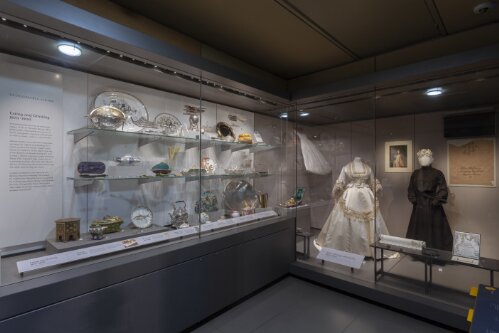
| Gallery label | British Galleries:
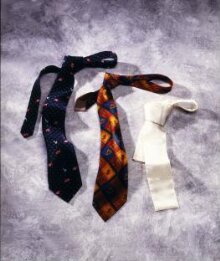
TIES Ties came in a variety of colours and styles and were still known as cravats. Some were tied by hand while others were ready-made into knots. Ready-mades had a cardboard stiffener to keep the knot in place. They were fastened around the neck with a buckle, catch or piece of elastic.(27/03/2003) |
| Credit line | Given by Dame Kathleen Courtney DBE |
| Object history | Made by John Barker & Co. Ltd., Hosiers and Shirtmakers, Kensington, London |
| Summary | Object Type The necktie was an essential part of a Victorian gentleman's dress. The variety of styles and colours must have offered some relief from the dark tones then fashionable for men's suits. In March 1895 the Tailor and Cutter referred to ties and scarves as being the 'saving touch from the monotony of sombreness ... Bows, scarves and ties seem to get more and more varied, and, in the majority of styles prettier and more artistic.' Design & Designing The high collars fashionable in the late 19th century often made it difficult to keep the neckband of the tie in place. The invention of tie clips and frames helped to solve this problem. Time During second half of the 19th century four distinct styles of necktie evolved. They were given a great many different names, which can be confusing. The main categories were: (i) bow tie; (ii) scarf or neckerchief; (iii) Ascot; and (iv) four-in-hand, or sailor's knot, generally referred to as the 'long tie'. |
| Collection | |
| Accession number | T.195-1964 |
About this object record
Explore the Collections contains over a million catalogue records, and over half a million images. It is a working database that includes information compiled over the life of the museum. Some of our records may contain offensive and discriminatory language, or reflect outdated ideas, practice and analysis. We are committed to addressing these issues, and to review and update our records accordingly.
You can write to us to suggest improvements to the record.
Suggest feedback
You can write to us to suggest improvements to the record.
Suggest feedback
| Record created | March 27, 2003 |
| Record URL |
Download as: JSONIIIF Manifest
