Dress Fabric
1760-1765 (made)
| Artist/Maker | |
| Place of origin |
Object Type
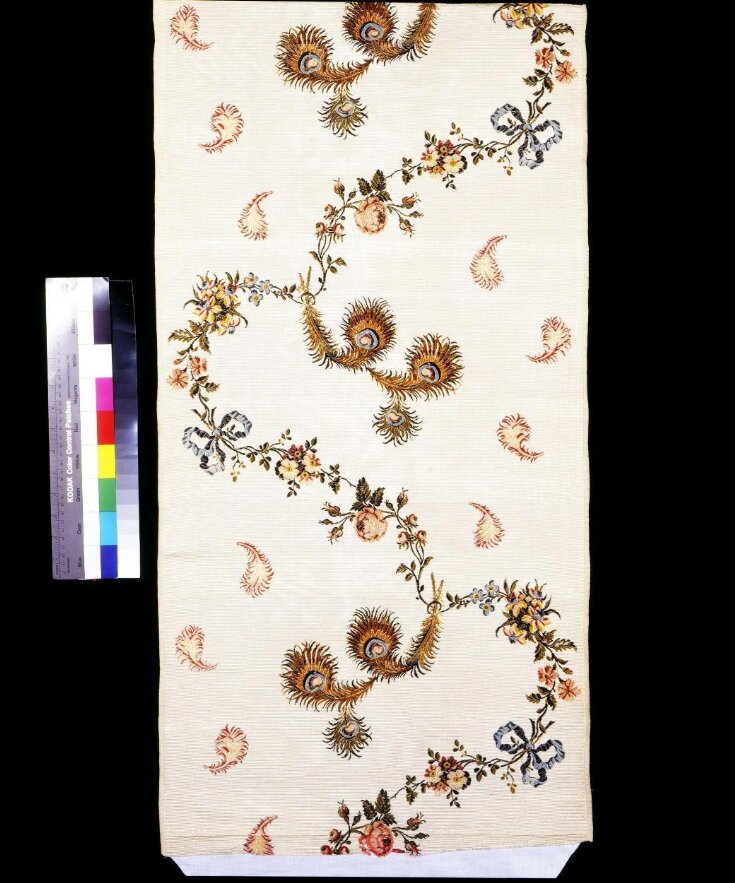
This fabric is a brocaded silk tobine and was intended for ladies' gowns. The technique of brocading allowed different colours to be introduced into the pattern of a fabric in specific, sometimes very small areas. It was a more laborious process for the weaver than using patterning wefts running from selvedge to selvedge, but the resulting effect could be much more varied and lively. The additional effect which makes this silk a tobine is the ribbed ground, created with an extra warp which in some fabrics makes a pattern in a contrasting colour but in this case is the same colour as the ground.
Design & Designing
In the article on silk designing from a contemporary handbook to art and manufacture, George Smith's 'Laboratory or School of Arts', the author recommends that pattern drawers should take advantage of the seasonal variety offered by nature. 'Every season of the year produces .... plants, flowers and shrubs, as afford greater varieties than we are able to imitate'. The naturalistic drawing of the flowers in this dress fabric illustrates this characteristic of English silks well. But the anonymous designer has taken the idea of naturalism further with a scattering of feathers whose brocaded texture allows them to appear as if floating over the surface of the silk.
This fabric is a brocaded silk tobine and was intended for ladies' gowns. The technique of brocading allowed different colours to be introduced into the pattern of a fabric in specific, sometimes very small areas. It was a more laborious process for the weaver than using patterning wefts running from selvedge to selvedge, but the resulting effect could be much more varied and lively. The additional effect which makes this silk a tobine is the ribbed ground, created with an extra warp which in some fabrics makes a pattern in a contrasting colour but in this case is the same colour as the ground.
Design & Designing
In the article on silk designing from a contemporary handbook to art and manufacture, George Smith's 'Laboratory or School of Arts', the author recommends that pattern drawers should take advantage of the seasonal variety offered by nature. 'Every season of the year produces .... plants, flowers and shrubs, as afford greater varieties than we are able to imitate'. The naturalistic drawing of the flowers in this dress fabric illustrates this characteristic of English silks well. But the anonymous designer has taken the idea of naturalism further with a scattering of feathers whose brocaded texture allows them to appear as if floating over the surface of the silk.
Object details
| Categories | |
| Object type | |
| Materials and techniques | Brocaded silk tobine |
| Brief description | brocaded silk, 1750-1799, English; Spitalfields |
| Physical description | Piece of silk for clothing use |
| Dimensions |
|
| Gallery label | British Galleries:
The peacock feathers here are typical of the fashion taste in the 1760s for fake three-dimensional trimmings, like fur and ribbons, woven into the pattern of the silk. The individual feathers are part of the repeating pattern, but the design skilfully places them in different directions as if randomly floating over the surface of the silk.(27/03/2003) |
| Credit line | Given by W. L. Collins |
| Object history | Woven in Spitalfields, London |
| Summary | Object Type This fabric is a brocaded silk tobine and was intended for ladies' gowns. The technique of brocading allowed different colours to be introduced into the pattern of a fabric in specific, sometimes very small areas. It was a more laborious process for the weaver than using patterning wefts running from selvedge to selvedge, but the resulting effect could be much more varied and lively. The additional effect which makes this silk a tobine is the ribbed ground, created with an extra warp which in some fabrics makes a pattern in a contrasting colour but in this case is the same colour as the ground. Design & Designing In the article on silk designing from a contemporary handbook to art and manufacture, George Smith's 'Laboratory or School of Arts', the author recommends that pattern drawers should take advantage of the seasonal variety offered by nature. 'Every season of the year produces .... plants, flowers and shrubs, as afford greater varieties than we are able to imitate'. The naturalistic drawing of the flowers in this dress fabric illustrates this characteristic of English silks well. But the anonymous designer has taken the idea of naturalism further with a scattering of feathers whose brocaded texture allows them to appear as if floating over the surface of the silk. |
| Collection | |
| Accession number | T.188-1922 |
About this object record
Explore the Collections contains over a million catalogue records, and over half a million images. It is a working database that includes information compiled over the life of the museum. Some of our records may contain offensive and discriminatory language, or reflect outdated ideas, practice and analysis. We are committed to addressing these issues, and to review and update our records accordingly.
You can write to us to suggest improvements to the record.
Suggest feedback
You can write to us to suggest improvements to the record.
Suggest feedback
| Record created | March 27, 2003 |
| Record URL |
Download as: JSONIIIF Manifest
