
Shawl
1851-1855 (made)
| Artist/Maker | |
| Place of origin |
Object Type
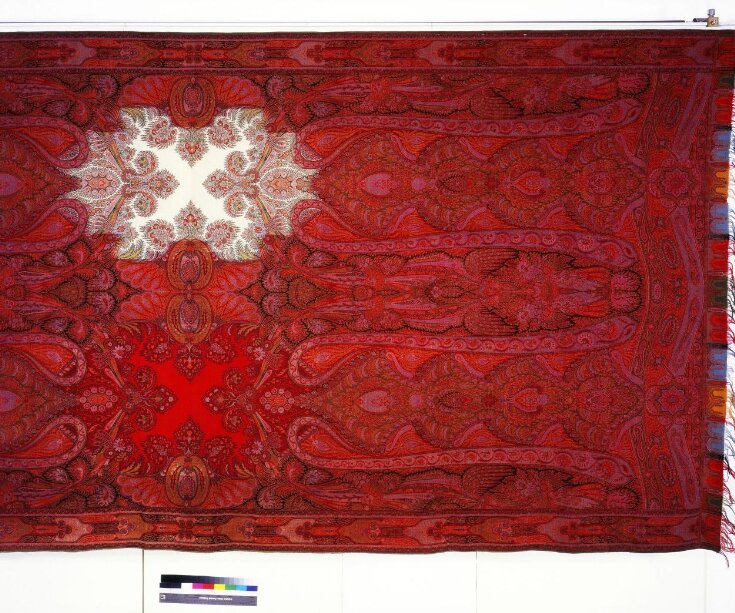
Shawls tended to be very large in the 1850s, mainly because they were worn over wide crinoline skirts (skirts supported by a cage-like structure). Shawls like this one, produced in large quantities on a jacquard loom, were generally cheaper than the Indian shawls, which were hand-woven using a more time-consuming technique. By the 1850s the kashmir shawl industry in India was largely controlled by European agents who brought their own pattern books for the local shawl weavers to copy.
Design & Designing
Paisley in Scotland was one of the first shawl manufacturing centres in Britain to attempt exact reproductions of kashmir patterns in the early 19th century. By the 1850s the industry in Paisley was looking to France as well as India for inspiration. This was largely due to the introduction of the jacquard loom from France, which was in general use in Paisley by 1845. The use of this type of loom meant that more elaborate designs could be produced at a faster rate.
Ownership & Use
This is a two-colour shawl, which could be worn with either a white or red corner folded over and showing at the back. This gave the impression that the wearer owned two different shawls. Sometimes shawls were four-coloured, with each corner decorated with a different pattern in the middle.
Shawls tended to be very large in the 1850s, mainly because they were worn over wide crinoline skirts (skirts supported by a cage-like structure). Shawls like this one, produced in large quantities on a jacquard loom, were generally cheaper than the Indian shawls, which were hand-woven using a more time-consuming technique. By the 1850s the kashmir shawl industry in India was largely controlled by European agents who brought their own pattern books for the local shawl weavers to copy.
Design & Designing
Paisley in Scotland was one of the first shawl manufacturing centres in Britain to attempt exact reproductions of kashmir patterns in the early 19th century. By the 1850s the industry in Paisley was looking to France as well as India for inspiration. This was largely due to the introduction of the jacquard loom from France, which was in general use in Paisley by 1845. The use of this type of loom meant that more elaborate designs could be produced at a faster rate.
Ownership & Use
This is a two-colour shawl, which could be worn with either a white or red corner folded over and showing at the back. This gave the impression that the wearer owned two different shawls. Sometimes shawls were four-coloured, with each corner decorated with a different pattern in the middle.
Object details
| Categories | |
| Object type | |
| Materials and techniques | Woven wool on a jacquard loom |
| Brief description | Woven shawl, Paisley, Great Britain, 1851-1855. |
| Physical description | Woven shawl with red and white centre. |
| Dimensions |
|
| Gallery label | British Galleries:
Shawls based on Indian designs were very fashionable in Britain by the 1850s. They combined both Indian and French influences. The elongated pine cone forms and the coloured end pieces were based on Indian patterns. The complex all-over pattern and floral motifs were distinctly European. Many of the colours, particularly the burgundy, would not have been used on a true Indian shawl.(27/03/2003) |
| Credit line | Bequeathed by Miss D. B. Simpson |
| Object history | Probably made in Paisley, Renfrewshire |
| Summary | Object Type Shawls tended to be very large in the 1850s, mainly because they were worn over wide crinoline skirts (skirts supported by a cage-like structure). Shawls like this one, produced in large quantities on a jacquard loom, were generally cheaper than the Indian shawls, which were hand-woven using a more time-consuming technique. By the 1850s the kashmir shawl industry in India was largely controlled by European agents who brought their own pattern books for the local shawl weavers to copy. Design & Designing Paisley in Scotland was one of the first shawl manufacturing centres in Britain to attempt exact reproductions of kashmir patterns in the early 19th century. By the 1850s the industry in Paisley was looking to France as well as India for inspiration. This was largely due to the introduction of the jacquard loom from France, which was in general use in Paisley by 1845. The use of this type of loom meant that more elaborate designs could be produced at a faster rate. Ownership & Use This is a two-colour shawl, which could be worn with either a white or red corner folded over and showing at the back. This gave the impression that the wearer owned two different shawls. Sometimes shawls were four-coloured, with each corner decorated with a different pattern in the middle. |
| Collection | |
| Accession number | T.111-1977 |
About this object record
Explore the Collections contains over a million catalogue records, and over half a million images. It is a working database that includes information compiled over the life of the museum. Some of our records may contain offensive and discriminatory language, or reflect outdated ideas, practice and analysis. We are committed to addressing these issues, and to review and update our records accordingly.
You can write to us to suggest improvements to the record.
Suggest feedback
You can write to us to suggest improvements to the record.
Suggest feedback
| Record created | March 27, 2003 |
| Record URL |
Download as: JSONIIIF Manifest
