Panel
1600-1620 (made)
| Artist/Maker | |
| Place of origin |
Object Type
Small furnishing panels such as this one were popular throughout the 17th century and were used to add colour and warmth to what could otherwise be rather bare rooms. Inventories from the early 17th century show that stools, benches and chairs were wooden, usually oak, and so thick textile panels that could be used for loose cushions or as fixed upholstery would have made the user more comfortable.
Materials & Making
The English were quick to adapt the technique of carpet-knotting, which they learned from the Turks, to their own local artistic traditions and needs. In a pile fabric, such as this panel, the foundation consists of two sets of threads, warp and weft, which interlace at right angles. The pile is created by tying a knot of coloured thread around two adjacent warp threads, building up the design row by row while the foundation is woven by the insertion of weft thread across the warp threads after each row of knots is completed. It requires only a small, simple loom and is easily done by hand. In this panel there are 1,024 knots per square decimetre.
Subjects Depicted
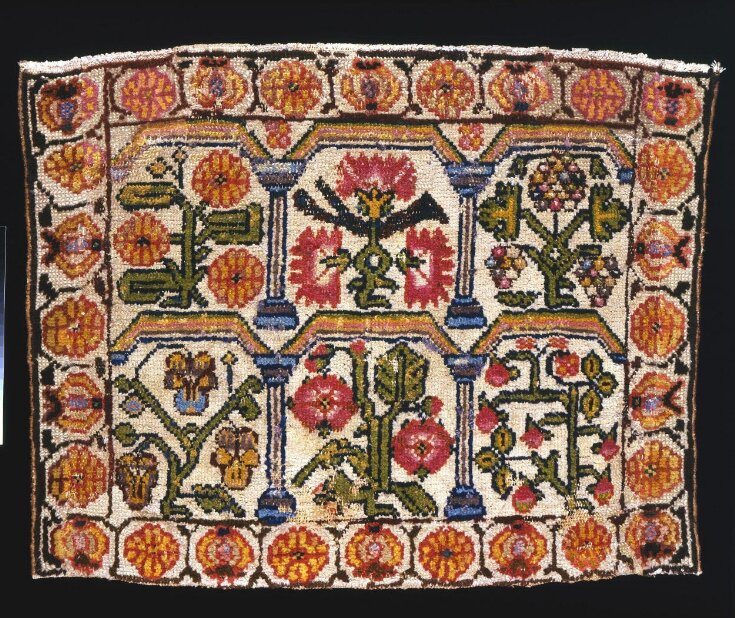
The flowers depicted within the architectural arches are those commonly found in English gardens of the period: marigolds, carnations, a grape-vine, pansies, roses and a strawberry plant.
Small furnishing panels such as this one were popular throughout the 17th century and were used to add colour and warmth to what could otherwise be rather bare rooms. Inventories from the early 17th century show that stools, benches and chairs were wooden, usually oak, and so thick textile panels that could be used for loose cushions or as fixed upholstery would have made the user more comfortable.
Materials & Making
The English were quick to adapt the technique of carpet-knotting, which they learned from the Turks, to their own local artistic traditions and needs. In a pile fabric, such as this panel, the foundation consists of two sets of threads, warp and weft, which interlace at right angles. The pile is created by tying a knot of coloured thread around two adjacent warp threads, building up the design row by row while the foundation is woven by the insertion of weft thread across the warp threads after each row of knots is completed. It requires only a small, simple loom and is easily done by hand. In this panel there are 1,024 knots per square decimetre.
Subjects Depicted
The flowers depicted within the architectural arches are those commonly found in English gardens of the period: marigolds, carnations, a grape-vine, pansies, roses and a strawberry plant.
Object details
| Categories | |
| Object type | |
| Materials and techniques | Hand knotted woollen pile on hemp warp and weft; the sides rewoven |
| Brief description | knotted wool pile, 1600-1629, English; Turkeywork |
| Physical description | Turkeywork panel |
| Dimensions |
|
| Gallery label | British Galleries:
The term 'turkeywork' refers to knotted carpets made in England which imitated imported Turkish carpets. Smaller turkeywork panels were used to cover chair seats and backs, and make cushion covers. This piece uses motifs of native English garden flowers, perhaps adapted from existing patterns for floral embroidery.(27/03/2003) |
| Object history | Made in England |
| Summary | Object Type Small furnishing panels such as this one were popular throughout the 17th century and were used to add colour and warmth to what could otherwise be rather bare rooms. Inventories from the early 17th century show that stools, benches and chairs were wooden, usually oak, and so thick textile panels that could be used for loose cushions or as fixed upholstery would have made the user more comfortable. Materials & Making The English were quick to adapt the technique of carpet-knotting, which they learned from the Turks, to their own local artistic traditions and needs. In a pile fabric, such as this panel, the foundation consists of two sets of threads, warp and weft, which interlace at right angles. The pile is created by tying a knot of coloured thread around two adjacent warp threads, building up the design row by row while the foundation is woven by the insertion of weft thread across the warp threads after each row of knots is completed. It requires only a small, simple loom and is easily done by hand. In this panel there are 1,024 knots per square decimetre. Subjects Depicted The flowers depicted within the architectural arches are those commonly found in English gardens of the period: marigolds, carnations, a grape-vine, pansies, roses and a strawberry plant. |
| Collection | |
| Accession number | T.101-1928 |
About this object record
Explore the Collections contains over a million catalogue records, and over half a million images. It is a working database that includes information compiled over the life of the museum. Some of our records may contain offensive and discriminatory language, or reflect outdated ideas, practice and analysis. We are committed to addressing these issues, and to review and update our records accordingly.
You can write to us to suggest improvements to the record.
Suggest feedback
You can write to us to suggest improvements to the record.
Suggest feedback
| Record created | March 27, 2003 |
| Record URL |
Download as: JSONIIIF Manifest
