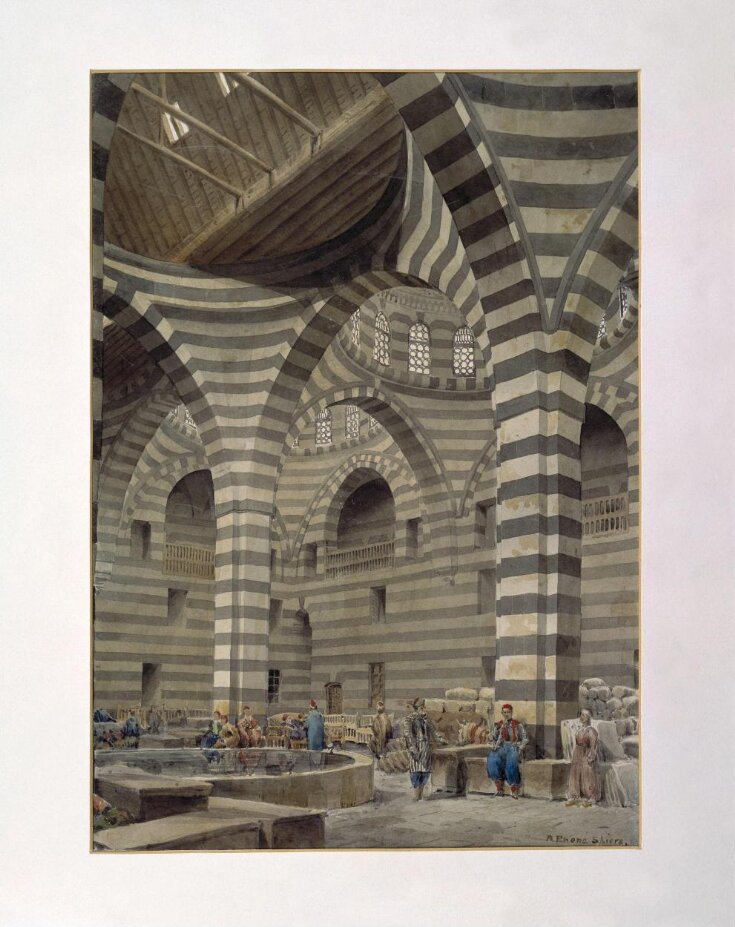

The Great Khan, Damascus
Watercolour
1865-1866 (made)
1865-1866 (made)
| Artist/Maker | |
| Place of origin |
Object Type
Paintings illustrating the treatment of exotic interiors became more frequent in the 19th century. In the search for ideas for a new building style British architects studied architecture outside Europe. These traditional forms were also threatened with obliteration by `the march of progress', and drawings had to be made to record them before they were destroyed.
People
Spiers was an architect better-known for his teaching and writing on the subject than as a practitioner. In 1865-1866 he toured the Middle East on a travelling scholarship from the Royal Academy. On his return he exhibited several pictures with Eastern subjects at the Royal Academy of which this was probably one. His aim was to encourage British architects to adopt or be inspired by the very different traditions of architectural practice to be found within Islam.
Subjects Depicted
In 1751 the Governor of Damascus, Assad Pasha al-Azam, commissioned the construction of this khan or secure place for merchants to stay, store and sell their goods. It was completed in 1753. The alternate colours of the bands of stone are good examples of polychrome or multicoloured architecture. Spiers wanted this type of building technique imitated in Britain.
Paintings illustrating the treatment of exotic interiors became more frequent in the 19th century. In the search for ideas for a new building style British architects studied architecture outside Europe. These traditional forms were also threatened with obliteration by `the march of progress', and drawings had to be made to record them before they were destroyed.
People
Spiers was an architect better-known for his teaching and writing on the subject than as a practitioner. In 1865-1866 he toured the Middle East on a travelling scholarship from the Royal Academy. On his return he exhibited several pictures with Eastern subjects at the Royal Academy of which this was probably one. His aim was to encourage British architects to adopt or be inspired by the very different traditions of architectural practice to be found within Islam.
Subjects Depicted
In 1751 the Governor of Damascus, Assad Pasha al-Azam, commissioned the construction of this khan or secure place for merchants to stay, store and sell their goods. It was completed in 1753. The alternate colours of the bands of stone are good examples of polychrome or multicoloured architecture. Spiers wanted this type of building technique imitated in Britain.
Object details
| Categories | |
| Object type | |
| Title | The Great Khan, Damascus (assigned by artist) |
| Materials and techniques | Watercolour over pencil, stuck down on card |
| Brief description | Watercolour, `The Great Khan, Damascus', 1865-1866, by Richard Phené Spiers FRIBA FSA |
| Physical description | Watercolour drawing |
| Dimensions |
|
| Marks and inscriptions | Signed R.Phené Spiers.; lettered with title and name of artist on former mount |
| Gallery label | British Galleries:
The artist Richard Phen‚ Spiers toured the Eastern Mediterranean region from 1865 to 1866 to study both ancient and contemporary Islamic architecture. This painting is a carefully-observed study of the architecture of a 16th-century building. Spiers then exhibited his paintings in the hope of inspiring British architects.(27/03/2003) |
| Credit line | Purchased with the assistance of the National Heritage Memorial Fund, Art Fund, Shell International and the Friends of the V&A |
| Object history | According to Rodney Searight: - `Bt Christie's, [2] Nov.1979 [(191)], via Fine Art Society, £110+'. |
| Historical context | The artist exhibited `Great Khan at Damascus' at the RA in 1867 (911). |
| Subject depicted | |
| Places depicted | |
| Summary | Object Type Paintings illustrating the treatment of exotic interiors became more frequent in the 19th century. In the search for ideas for a new building style British architects studied architecture outside Europe. These traditional forms were also threatened with obliteration by `the march of progress', and drawings had to be made to record them before they were destroyed. People Spiers was an architect better-known for his teaching and writing on the subject than as a practitioner. In 1865-1866 he toured the Middle East on a travelling scholarship from the Royal Academy. On his return he exhibited several pictures with Eastern subjects at the Royal Academy of which this was probably one. His aim was to encourage British architects to adopt or be inspired by the very different traditions of architectural practice to be found within Islam. Subjects Depicted In 1751 the Governor of Damascus, Assad Pasha al-Azam, commissioned the construction of this khan or secure place for merchants to stay, store and sell their goods. It was completed in 1753. The alternate colours of the bands of stone are good examples of polychrome or multicoloured architecture. Spiers wanted this type of building technique imitated in Britain. |
| Bibliographic references |
|
| Collection | |
| Accession number | SD.997 |
About this object record
Explore the Collections contains over a million catalogue records, and over half a million images. It is a working database that includes information compiled over the life of the museum. Some of our records may contain offensive and discriminatory language, or reflect outdated ideas, practice and analysis. We are committed to addressing these issues, and to review and update our records accordingly.
You can write to us to suggest improvements to the record.
Suggest feedback
You can write to us to suggest improvements to the record.
Suggest feedback
| Record created | March 27, 2003 |
| Record URL |
Download as: JSONIIIF Manifest
