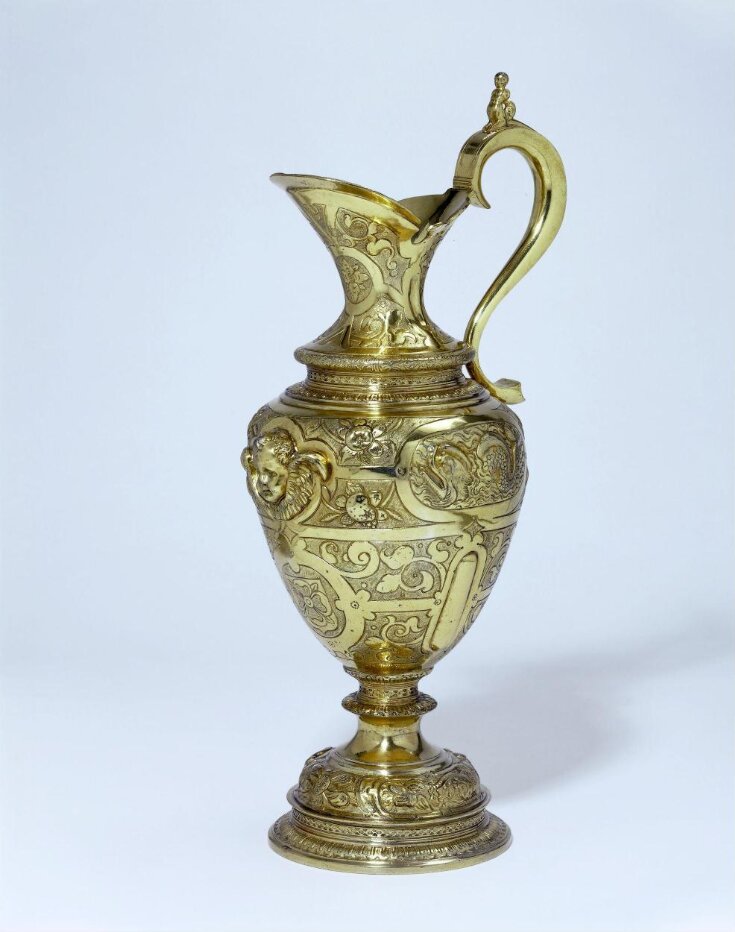

Ewer
1888 (made)
| Artist/Maker | |
| Place of origin |
Object Type
This electrotype ewer is a copy of a silver-gilt example of 1595. In the 16th and early 17th centuries, ewers and basins would be filled with sweet-scented water and ceremonially offered to guests during and after dining, for washing their hands.
Ownership & Use
Such vessels would also have played a prominent role on the sideboard or 'buffet', often being the largest items and frequently gilded and decorated in the latest fashion. The buffet display was designed to impress guests with the wealth and sophistication of the host. It is not surprising that ewers and basins became the standard diplomatic gift in Europe.
Materials & Making
The technique of reproducing objects by electrotyping was first developed by the manufacturing firm of Elkington & Co. of Birmingham in the 1840s. Henry Cole (1808-82), the first director of the South Kensington Museum (now the V&A), was quick to adopt this new technique to reproduce works of art. A plaster mould is made from an original object and used to make a cast in base metal. The model and an amount of plating metal are connected to electric terminals and placed in a container filled with a conductive solution. As it passes through, the electric current causes particles of the plating metal to be deposited on the surface of the model. The thickness of the plating can be regulated by the duration and voltage of the current. The plated object is then worked manually to erase imperfections.
This electrotype ewer is a copy of a silver-gilt example of 1595. In the 16th and early 17th centuries, ewers and basins would be filled with sweet-scented water and ceremonially offered to guests during and after dining, for washing their hands.
Ownership & Use
Such vessels would also have played a prominent role on the sideboard or 'buffet', often being the largest items and frequently gilded and decorated in the latest fashion. The buffet display was designed to impress guests with the wealth and sophistication of the host. It is not surprising that ewers and basins became the standard diplomatic gift in Europe.
Materials & Making
The technique of reproducing objects by electrotyping was first developed by the manufacturing firm of Elkington & Co. of Birmingham in the 1840s. Henry Cole (1808-82), the first director of the South Kensington Museum (now the V&A), was quick to adopt this new technique to reproduce works of art. A plaster mould is made from an original object and used to make a cast in base metal. The model and an amount of plating metal are connected to electric terminals and placed in a container filled with a conductive solution. As it passes through, the electric current causes particles of the plating metal to be deposited on the surface of the model. The thickness of the plating can be regulated by the duration and voltage of the current. The plated object is then worked manually to erase imperfections.
Object details
| Categories | |
| Object type | |
| Materials and techniques | Electrotype copy of silver-gilt original |
| Brief description | Ewer |
| Dimensions |
|
| Gallery label | British Galleries:
ELECTROPLATE COPIES OF TUDOR SILVER The custom of melting down silver to remake it in newly-fashionable forms means that few pieces have survived from the 16th or early 17th centuries. These pieces are copies, made between 1868 and 1888 of the kinds of silver that might have been displayed on a court cupboard in about 1620.(27/03/2003) |
| Object history | Original ewer (and a companion basin) presented to the Corporation of by the executors of Robert Kitchen, formerly mayor of Bristol, in his memory; made in London by John Brodie, 1595-6 Made by Elkington & Co., Birmingham |
| Production | After original of 1595. Original ewer (and a companion basin) presented to the Corporation of by the executors of Robert Kitchen, formerly mayor of Bristol, in his memory; made in London by John Brodie, 1595-6 Made by Elkington & Co., Birmingham. |
| Summary | Object Type This electrotype ewer is a copy of a silver-gilt example of 1595. In the 16th and early 17th centuries, ewers and basins would be filled with sweet-scented water and ceremonially offered to guests during and after dining, for washing their hands. Ownership & Use Such vessels would also have played a prominent role on the sideboard or 'buffet', often being the largest items and frequently gilded and decorated in the latest fashion. The buffet display was designed to impress guests with the wealth and sophistication of the host. It is not surprising that ewers and basins became the standard diplomatic gift in Europe. Materials & Making The technique of reproducing objects by electrotyping was first developed by the manufacturing firm of Elkington & Co. of Birmingham in the 1840s. Henry Cole (1808-82), the first director of the South Kensington Museum (now the V&A), was quick to adopt this new technique to reproduce works of art. A plaster mould is made from an original object and used to make a cast in base metal. The model and an amount of plating metal are connected to electric terminals and placed in a container filled with a conductive solution. As it passes through, the electric current causes particles of the plating metal to be deposited on the surface of the model. The thickness of the plating can be regulated by the duration and voltage of the current. The plated object is then worked manually to erase imperfections. |
| Collection | |
| Accession number | REPRO.1888C-632 |
About this object record
Explore the Collections contains over a million catalogue records, and over half a million images. It is a working database that includes information compiled over the life of the museum. Some of our records may contain offensive and discriminatory language, or reflect outdated ideas, practice and analysis. We are committed to addressing these issues, and to review and update our records accordingly.
You can write to us to suggest improvements to the record.
Suggest feedback
You can write to us to suggest improvements to the record.
Suggest feedback
| Record created | March 27, 2003 |
| Record URL |
Download as: JSONIIIF Manifest
