Relief
ca. 1851 (made)
| Artist/Maker | |
| Place of origin |
Object Type
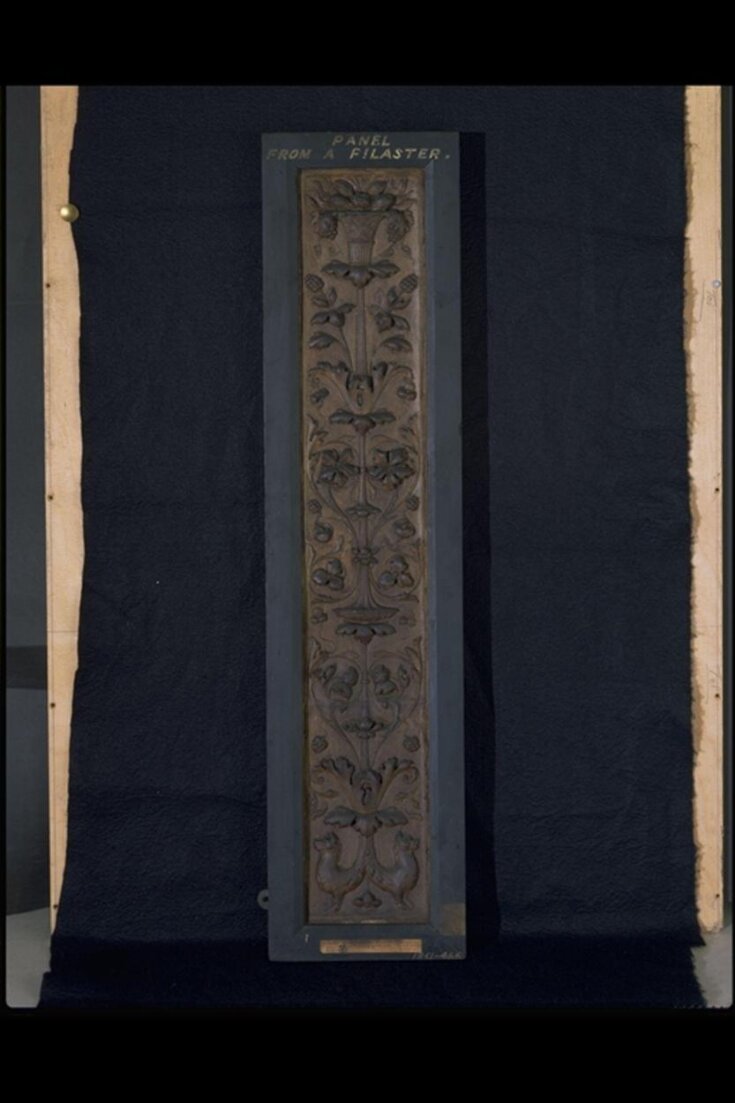
This plaster cast was one of many made primarily to educate students and craftsmen, and was one of the earliest acquisitions of the Museum. It is taken from the 15th-century church of Santa Maria dei Miracoli in Venice, which was highly regarded by Ruskin, and considered by many to be one of the most important examples of early Renaissance Venetian architecture.
Materials & Making
Plaster casts were the most common three-dimensional reproductions of architectural details and sculpture, and were produced in great numbers during the 19th century in particular. The wet plaster of Paris (ground alabaster mixed with water) was poured into a mould, and then left to set. Often moulds of a complicated original were made in more than one piece (known as piece-moulds), and the resulting casts joined together with more wet plaster after they had been released from the moulds.
Places
Works of art from Italy (especially Venice, Florence and Rome) were and still are among the most sought-after and most studied examples in Europe and America. Many casts were acquired by the Museum from Italy; at first these were shown alongside original objects (objects which were not reproductions). From the early 1870s onwards plaster casts were displayed in the large galleries known as the Architectural Courts (now known as the Cast Courts). Here they were seen during the 19th century in the company of architectural models, drawings, other items of sculpture and architectural fragments.
This plaster cast was one of many made primarily to educate students and craftsmen, and was one of the earliest acquisitions of the Museum. It is taken from the 15th-century church of Santa Maria dei Miracoli in Venice, which was highly regarded by Ruskin, and considered by many to be one of the most important examples of early Renaissance Venetian architecture.
Materials & Making
Plaster casts were the most common three-dimensional reproductions of architectural details and sculpture, and were produced in great numbers during the 19th century in particular. The wet plaster of Paris (ground alabaster mixed with water) was poured into a mould, and then left to set. Often moulds of a complicated original were made in more than one piece (known as piece-moulds), and the resulting casts joined together with more wet plaster after they had been released from the moulds.
Places
Works of art from Italy (especially Venice, Florence and Rome) were and still are among the most sought-after and most studied examples in Europe and America. Many casts were acquired by the Museum from Italy; at first these were shown alongside original objects (objects which were not reproductions). From the early 1870s onwards plaster casts were displayed in the large galleries known as the Architectural Courts (now known as the Cast Courts). Here they were seen during the 19th century in the company of architectural models, drawings, other items of sculpture and architectural fragments.
Object details
| Categories | |
| Object type | |
| Materials and techniques | Plaster cast |
| Brief description | Plaster cast from Architectural component of Santa Maria de'Miracoli, Venice, 15th Century |
| Dimensions |
|
| Gallery label | British Galleries:
Architectural ornament was considered an essential part of a student's design education. The Schools of Design collected both original examples and casts of ornament for students to draw. This cast was taken from an early Renaissance church in Venice.(27/03/2003) |
| Object history | Cast from a panel possibly from the church of Sta Maria dei Miracoli, Venice, Italy |
| Production | Cast from a 15th-century original |
| Summary | Object Type This plaster cast was one of many made primarily to educate students and craftsmen, and was one of the earliest acquisitions of the Museum. It is taken from the 15th-century church of Santa Maria dei Miracoli in Venice, which was highly regarded by Ruskin, and considered by many to be one of the most important examples of early Renaissance Venetian architecture. Materials & Making Plaster casts were the most common three-dimensional reproductions of architectural details and sculpture, and were produced in great numbers during the 19th century in particular. The wet plaster of Paris (ground alabaster mixed with water) was poured into a mould, and then left to set. Often moulds of a complicated original were made in more than one piece (known as piece-moulds), and the resulting casts joined together with more wet plaster after they had been released from the moulds. Places Works of art from Italy (especially Venice, Florence and Rome) were and still are among the most sought-after and most studied examples in Europe and America. Many casts were acquired by the Museum from Italy; at first these were shown alongside original objects (objects which were not reproductions). From the early 1870s onwards plaster casts were displayed in the large galleries known as the Architectural Courts (now known as the Cast Courts). Here they were seen during the 19th century in the company of architectural models, drawings, other items of sculpture and architectural fragments. |
| Bibliographic references |
|
| Collection | |
| Accession number | REPRO.1851-466 |
About this object record
Explore the Collections contains over a million catalogue records, and over half a million images. It is a working database that includes information compiled over the life of the museum. Some of our records may contain offensive and discriminatory language, or reflect outdated ideas, practice and analysis. We are committed to addressing these issues, and to review and update our records accordingly.
You can write to us to suggest improvements to the record.
Suggest feedback
You can write to us to suggest improvements to the record.
Suggest feedback
| Record created | March 27, 2003 |
| Record URL |
Download as: JSONIIIF Manifest
