
Elizabeth I
Design
ca. 1585 (made)
ca. 1585 (made)
| Artist/Maker | |
| Place of origin |
Object Type
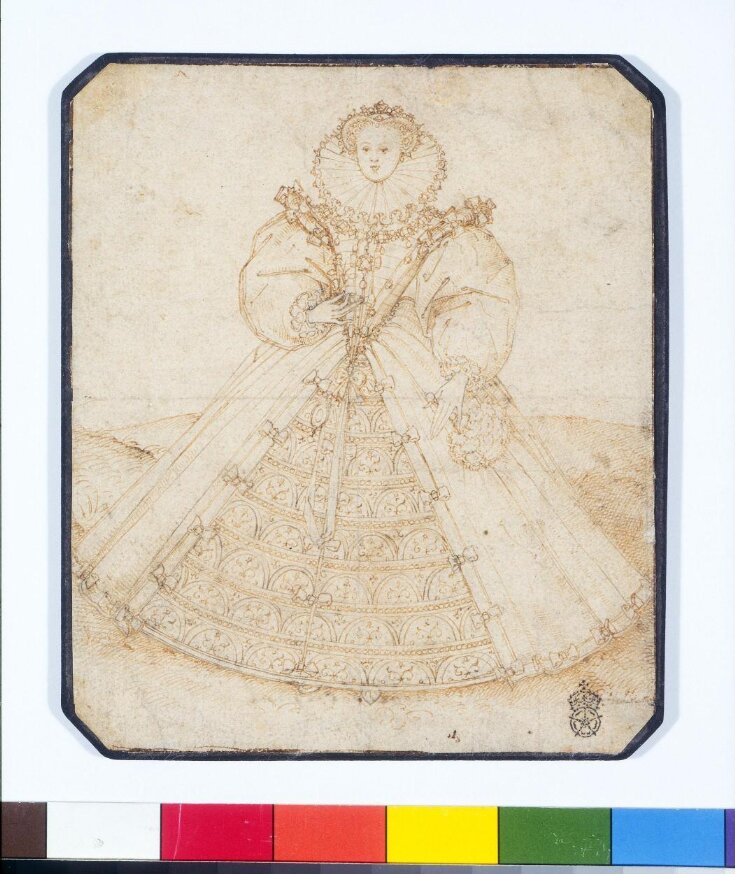
This portrait of Elizabeth I by Nicholas Hilliard is almost certainly one of the pattern drawings that he made for her Great Seal in 1584. Hilliard completed several drawings for the commission and the Queen chose the one that she liked best for the final design. This was not the chosen version.
Design & Designing
Hilliard was an established goldsmith as well as a painter of miniatures. Indeed, between the ages of 15 and 22 he had been apprenticed to the Queen's own Goldsmith, Robert Brandon. This explains why some fifteen years later the design of the silver seal fell to him. Hilliard later complained that the commission caused resentment amongst employees of the Royal Mint who considered the project their own: 'I had once envy enough ..for my doing well in other men's offices.'
Subjects Depicted
Several factors show that this is a portrait of Elizabeth I and a design for her second Great Seal. Because Hilliard rarely produced pen drawings, the very existence of this work suggests a special story; one which in turn fits the evidence that the Queen insisted on seeing several preliminary 'patterns on parchment' before choosing the final design. The costume, jewels and facial features also correspond to other portraits of Elizabeth.
This portrait of Elizabeth I by Nicholas Hilliard is almost certainly one of the pattern drawings that he made for her Great Seal in 1584. Hilliard completed several drawings for the commission and the Queen chose the one that she liked best for the final design. This was not the chosen version.
Design & Designing
Hilliard was an established goldsmith as well as a painter of miniatures. Indeed, between the ages of 15 and 22 he had been apprenticed to the Queen's own Goldsmith, Robert Brandon. This explains why some fifteen years later the design of the silver seal fell to him. Hilliard later complained that the commission caused resentment amongst employees of the Royal Mint who considered the project their own: 'I had once envy enough ..for my doing well in other men's offices.'
Subjects Depicted
Several factors show that this is a portrait of Elizabeth I and a design for her second Great Seal. Because Hilliard rarely produced pen drawings, the very existence of this work suggests a special story; one which in turn fits the evidence that the Queen insisted on seeing several preliminary 'patterns on parchment' before choosing the final design. The costume, jewels and facial features also correspond to other portraits of Elizabeth.
Delve deeper
Discover more about this object

Object details
| Categories | |
| Object type | |
| Title | Elizabeth I (generic title) |
| Materials and techniques | Pen and ink drawing on vellum |
| Brief description | Design for the Great Seal depicting Elizabeth I, pen and ink drawing, by Nicholas Hilliard, ca. 1585. |
| Physical description | Drawing, in outline, depicting Elizabeth I, full length. The borders of the sheet have been chamferred. |
| Dimensions |
|
| Content description | Portrait of a woman, full length, turned to front, her left hand placed against her bodice; in her right hand she holds a feathered fan. |
| Styles | |
| Gallery label | British Galleries:
THE OFFICIAL IMAGE OF ELIZABETH I Queen Elizabeth commissioned a new Great Seal in 1584. This drawing by Nicholas Hilliard may be one of the designs for her new seal. The silver seal itself was made at the royal mint. The Queen used to authorise important documents with a stamped wax impression like the one displayed here.(27/03/2003) |
| Credit line | Presented by Art Fund |
| Subjects depicted | |
| Summary | Object Type This portrait of Elizabeth I by Nicholas Hilliard is almost certainly one of the pattern drawings that he made for her Great Seal in 1584. Hilliard completed several drawings for the commission and the Queen chose the one that she liked best for the final design. This was not the chosen version. Design & Designing Hilliard was an established goldsmith as well as a painter of miniatures. Indeed, between the ages of 15 and 22 he had been apprenticed to the Queen's own Goldsmith, Robert Brandon. This explains why some fifteen years later the design of the silver seal fell to him. Hilliard later complained that the commission caused resentment amongst employees of the Royal Mint who considered the project their own: 'I had once envy enough ..for my doing well in other men's offices.' Subjects Depicted Several factors show that this is a portrait of Elizabeth I and a design for her second Great Seal. Because Hilliard rarely produced pen drawings, the very existence of this work suggests a special story; one which in turn fits the evidence that the Queen insisted on seeing several preliminary 'patterns on parchment' before choosing the final design. The costume, jewels and facial features also correspond to other portraits of Elizabeth. |
| Bibliographic references |
|
| Collection | |
| Accession number | P.9-1943 |
About this object record
Explore the Collections contains over a million catalogue records, and over half a million images. It is a working database that includes information compiled over the life of the museum. Some of our records may contain offensive and discriminatory language, or reflect outdated ideas, practice and analysis. We are committed to addressing these issues, and to review and update our records accordingly.
You can write to us to suggest improvements to the record.
Suggest feedback
You can write to us to suggest improvements to the record.
Suggest feedback
| Record created | March 27, 2003 |
| Record URL |
Download as: JSONIIIF Manifest
