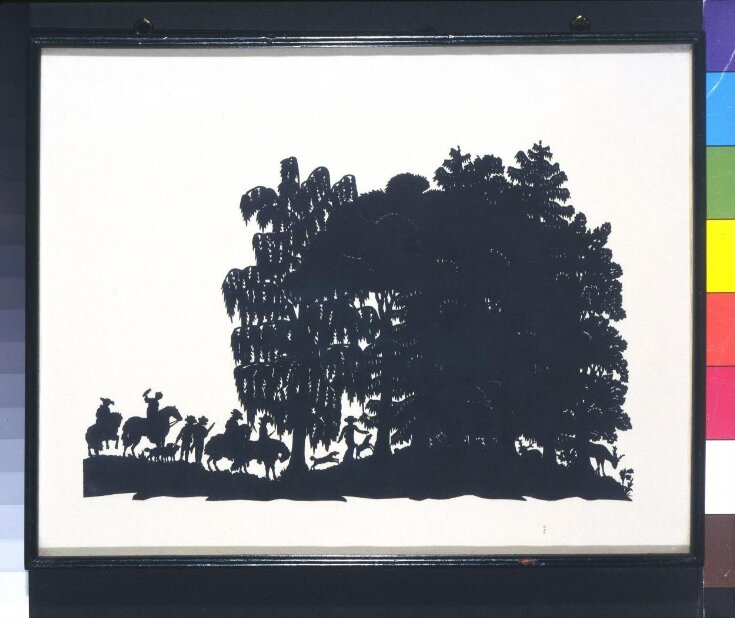
A Stag Hunt
Miniature
ca. 1820-1828 (made)
ca. 1820-1828 (made)
| Artist/Maker | |
| Place of origin |
Object Type
This silhouette was originally mounted in an album of cut paper works by the amateur cutter Laura Muir Mackenzie. Four works were selected for the V&A. Many of the works in this album reflected a taste for the Classical cameo encouraged by archaeological discoveries in the 18th century at sites such as Pompeii. These discoveries inspired Josiah Wedgwood's white pottery cameos set against blue and green backgrounds. Mackenzie mimicked them by setting her white silhouettes against blue and green card. This silhouette is a more conventional black cut work.
People
Laura Muir Mackenzie was a cousin of the Hon. Frances Talbot, who gave this work to the V&A. Laura was the daughter of Sir Alexander Muir Mackenzie of Delvine, Perthshire. According to her cousin there was an inscription on a family vault stating that Laura was born in 1801. One silhouette by Laura was apparently dated as early as 1806, implying that she was cutting works at five years old.
Silhouette
The word 'silhouette', describing images in outline, came into use in English in the 19th century. Before this date such works, particularly portraits, were called 'profiles'. The word 'silhouette' came from Etienne de Silhouette (1709-1769), a keen amateur paper cutter and a French finance minister who introduced petty tax reforms. The popular mind apparently came to associate his meanness with the inexpensiveness of his hobby, and the word 'silhouette' caught on.
This silhouette was originally mounted in an album of cut paper works by the amateur cutter Laura Muir Mackenzie. Four works were selected for the V&A. Many of the works in this album reflected a taste for the Classical cameo encouraged by archaeological discoveries in the 18th century at sites such as Pompeii. These discoveries inspired Josiah Wedgwood's white pottery cameos set against blue and green backgrounds. Mackenzie mimicked them by setting her white silhouettes against blue and green card. This silhouette is a more conventional black cut work.
People
Laura Muir Mackenzie was a cousin of the Hon. Frances Talbot, who gave this work to the V&A. Laura was the daughter of Sir Alexander Muir Mackenzie of Delvine, Perthshire. According to her cousin there was an inscription on a family vault stating that Laura was born in 1801. One silhouette by Laura was apparently dated as early as 1806, implying that she was cutting works at five years old.
Silhouette
The word 'silhouette', describing images in outline, came into use in English in the 19th century. Before this date such works, particularly portraits, were called 'profiles'. The word 'silhouette' came from Etienne de Silhouette (1709-1769), a keen amateur paper cutter and a French finance minister who introduced petty tax reforms. The popular mind apparently came to associate his meanness with the inexpensiveness of his hobby, and the word 'silhouette' caught on.
Object details
| Categories | |
| Object type | |
| Title | A Stag Hunt (assigned by artist) |
| Materials and techniques | Cut paper, blackened on one side with ink |
| Brief description | Cut paper silhouette miniature by Laura Mackenzie entitled 'A Stag Hunt'. Great Britain, ca. 1820-1828. |
| Physical description | Cut paper silhouette miniature of a stag hunt. |
| Dimensions |
|
| Gallery label | British Galleries:
Before the 1820s when black paper became widely available, cut-paper silhouettes were cut from white paper and blackened with ink or charcoal. This hunting scene, cut by Laura Muir Mackenzie at the age of about 15, is of the earlier type.(27/03/2003) |
| Credit line | Given by the Hon. Frances M. Talbot |
| Object history | Made by Laura Jemima Muir Mackenzie (born about 1800, died in 1828) probably at Delvine, near Dunkeld, Perthshire, Scotland |
| Subjects depicted | |
| Summary | Object Type This silhouette was originally mounted in an album of cut paper works by the amateur cutter Laura Muir Mackenzie. Four works were selected for the V&A. Many of the works in this album reflected a taste for the Classical cameo encouraged by archaeological discoveries in the 18th century at sites such as Pompeii. These discoveries inspired Josiah Wedgwood's white pottery cameos set against blue and green backgrounds. Mackenzie mimicked them by setting her white silhouettes against blue and green card. This silhouette is a more conventional black cut work. People Laura Muir Mackenzie was a cousin of the Hon. Frances Talbot, who gave this work to the V&A. Laura was the daughter of Sir Alexander Muir Mackenzie of Delvine, Perthshire. According to her cousin there was an inscription on a family vault stating that Laura was born in 1801. One silhouette by Laura was apparently dated as early as 1806, implying that she was cutting works at five years old. Silhouette The word 'silhouette', describing images in outline, came into use in English in the 19th century. Before this date such works, particularly portraits, were called 'profiles'. The word 'silhouette' came from Etienne de Silhouette (1709-1769), a keen amateur paper cutter and a French finance minister who introduced petty tax reforms. The popular mind apparently came to associate his meanness with the inexpensiveness of his hobby, and the word 'silhouette' caught on. |
| Collection | |
| Accession number | P.58-1930 |
About this object record
Explore the Collections contains over a million catalogue records, and over half a million images. It is a working database that includes information compiled over the life of the museum. Some of our records may contain offensive and discriminatory language, or reflect outdated ideas, practice and analysis. We are committed to addressing these issues, and to review and update our records accordingly.
You can write to us to suggest improvements to the record.
Suggest feedback
You can write to us to suggest improvements to the record.
Suggest feedback
| Record created | March 27, 2003 |
| Record URL |
Download as: JSONIIIF Manifest
