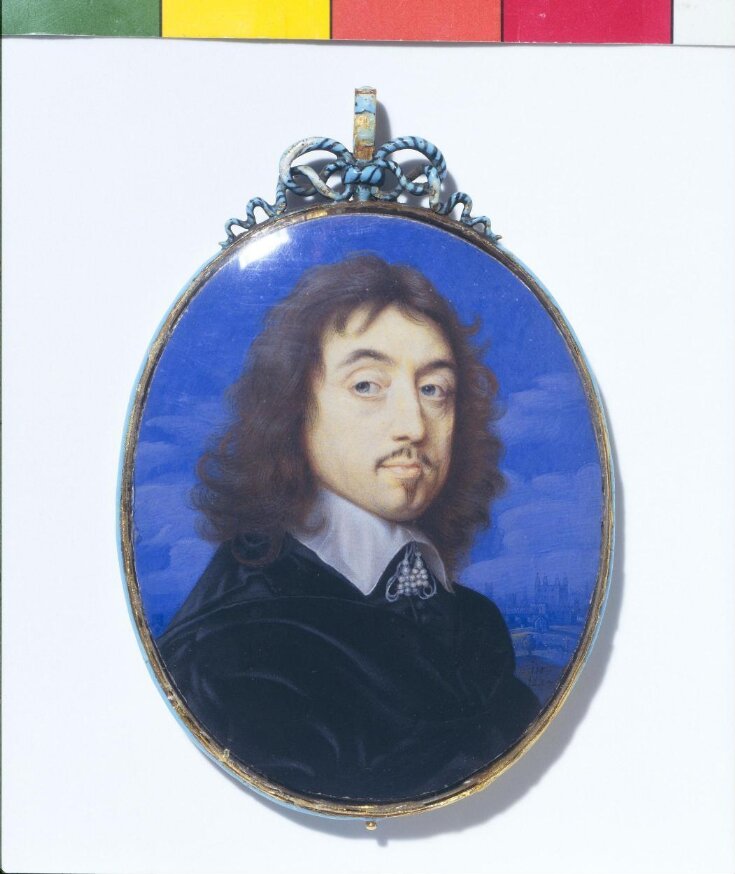
A Man, perhaps Sir John Wildman
Portrait Miniature
1647 (painted)
1647 (painted)
| Artist/Maker | |
| Place of origin |
Object Type
The term 'miniature' describes the watercolour technique in which this portrait has been painted, rather than the size of the painting. Unusually this miniature is still in a 17th-century blue enamelled gold locket; many such miniatures have lost their original frames.
People
This miniature closely resembles the subject of an etching from 1653 by the Bohemian Wenceslaus Hollar, which is said to depict Sir John Wildman. Wildman was notorious as one of those involved in trying and condemning to death Charles I. However, the Hollar print was not described as showing Wildman until almost 100 years after Wildman's death. No other portraits of Wildman are known, so the description must remain doubtful.
Attribution
This miniature is signed 'IH' for John Hoskins. We know that John Hoskins had too much work for one hand and that his son, John Hoskins the Younger, worked in his studio. But confusingly all works from the Hoskins studio were signed 'IH'. This miniature has been attributed to Hoskins the Younger because it is like others in a group of miniatures apparently by one hand. The heart of this group is a miniature signed Ipse ('himself'), which is probably a self-portrait by Hoskins the Younger. Thus the whole group is believed to be by this artist.
The term 'miniature' describes the watercolour technique in which this portrait has been painted, rather than the size of the painting. Unusually this miniature is still in a 17th-century blue enamelled gold locket; many such miniatures have lost their original frames.
People
This miniature closely resembles the subject of an etching from 1653 by the Bohemian Wenceslaus Hollar, which is said to depict Sir John Wildman. Wildman was notorious as one of those involved in trying and condemning to death Charles I. However, the Hollar print was not described as showing Wildman until almost 100 years after Wildman's death. No other portraits of Wildman are known, so the description must remain doubtful.
Attribution
This miniature is signed 'IH' for John Hoskins. We know that John Hoskins had too much work for one hand and that his son, John Hoskins the Younger, worked in his studio. But confusingly all works from the Hoskins studio were signed 'IH'. This miniature has been attributed to Hoskins the Younger because it is like others in a group of miniatures apparently by one hand. The heart of this group is a miniature signed Ipse ('himself'), which is probably a self-portrait by Hoskins the Younger. Thus the whole group is believed to be by this artist.
Object details
| Categories | |
| Object type | |
| Title | A Man, perhaps Sir John Wildman (generic title) |
| Materials and techniques | Water-colour on vellum, put down on a leaf from a table- book |
| Brief description | Portrait miniature of a man, perhaps Sir John Wildman, watercolour on vellum, painted by John Hoskins, 1647. |
| Physical description | Head and shoulders oval miniature portrait of a man, turned to right and looking to left, his hair long and wearing a dark tunic with a white collar. In the right background is a view of a city - possibly London and the Tower of London. Features deftly and directly hatched in brown and sanguine, with some blue-grey shadow, on a thick, pale carnation ground; hair in brown wash, lined with darker colour and with gouache heightening; collar in white on pale grey wash, costume in black with lights in grey; background, a landscape washed and hatched in gouache; on vellum put down on a leaf from a table- book. Frame: Seventeenth-century enamelled gold locket with a convex back covered with opaque pale blue enamel within a gold border; the inside partly counter-enamelled; the sides rounded and enamelled in the same pale blue, with the gold drawn up into a bezel which holds the convex glass; the hanger of inverted D-section, enamelled (much missing), and with a simulated knotted cord in pale blue and black enamel wound round its shank, making two symmetrical bows, the tapering ends passing through the bows and over the case in three undulations. A severe damage to the enamel at the base on the back and numerous losses. The front cover missing and points of attachment damaged or filed off. |
| Dimensions |
|
| Styles | |
| Marks and inscriptions | 'IH 1647' (Signed) |
| Gallery label | British Galleries:
This miniature may show Sir John Wildman (possibly 1621-1693). In 1647 he campaigned as a spokesman for the Parliamentary soldiers and the Levellers, a radical republican group. From 1650 to 1655 he made a comfortable fortune through the sale of Royalist properties.(27/03/2003) |
| Object history | The identification as John Wildman, the Leveller who rose to prominence in 1647 when he opposed Cromwell’s negotiations with Charles I, is based on its direct relationship with an engraving by Wenceslaus Hollar, dated 1653 (George Vertue, Hollar, 1745, p.72; Gustav Parthey, Hollar, 1853, p.385, no.1697). The early impressions bear no name, but from the second half of the 18th century the engraving became known as a portrait of Wildman (see the Rev. James Granger, Biographical History of England, 1774, Supplement p.296; 1824, illustrated ed. Vol. II, part III, p.207). Provenance: Miss Armorel Carey in 1946; sold by private treaty to the Museum, February 1962. |
| Subjects depicted | |
| Places depicted | |
| Summary | Object Type The term 'miniature' describes the watercolour technique in which this portrait has been painted, rather than the size of the painting. Unusually this miniature is still in a 17th-century blue enamelled gold locket; many such miniatures have lost their original frames. People This miniature closely resembles the subject of an etching from 1653 by the Bohemian Wenceslaus Hollar, which is said to depict Sir John Wildman. Wildman was notorious as one of those involved in trying and condemning to death Charles I. However, the Hollar print was not described as showing Wildman until almost 100 years after Wildman's death. No other portraits of Wildman are known, so the description must remain doubtful. Attribution This miniature is signed 'IH' for John Hoskins. We know that John Hoskins had too much work for one hand and that his son, John Hoskins the Younger, worked in his studio. But confusingly all works from the Hoskins studio were signed 'IH'. This miniature has been attributed to Hoskins the Younger because it is like others in a group of miniatures apparently by one hand. The heart of this group is a miniature signed Ipse ('himself'), which is probably a self-portrait by Hoskins the Younger. Thus the whole group is believed to be by this artist. |
| Bibliographic references |
|
| Collection | |
| Accession number | P.2-1962 |
About this object record
Explore the Collections contains over a million catalogue records, and over half a million images. It is a working database that includes information compiled over the life of the museum. Some of our records may contain offensive and discriminatory language, or reflect outdated ideas, practice and analysis. We are committed to addressing these issues, and to review and update our records accordingly.
You can write to us to suggest improvements to the record.
Suggest feedback
You can write to us to suggest improvements to the record.
Suggest feedback
| Record created | March 27, 2003 |
| Record URL |
Download as: JSONIIIF Manifest
