
Ring
1500-1600 (made)
| Artist/Maker | |
| Place of origin |
Object Type
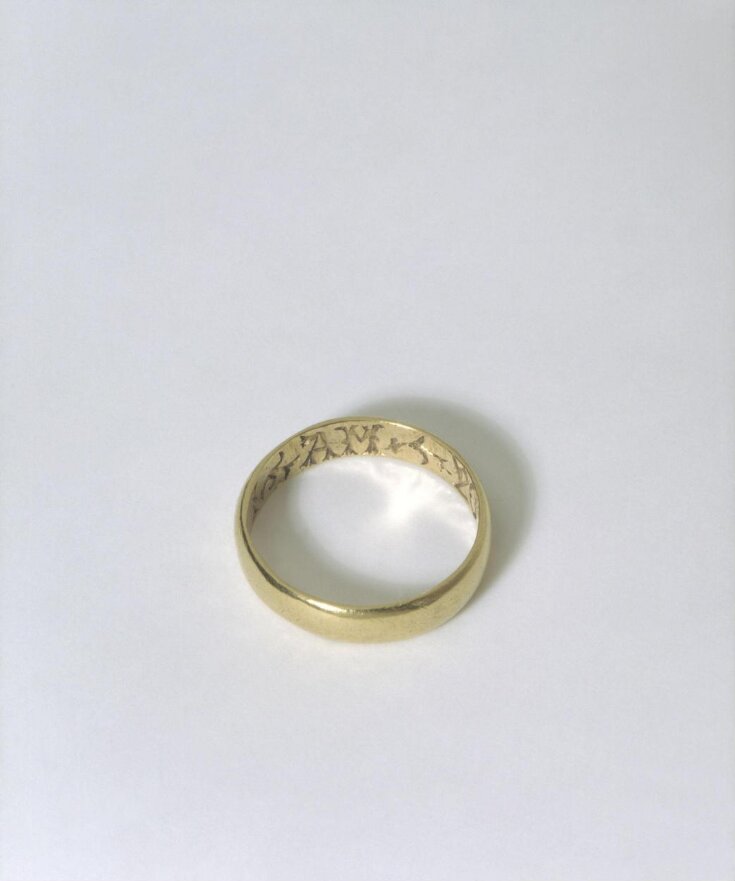
This gold love ring is engraved on the outside with sprigs and on the inside with an inscription in in floriated (flowery) capitals: 'I AM YOURS KS'.
Ownership & Use
By 1430 love rings engraved with inscriptions were known as 'posies' (from 'poesy' or poetry). In the 13th and 14th centuries the language of the posy was usually French, but from the 15th century English became increasingly common. Rings were given on many occasions. They often seem to have been declarations of love, rather than formal betrothal or marriage rings.
With many posy rings, it is reasonable to suppose that the initials after the declaration of love were those of an ardent lover. In this case the initials are 'KS', which are also found on another posy ring, accompanied by an identical declaration of love. This seems a considerable coincidence. Although no proof can be produced to support it, the inscription on these two rings, 'KS', may stand for 'Kiss' or 'Kisses'.
This gold love ring is engraved on the outside with sprigs and on the inside with an inscription in in floriated (flowery) capitals: 'I AM YOURS KS'.
Ownership & Use
By 1430 love rings engraved with inscriptions were known as 'posies' (from 'poesy' or poetry). In the 13th and 14th centuries the language of the posy was usually French, but from the 15th century English became increasingly common. Rings were given on many occasions. They often seem to have been declarations of love, rather than formal betrothal or marriage rings.
With many posy rings, it is reasonable to suppose that the initials after the declaration of love were those of an ardent lover. In this case the initials are 'KS', which are also found on another posy ring, accompanied by an identical declaration of love. This seems a considerable coincidence. Although no proof can be produced to support it, the inscription on these two rings, 'KS', may stand for 'Kiss' or 'Kisses'.
Object details
| Categories | |
| Object type | |
| Materials and techniques | Engraved gold |
| Brief description | Gold posy ring, engraved 'I am yours KS'. England, 1500-1600. |
| Dimensions |
|
| Marks and inscriptions | Engraved inside 'I AM YOURS KS' |
| Gallery label | British Galleries:
THREE RINGS Rings engraved with declarations of love were called posy rings (from 'poesy' meaning poetry). It is frequently not possible to tell which love rings were wedding rings, unless, like two of these rings, they make a direct reference to marriage. Any ring could be a wedding ring, and plain gold bands did not become common until the second half of the 17th century. Interlinking rings are known as gimmel rings (gimmel means twin). They symbolised the joining of two people.(27/03/2003) |
| Credit line | Given by Dame Joan Evans |
| Object history | Made in England |
| Summary | Object Type This gold love ring is engraved on the outside with sprigs and on the inside with an inscription in in floriated (flowery) capitals: 'I AM YOURS KS'. Ownership & Use By 1430 love rings engraved with inscriptions were known as 'posies' (from 'poesy' or poetry). In the 13th and 14th centuries the language of the posy was usually French, but from the 15th century English became increasingly common. Rings were given on many occasions. They often seem to have been declarations of love, rather than formal betrothal or marriage rings. With many posy rings, it is reasonable to suppose that the initials after the declaration of love were those of an ardent lover. In this case the initials are 'KS', which are also found on another posy ring, accompanied by an identical declaration of love. This seems a considerable coincidence. Although no proof can be produced to support it, the inscription on these two rings, 'KS', may stand for 'Kiss' or 'Kisses'. |
| Collection | |
| Accession number | M.67-1960 |
About this object record
Explore the Collections contains over a million catalogue records, and over half a million images. It is a working database that includes information compiled over the life of the museum. Some of our records may contain offensive and discriminatory language, or reflect outdated ideas, practice and analysis. We are committed to addressing these issues, and to review and update our records accordingly.
You can write to us to suggest improvements to the record.
Suggest feedback
You can write to us to suggest improvements to the record.
Suggest feedback
| Record created | March 27, 2003 |
| Record URL |
Download as: JSONIIIF Manifest
