
Ring
ca. 1600 (made), 1st century (intaglio)
| Artist/Maker | |
| Place of origin |
Object Type
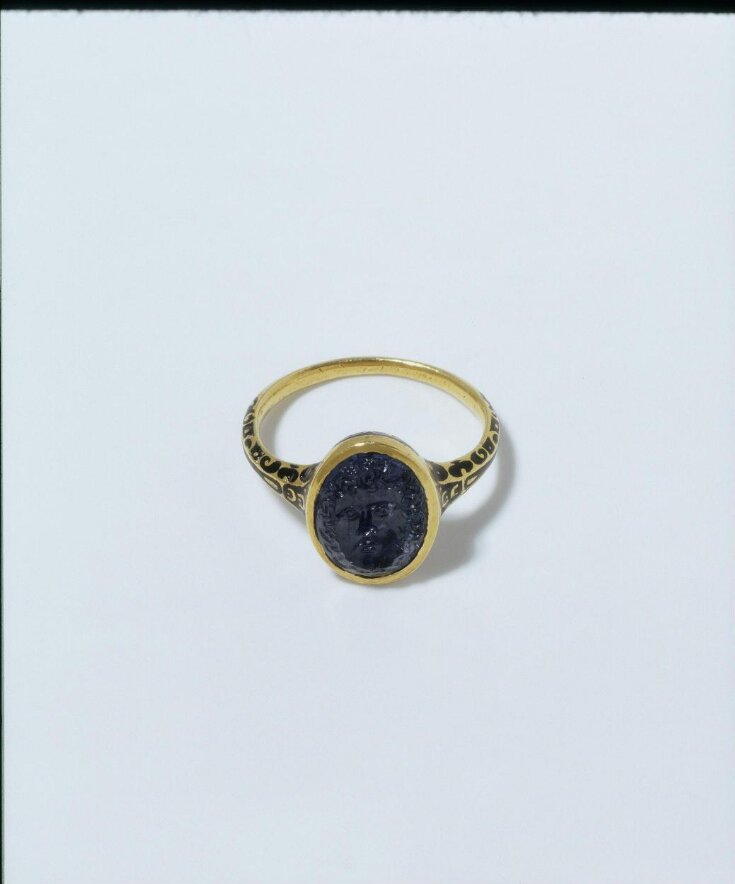
The shoulders and sides of the bezel (head) of this ring are decorated with scrolls on a black enamel ground. The very fine sapphire intaglio (the design engraved into the stone) is Graeco-Roman, dating from the 1st century AD.
People
The intaglio was probably mounted into the ring in about 1590-1600. It then appears to have entered the collection of the Gonzaga dukes of Mantua. The ducal art collections became the target of dealers, including Daniel Nys, who in 1627 sold to Charles I paintings by, among others, Titian, Raphael, Correggio and Giulio Romano. In 1637, when Charles declined to buy from Nys the Gonzaga gems, Thomas, 14th Earl of Arundel agreed to purchase them through his agent William Petty. Arundel was the most dedicated English collector of his generation, who built a library of 3000 books, exchanged engraved gems with Rubens, and played a role in bringing Van Dyck to London, as well as making collections of antiquities, Renaissance drawings and paintings on the most extensive scale.
The range, antiquity and splendour of the objects Thomas Howard, Earl of Arundel (1585-1646) acquired put him on a par with great European collectors. As well as paintings and drawings of the greatest importance, he collected works of the classical period. These included cameos and intaglios. His principal agent was the tireless William Petty (possibly born in 1585, died 1639), who in 1638 purchased for Arundel the gem collection of the Flemish dealer Daniel Nys in Italy.
The Arundel Collection gems passed by descent to Charles Spencer, 3rd Duke of Marlborough (1706-1758, himself a great collector of engraved gems.The Marlborough Collection was later sold at Christie's auction house on 28 June 1875.
Subjects Depicted
The sapphire is engraved with the head of Medusa. In Greek mythology she was one of three sisters, the Gorgons, whose terrifying appearance turned those who saw them into stone. She was beheaded by the legendary hero Perseus.
The shoulders and sides of the bezel (head) of this ring are decorated with scrolls on a black enamel ground. The very fine sapphire intaglio (the design engraved into the stone) is Graeco-Roman, dating from the 1st century AD.
People
The intaglio was probably mounted into the ring in about 1590-1600. It then appears to have entered the collection of the Gonzaga dukes of Mantua. The ducal art collections became the target of dealers, including Daniel Nys, who in 1627 sold to Charles I paintings by, among others, Titian, Raphael, Correggio and Giulio Romano. In 1637, when Charles declined to buy from Nys the Gonzaga gems, Thomas, 14th Earl of Arundel agreed to purchase them through his agent William Petty. Arundel was the most dedicated English collector of his generation, who built a library of 3000 books, exchanged engraved gems with Rubens, and played a role in bringing Van Dyck to London, as well as making collections of antiquities, Renaissance drawings and paintings on the most extensive scale.
The range, antiquity and splendour of the objects Thomas Howard, Earl of Arundel (1585-1646) acquired put him on a par with great European collectors. As well as paintings and drawings of the greatest importance, he collected works of the classical period. These included cameos and intaglios. His principal agent was the tireless William Petty (possibly born in 1585, died 1639), who in 1638 purchased for Arundel the gem collection of the Flemish dealer Daniel Nys in Italy.
The Arundel Collection gems passed by descent to Charles Spencer, 3rd Duke of Marlborough (1706-1758, himself a great collector of engraved gems.The Marlborough Collection was later sold at Christie's auction house on 28 June 1875.
Subjects Depicted
The sapphire is engraved with the head of Medusa. In Greek mythology she was one of three sisters, the Gorgons, whose terrifying appearance turned those who saw them into stone. She was beheaded by the legendary hero Perseus.
Object details
| Categories | |
| Object type | |
| Parts | This object consists of 2 parts.
|
| Materials and techniques | Gold enamelled in black, set with a sapphire intaglio of the Medusa |
| Brief description | Ring with classical gemstone |
| Dimensions |
|
| Style | |
| Gallery label |
|
| Credit line | The Salting Bequest |
| Object history | Probably collection of the Gonzaga dukes of Mantua. Purchased by William Petty from Daniel Nys, for Thomas, 14th Earl of Arundel (1585-1646). By descent to the widow of Henry Howard, brother of Henry, 6th Duke of Norfolk. Sold to Henry, Earl of Peterborough. Bequeathed by Lady Mary Mordaunt, his daughter, to her second husband, Sir John Germain. Given by his widow, Lady Elizabeth Germain, to Hon. Mary Beauclerk on the latter’s marriage to Lord Charles Spencer, from whom the collection passed to George, 4th Duke of Marlborough (1739-1817). Sold by John, 7th Duke of Marlborough to David Bromilow, 1875. Christie’s, 26-29 June 1899, lot 98 (Whelan; £105). Salting Collection. |
| Subject depicted | |
| Summary | Object Type The shoulders and sides of the bezel (head) of this ring are decorated with scrolls on a black enamel ground. The very fine sapphire intaglio (the design engraved into the stone) is Graeco-Roman, dating from the 1st century AD. People The intaglio was probably mounted into the ring in about 1590-1600. It then appears to have entered the collection of the Gonzaga dukes of Mantua. The ducal art collections became the target of dealers, including Daniel Nys, who in 1627 sold to Charles I paintings by, among others, Titian, Raphael, Correggio and Giulio Romano. In 1637, when Charles declined to buy from Nys the Gonzaga gems, Thomas, 14th Earl of Arundel agreed to purchase them through his agent William Petty. Arundel was the most dedicated English collector of his generation, who built a library of 3000 books, exchanged engraved gems with Rubens, and played a role in bringing Van Dyck to London, as well as making collections of antiquities, Renaissance drawings and paintings on the most extensive scale. The range, antiquity and splendour of the objects Thomas Howard, Earl of Arundel (1585-1646) acquired put him on a par with great European collectors. As well as paintings and drawings of the greatest importance, he collected works of the classical period. These included cameos and intaglios. His principal agent was the tireless William Petty (possibly born in 1585, died 1639), who in 1638 purchased for Arundel the gem collection of the Flemish dealer Daniel Nys in Italy. The Arundel Collection gems passed by descent to Charles Spencer, 3rd Duke of Marlborough (1706-1758, himself a great collector of engraved gems.The Marlborough Collection was later sold at Christie's auction house on 28 June 1875. Subjects Depicted The sapphire is engraved with the head of Medusa. In Greek mythology she was one of three sisters, the Gorgons, whose terrifying appearance turned those who saw them into stone. She was beheaded by the legendary hero Perseus. |
| Bibliographic references |
|
| Collection | |
| Accession number | M.553-1910 |
About this object record
Explore the Collections contains over a million catalogue records, and over half a million images. It is a working database that includes information compiled over the life of the museum. Some of our records may contain offensive and discriminatory language, or reflect outdated ideas, practice and analysis. We are committed to addressing these issues, and to review and update our records accordingly.
You can write to us to suggest improvements to the record.
Suggest feedback
You can write to us to suggest improvements to the record.
Suggest feedback
| Record created | March 27, 2003 |
| Record URL |
Download as: JSONIIIF Manifest
