Cup and Cover
1821-1822 (hallmarked)
| Artist/Maker | |
| Place of origin |
Object Type
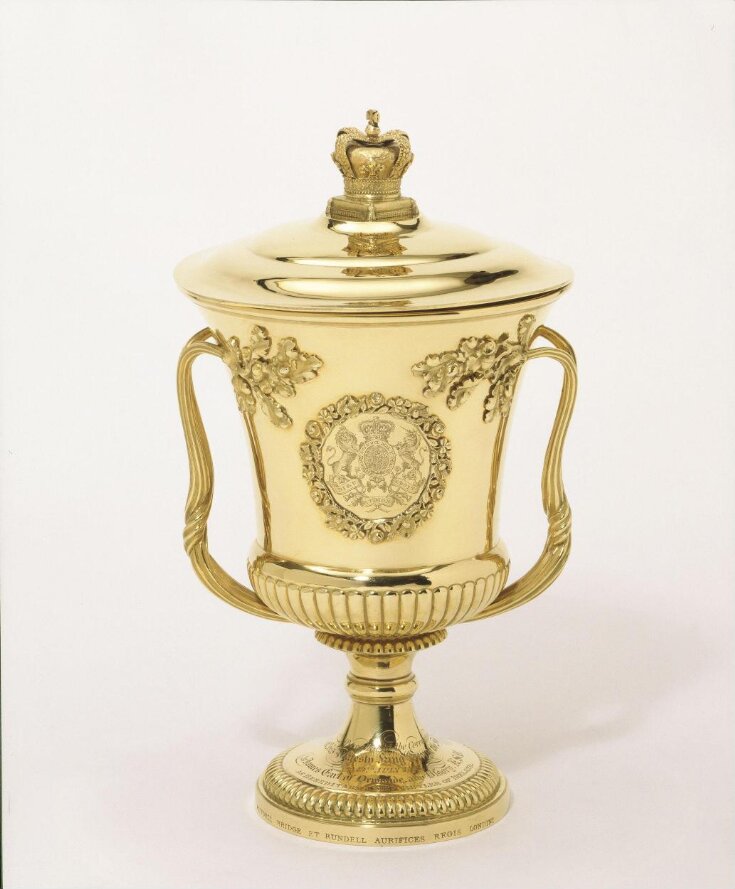
This cup and cover was a ceremonial gift intended for display on a buffet or sideboard. It was one of a number of pieces presented by George IV (1762-1830; reigned 1820-1830) to government officials and royal attendants.
People
The cup and cover was made by the Royal Goldsmiths Rundell, Bridge & Rundell for George IV. Surviving documents record that it was for 'The Right Honourable the Earl of Ormonde & Ossory, as his fee for executing the office of Chief Butler for Ireland at the Coronation'. Ormonde was one the chief attendants at the coronation. The cup and cover cost the nation over £230.
Historical Associations
This cup and cover was one of a number of gifts that George IV gave to officials and attendants who assisted at his coronation and banquet in 1821. It was a custom for the sovereign to present gifts at the time of the coronation. The gifts included badges, mazers, and gold chains, as well as three other gold cups.
The banquet was the last traditional and the most extravagant feast of its kind ever held. For this very splendid occasion the King spent £48,152 10s 2d to borrow jewels, refurbish plate and to buy new silver and gifts from the Royal Goldsmiths. The steward's bill, mostly for food, came to over £25,000.
This cup and cover was a ceremonial gift intended for display on a buffet or sideboard. It was one of a number of pieces presented by George IV (1762-1830; reigned 1820-1830) to government officials and royal attendants.
People
The cup and cover was made by the Royal Goldsmiths Rundell, Bridge & Rundell for George IV. Surviving documents record that it was for 'The Right Honourable the Earl of Ormonde & Ossory, as his fee for executing the office of Chief Butler for Ireland at the Coronation'. Ormonde was one the chief attendants at the coronation. The cup and cover cost the nation over £230.
Historical Associations
This cup and cover was one of a number of gifts that George IV gave to officials and attendants who assisted at his coronation and banquet in 1821. It was a custom for the sovereign to present gifts at the time of the coronation. The gifts included badges, mazers, and gold chains, as well as three other gold cups.
The banquet was the last traditional and the most extravagant feast of its kind ever held. For this very splendid occasion the King spent £48,152 10s 2d to borrow jewels, refurbish plate and to buy new silver and gifts from the Royal Goldsmiths. The steward's bill, mostly for food, came to over £25,000.
Object details
| Categories | |
| Object type | |
| Parts | This object consists of 2 parts.
|
| Materials and techniques | Gold, cast, applied and chased and engraved |
| Brief description | Gold, London hallmarks for 1821-22, mark of Rundell, Bridge and Rundell |
| Physical description | Classical vase shape with finial in the form of a royal crown, the cup decorated with roses, thistles and shamrocks representing respectively, England, Ireland and Scotland, with acorns and oak leaves at the end of the handles. |
| Dimensions |
|
| Marks and inscriptions |
|
| Gallery label | British Galleries:
After his coronation King George IV (1774-1830) presented this cup to James Butler, 19th Earl of Ormonde (1774-1838), who attended him as Chief Butler of Ireland. The classical vase shape is decorated with motifs appropriate for such a patriotic occasion. They include roses, thistles and shamrocks, with acorns and oak leaves on the handles, and represent England, Scotland and Ireland.(27/03/2003) |
| Object history | Made in London by Rundell, Bridge & Rundell Rundell, Bridge & Rundell Exhibition RF.2005/25 Historical significance: The office of Chief Butler of England was filled by the Earls of Arundel from 1243 until 1821; The office of Chief Butler of Ireland was uniquely filled by James Butler, Earl of Ormonde at the Coronation of George IV, following the Act of Union with Ireland in 1801 |
| Historical context | Rundells supplied the plate including cups and other perquisites in gold or silver for all the officers of state who assisted at the Coronation ceremony. They charged £230 16s 6d for the Ormonde gold cup. A photograph sent in as an enquiry in 2009 shows the silver-gilt Coronation cup of identical form but differing inscription presented to William Wilshire, Baron of the Manor of Great Wymondley after he had presented the cup of wine to the King at the Coronation Banquet. The photograph suggests that the inscription read 'CORONATION DINNER TO HIS MAJESTY KING GEORGE IV ON THE 19th DAY OF JULY, 1821 This Cup having been delivered from His Majesty's Jewel Office to William Wilshire, Esq, Lord of the Manor of Great Wymondsley, was by him travelling to the antient tenure of the Manore presented with wine therein to His Majesty, who having drunk thereof returned the Cup to him for his fee'. Its present whereabouts unknown. |
| Subjects depicted | |
| Summary | Object Type This cup and cover was a ceremonial gift intended for display on a buffet or sideboard. It was one of a number of pieces presented by George IV (1762-1830; reigned 1820-1830) to government officials and royal attendants. People The cup and cover was made by the Royal Goldsmiths Rundell, Bridge & Rundell for George IV. Surviving documents record that it was for 'The Right Honourable the Earl of Ormonde & Ossory, as his fee for executing the office of Chief Butler for Ireland at the Coronation'. Ormonde was one the chief attendants at the coronation. The cup and cover cost the nation over £230. Historical Associations This cup and cover was one of a number of gifts that George IV gave to officials and attendants who assisted at his coronation and banquet in 1821. It was a custom for the sovereign to present gifts at the time of the coronation. The gifts included badges, mazers, and gold chains, as well as three other gold cups. The banquet was the last traditional and the most extravagant feast of its kind ever held. For this very splendid occasion the King spent £48,152 10s 2d to borrow jewels, refurbish plate and to buy new silver and gifts from the Royal Goldsmiths. The steward's bill, mostly for food, came to over £25,000. |
| Bibliographic reference | Christopher Hartop, The Art of Rundell and Bridge, 1797-1843, 2005,pp.75, 156; cat.no.63 |
| Collection | |
| Accession number | M.42:1, 2-1982 |
About this object record
Explore the Collections contains over a million catalogue records, and over half a million images. It is a working database that includes information compiled over the life of the museum. Some of our records may contain offensive and discriminatory language, or reflect outdated ideas, practice and analysis. We are committed to addressing these issues, and to review and update our records accordingly.
You can write to us to suggest improvements to the record.
Suggest feedback
You can write to us to suggest improvements to the record.
Suggest feedback
| Record created | March 27, 2003 |
| Record URL |
Download as: JSONIIIF Manifest
