The Beddington Lock
Lock
ca. 1539-1547 (made)
ca. 1539-1547 (made)
| Artist/Maker | |
| Place of origin |
Object Type
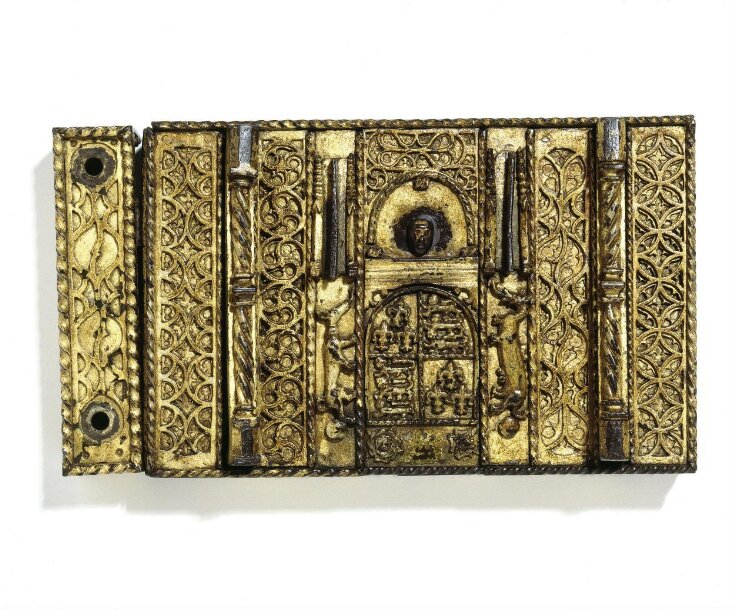
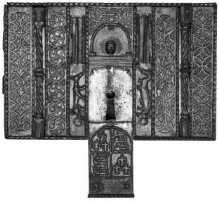
This lock has a central sliding plate, decorated with the arms of Henry VIII (ruled 1509-1547), which conceals two keyholes. The lock can be opened with one key by inserting a pin into its back. Locks - and ironwork - were valuable items, so high quality examples such as this one were often made to be portable. The gilding on the Beddington lock is unusual but apparently original, and indicates its high status.
People & Places
The lock was originally on the door of the great hall at Beddington House, manor of the Carew family. The property was seized by Henry VIII when Sir Nicholas Carew was executed for treason in 1539. It remained in crown ownership until 1552. The heraldry suggests that this lock was made for Beddington after it became a royal manor. If so, it could be the work of the royal lockmaker Henry Romaynes (died 1553), who lived and worked in the parish of St Martin in the Fields, London.
Design & Designing
This lock is Gothic in style, despite its late date. Smiths seem to have been conservative craftsmen and continued using Gothic motifs late into the 16th century. A comparable lock of similar style and date can be seen on doors in St George's Chapel, Windsor, Berkshire, and there is another in the collection of the Walters Art Gallery, Baltimore, USA.
This lock has a central sliding plate, decorated with the arms of Henry VIII (ruled 1509-1547), which conceals two keyholes. The lock can be opened with one key by inserting a pin into its back. Locks - and ironwork - were valuable items, so high quality examples such as this one were often made to be portable. The gilding on the Beddington lock is unusual but apparently original, and indicates its high status.
People & Places
The lock was originally on the door of the great hall at Beddington House, manor of the Carew family. The property was seized by Henry VIII when Sir Nicholas Carew was executed for treason in 1539. It remained in crown ownership until 1552. The heraldry suggests that this lock was made for Beddington after it became a royal manor. If so, it could be the work of the royal lockmaker Henry Romaynes (died 1553), who lived and worked in the parish of St Martin in the Fields, London.
Design & Designing
This lock is Gothic in style, despite its late date. Smiths seem to have been conservative craftsmen and continued using Gothic motifs late into the 16th century. A comparable lock of similar style and date can be seen on doors in St George's Chapel, Windsor, Berkshire, and there is another in the collection of the Walters Art Gallery, Baltimore, USA.
Object details
| Categories | |
| Object type | |
| Parts | This object consists of 7 parts.
|
| Title | The Beddington Lock (popular title) |
| Materials and techniques | Iron, wrought, carved and gilded |
| Brief description | The Beddington Lock |
| Physical description | The Beddington Lock. Of rectangular form, decorated with plaques of Gothic openwork tracery and salomonic columns.This lock has a central sliding plate, decorated with the arms of Henry VIII (ruled 1509-1547), which conceals two keyholes. The lock can be opened with one key by inserting a pin into its back. |
| Dimensions |
|
| Marks and inscriptions | Bearing the royal arms and supporters used by all Tudor monarchs, especially Henry VII and Henry VIII. |
| Gallery label | British Galleries:
One of two keyholes is concealed by a sliding plate decorated with the royal arms. As Henry VIII moved between his many palaces, smaller locks of this type were constantly transported and re-fitted to maintain security, with the king himself holding the master key.(27/03/2003) |
| Object history | Probably made in London by the royal lockmaker Henry Romaynes (died in London, 1553) L'Art du Serrurier Exhibition RF.2006/620 Formerly on the main door of the 16th-century great hall of Beddington Place, Surrey |
| Production | probably 1539-1547 |
| Summary | Object Type This lock has a central sliding plate, decorated with the arms of Henry VIII (ruled 1509-1547), which conceals two keyholes. The lock can be opened with one key by inserting a pin into its back. Locks - and ironwork - were valuable items, so high quality examples such as this one were often made to be portable. The gilding on the Beddington lock is unusual but apparently original, and indicates its high status. People & Places The lock was originally on the door of the great hall at Beddington House, manor of the Carew family. The property was seized by Henry VIII when Sir Nicholas Carew was executed for treason in 1539. It remained in crown ownership until 1552. The heraldry suggests that this lock was made for Beddington after it became a royal manor. If so, it could be the work of the royal lockmaker Henry Romaynes (died 1553), who lived and worked in the parish of St Martin in the Fields, London. Design & Designing This lock is Gothic in style, despite its late date. Smiths seem to have been conservative craftsmen and continued using Gothic motifs late into the 16th century. A comparable lock of similar style and date can be seen on doors in St George's Chapel, Windsor, Berkshire, and there is another in the collection of the Walters Art Gallery, Baltimore, USA. |
| Bibliographic reference | Campbell, Marian, An Introduction to Ironwork, London: HMSO, 1985, p. 19, pl. 4. |
| Collection | |
| Accession number | M.397&:1 to 6-1921 |
About this object record
Explore the Collections contains over a million catalogue records, and over half a million images. It is a working database that includes information compiled over the life of the museum. Some of our records may contain offensive and discriminatory language, or reflect outdated ideas, practice and analysis. We are committed to addressing these issues, and to review and update our records accordingly.
You can write to us to suggest improvements to the record.
Suggest feedback
You can write to us to suggest improvements to the record.
Suggest feedback
| Record created | March 27, 2003 |
| Record URL |
Download as: JSONIIIF Manifest
