Vase
1802-1803 (made)
| Artist/Maker | |
| Place of origin |
Object Type
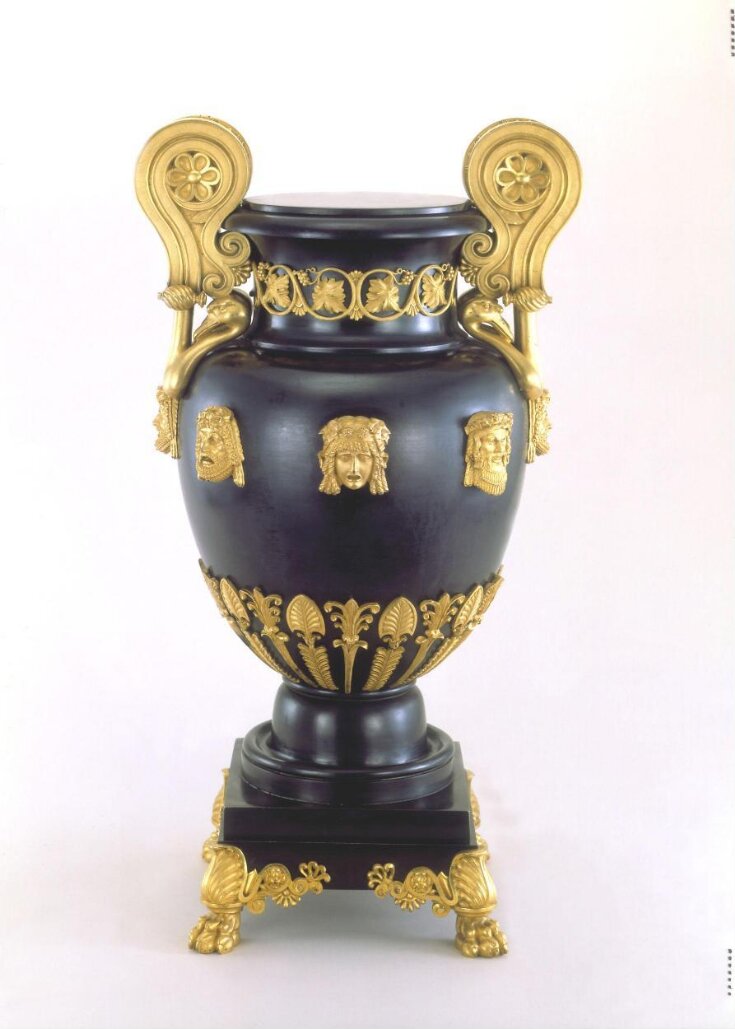
Thomas Hope commissioned this vase of patinated copper with ormolu (gilt-bronze) mounts for his London mansion at Duchess Street, where it was displayed in the dining room. It is based on a classical volute (spiral scroll) 'krater', an ancient Greek vase with two handles that was used for mixing wine and water. Hope's own account of the precise source was 'a vase of white marble' in the Museum at Portici, Italy.
Materials & Making
The maker was a French bronze and ormolu (gilded bronze) manufacturer named Alexis Decaix who came to London as a refugee from the French Revolution. He worked for the well-known silversmith Garrards as an ormolu maker and produced a range of gilt bronzes between 1799 and 1804 for aristocratic clients including the Prince of Wales. The contrasting use of matt gilding and burnished (polished) gilding is a feature of this vase. The technique highlights the detailed decoration of the vase and was used by the celebrated Parisian ormolu makers Pierre Gouthière (1732-1813) and Pierre-Philippe Thomire (1751-1843).
Places
Hope's mansion in Duchess Street was an outstanding example of Neo-classical design. In 1807 he published an illustrated account of the house and its furnishings in. Entitled Household Furniture and Interior Decoration..., it had a considerable influence on other architects and designers working in the Greek Revival style.
Thomas Hope commissioned this vase of patinated copper with ormolu (gilt-bronze) mounts for his London mansion at Duchess Street, where it was displayed in the dining room. It is based on a classical volute (spiral scroll) 'krater', an ancient Greek vase with two handles that was used for mixing wine and water. Hope's own account of the precise source was 'a vase of white marble' in the Museum at Portici, Italy.
Materials & Making
The maker was a French bronze and ormolu (gilded bronze) manufacturer named Alexis Decaix who came to London as a refugee from the French Revolution. He worked for the well-known silversmith Garrards as an ormolu maker and produced a range of gilt bronzes between 1799 and 1804 for aristocratic clients including the Prince of Wales. The contrasting use of matt gilding and burnished (polished) gilding is a feature of this vase. The technique highlights the detailed decoration of the vase and was used by the celebrated Parisian ormolu makers Pierre Gouthière (1732-1813) and Pierre-Philippe Thomire (1751-1843).
Places
Hope's mansion in Duchess Street was an outstanding example of Neo-classical design. In 1807 he published an illustrated account of the house and its furnishings in. Entitled Household Furniture and Interior Decoration..., it had a considerable influence on other architects and designers working in the Greek Revival style.
Delve deeper
Discover more about this object

Object details
| Categories | |
| Object type | |
| Materials and techniques | Copper, treated to resemble bronze, with applied ormolu (gilt bronze) mounts |
| Brief description | Vase, patinated copper with ormolu (gilt-brass) mounts, designed by Thomas Hope, made by Alexis Decaix, England, 1802-03 |
| Physical description | Vase, patinated copper with ormolu (gilt-brass) mounts, 59 cm high, 33.5 cm diam. Detachable flat lid. Based on the Greek krater form decorated with masks from Greek mythology. |
| Dimensions |
|
| Gallery label | British Galleries:
When Thomas Hope visited Naples in 1802, he sketched a Greek marble vase in the museum at Portici. He then used the sketch to design this vase for himself. A French metalworker living in London executed the work and it was displayed in the dining room of Hope's London house in Duchess Street.(27/03/2003) |
| Object history | Designed by Thomas Hope (born in Amsterdam, The Netherlands, 1769, died in London, 1831); probably made in London by Alexis Decaix (died in 1811) Thomas Hope Exhibition RF.2005/610 |
| Subjects depicted | |
| Summary | Object Type Thomas Hope commissioned this vase of patinated copper with ormolu (gilt-bronze) mounts for his London mansion at Duchess Street, where it was displayed in the dining room. It is based on a classical volute (spiral scroll) 'krater', an ancient Greek vase with two handles that was used for mixing wine and water. Hope's own account of the precise source was 'a vase of white marble' in the Museum at Portici, Italy. Materials & Making The maker was a French bronze and ormolu (gilded bronze) manufacturer named Alexis Decaix who came to London as a refugee from the French Revolution. He worked for the well-known silversmith Garrards as an ormolu maker and produced a range of gilt bronzes between 1799 and 1804 for aristocratic clients including the Prince of Wales. The contrasting use of matt gilding and burnished (polished) gilding is a feature of this vase. The technique highlights the detailed decoration of the vase and was used by the celebrated Parisian ormolu makers Pierre Gouthière (1732-1813) and Pierre-Philippe Thomire (1751-1843). Places Hope's mansion in Duchess Street was an outstanding example of Neo-classical design. In 1807 he published an illustrated account of the house and its furnishings in. Entitled Household Furniture and Interior Decoration..., it had a considerable influence on other architects and designers working in the Greek Revival style. |
| Bibliographic references |
|
| Collection | |
| Accession number | M.33-1983 |
About this object record
Explore the Collections contains over a million catalogue records, and over half a million images. It is a working database that includes information compiled over the life of the museum. Some of our records may contain offensive and discriminatory language, or reflect outdated ideas, practice and analysis. We are committed to addressing these issues, and to review and update our records accordingly.
You can write to us to suggest improvements to the record.
Suggest feedback
You can write to us to suggest improvements to the record.
Suggest feedback
| Record created | March 27, 2003 |
| Record URL |
Download as: JSONIIIF Manifest
