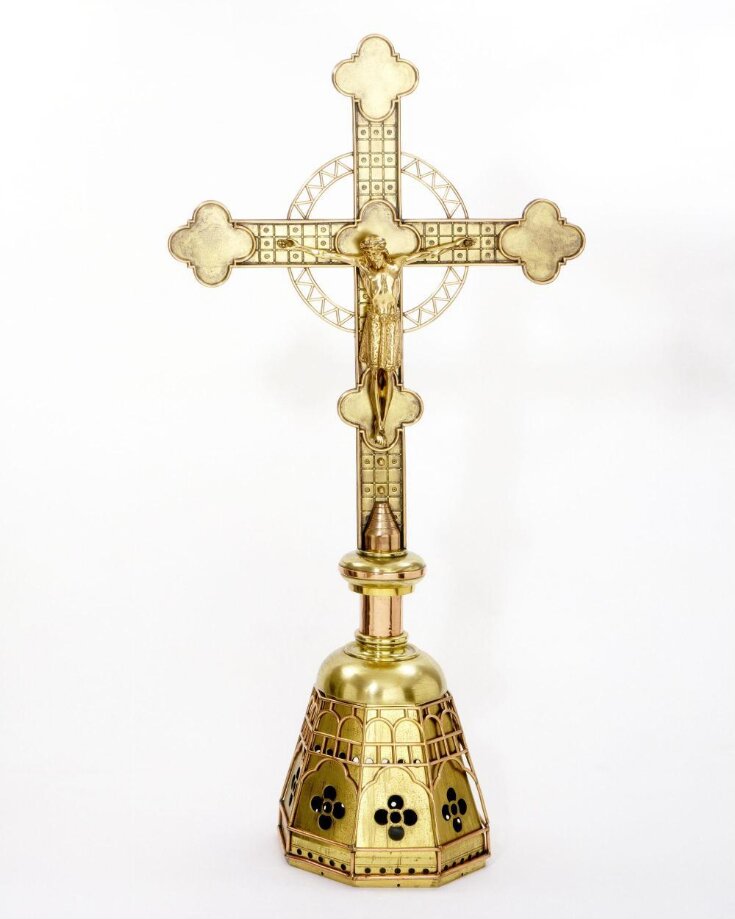

Altar Cross
1867-1874 (made)
| Artist/Maker |
Object Type
Ornaments on the altar, such as this cross, were the subject of dispute in the Anglican church in the 19th century. Early Christian altars had minimal adornment. However, 19th-century supporters of the re-introduction of ceremony or ritual into church services adopted the use of a large number of altar furnishings such as candlesticks, crosses, flowers and books. This practice had been common on Roman Catholic altars in the 16th and 17th centuries. Crosses were especially controversial. They were associated with Roman Catholicism in the mid-19th century, and senior Anglican clergy often ordered their removal.
Time
Brass church furnishings, a cost-effective way to furnish a church, were especially popular in the 1860s and 1870s. The style of this cross and other metalwork designed by the architect James Brooks (1825-1901) was influential at the time. His designs were less ornate than those of architects such as A.W.N. Pugin (1812-1852) and William Burges (1827-1881) and less concerned with reproducing authentic details of medieval pieces. By the early 20th century, designs similar to those of James Brooks were offered by a number of firms including The Artificer's Guild.
Ornaments on the altar, such as this cross, were the subject of dispute in the Anglican church in the 19th century. Early Christian altars had minimal adornment. However, 19th-century supporters of the re-introduction of ceremony or ritual into church services adopted the use of a large number of altar furnishings such as candlesticks, crosses, flowers and books. This practice had been common on Roman Catholic altars in the 16th and 17th centuries. Crosses were especially controversial. They were associated with Roman Catholicism in the mid-19th century, and senior Anglican clergy often ordered their removal.
Time
Brass church furnishings, a cost-effective way to furnish a church, were especially popular in the 1860s and 1870s. The style of this cross and other metalwork designed by the architect James Brooks (1825-1901) was influential at the time. His designs were less ornate than those of architects such as A.W.N. Pugin (1812-1852) and William Burges (1827-1881) and less concerned with reproducing authentic details of medieval pieces. By the early 20th century, designs similar to those of James Brooks were offered by a number of firms including The Artificer's Guild.
Object details
| Categories | |
| Object type | |
| Materials and techniques | Brass and copper |
| Brief description | altar cross for St. Columba's, Haggerston |
| Dimensions |
|
| Gallery label | British Galleries:
James Brooks designed this cross for the high altar of a church that he designed in a poor area of East London. Brooks was well known for his severe Gothic designs with little ornament. His style was well suited to producing buildings and furnishings on a relatively small budget.(27/03/2003) |
| Object history | Designed by James Brooks (born in Hatford, Oxfordshire, 1825, died in London, 1901) |
| Summary | Object Type Ornaments on the altar, such as this cross, were the subject of dispute in the Anglican church in the 19th century. Early Christian altars had minimal adornment. However, 19th-century supporters of the re-introduction of ceremony or ritual into church services adopted the use of a large number of altar furnishings such as candlesticks, crosses, flowers and books. This practice had been common on Roman Catholic altars in the 16th and 17th centuries. Crosses were especially controversial. They were associated with Roman Catholicism in the mid-19th century, and senior Anglican clergy often ordered their removal. Time Brass church furnishings, a cost-effective way to furnish a church, were especially popular in the 1860s and 1870s. The style of this cross and other metalwork designed by the architect James Brooks (1825-1901) was influential at the time. His designs were less ornate than those of architects such as A.W.N. Pugin (1812-1852) and William Burges (1827-1881) and less concerned with reproducing authentic details of medieval pieces. By the early 20th century, designs similar to those of James Brooks were offered by a number of firms including The Artificer's Guild. |
| Collection | |
| Accession number | M.252-1984 |
About this object record
Explore the Collections contains over a million catalogue records, and over half a million images. It is a working database that includes information compiled over the life of the museum. Some of our records may contain offensive and discriminatory language, or reflect outdated ideas, practice and analysis. We are committed to addressing these issues, and to review and update our records accordingly.
You can write to us to suggest improvements to the record.
Suggest feedback
You can write to us to suggest improvements to the record.
Suggest feedback
| Record created | March 27, 2003 |
| Record URL |
Download as: JSONIIIF Manifest
