Coffee Pot
1867 (made)
| Artist/Maker | |
| Place of origin |
Object Type
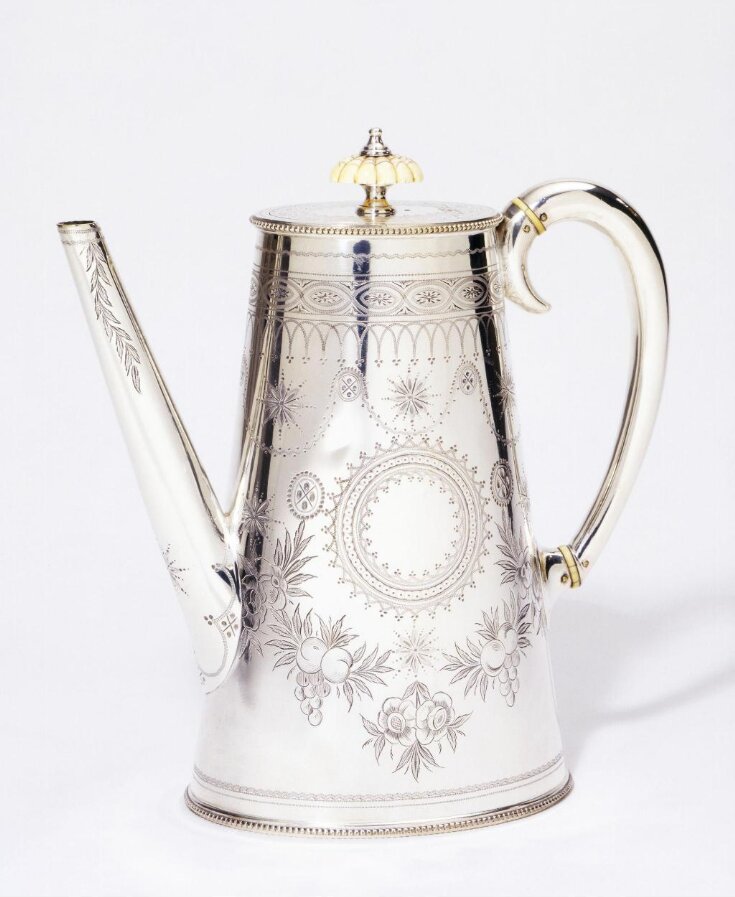
The coffee pot was used to infuse ground coffee. Mrs Beeton's Book of Household Management, published in 1888 recommended adding 1/2 -1 tablespoonful of coffee for each person and 1/2 pint of water to every ounce of coffee put into the coffee pot to give a strong coffee which could be diluted with hot milk or cream. A small muslin bag was used as a filter. British households generally continued to prefer tea throughout the 19th century, but coffee was offered at most social gatherings in the home, from dinner parties to 'at home' tea parties, balls and suppers.
The Victorian Tea Service
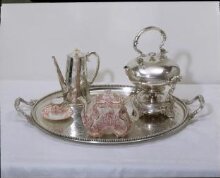
A complete tea service in one pattern and material was just one option for the Victorian household. Those consumers who could afford it were more likely to purchase a silver teapot, tea kettle and stand, milk jug and sugar bowl, as well as a coffee pot, to use with porcelain cups and saucers. Domestic advice manuals advised the housewife to buy equipment and cutlery as the minimum quantity of silver that a respectable household should own. Electroplated nickel silver (a cheaper, plated alternative ) was an accepted substitute for silver. In 1869 the manufacturers Elkington & Co. advertised similar coffee pots in their catalogue for £ 6 6s (£6.30). Apart from the tea kettle, the coffee pot was the most expensive item for serving hot drinks.
The Manufacturer
Elkington & Co., who made this coffee pot, became the largest and most successful silversmithing business in England in the 19th century, supplying the top end of the domestic market as well as the emerging hotel, restaurant and travel trade. The firm was founded in Birmingham by George Richard Elkington (1801-1865) and his cousin Henry Elkington (about 1801-1852), who with the capital from other business partners exploited the development of the new manufacturing processes of electroplating (depositing silver on a base metal by the action of an electric current ), electrogilding (gilding by use of electricity ) and electrotyping (a form of electronic casting to form the whole object ). This coffee pot was made by the electroplating method. By marketing electroplate as a cheaper substitute for silver and by selling the patents for all the new techniques Elkingtons revolutionised the silver and plating trades throughout the world.
The coffee pot was used to infuse ground coffee. Mrs Beeton's Book of Household Management, published in 1888 recommended adding 1/2 -1 tablespoonful of coffee for each person and 1/2 pint of water to every ounce of coffee put into the coffee pot to give a strong coffee which could be diluted with hot milk or cream. A small muslin bag was used as a filter. British households generally continued to prefer tea throughout the 19th century, but coffee was offered at most social gatherings in the home, from dinner parties to 'at home' tea parties, balls and suppers.
The Victorian Tea Service
A complete tea service in one pattern and material was just one option for the Victorian household. Those consumers who could afford it were more likely to purchase a silver teapot, tea kettle and stand, milk jug and sugar bowl, as well as a coffee pot, to use with porcelain cups and saucers. Domestic advice manuals advised the housewife to buy equipment and cutlery as the minimum quantity of silver that a respectable household should own. Electroplated nickel silver (a cheaper, plated alternative ) was an accepted substitute for silver. In 1869 the manufacturers Elkington & Co. advertised similar coffee pots in their catalogue for £ 6 6s (£6.30). Apart from the tea kettle, the coffee pot was the most expensive item for serving hot drinks.
The Manufacturer
Elkington & Co., who made this coffee pot, became the largest and most successful silversmithing business in England in the 19th century, supplying the top end of the domestic market as well as the emerging hotel, restaurant and travel trade. The firm was founded in Birmingham by George Richard Elkington (1801-1865) and his cousin Henry Elkington (about 1801-1852), who with the capital from other business partners exploited the development of the new manufacturing processes of electroplating (depositing silver on a base metal by the action of an electric current ), electrogilding (gilding by use of electricity ) and electrotyping (a form of electronic casting to form the whole object ). This coffee pot was made by the electroplating method. By marketing electroplate as a cheaper substitute for silver and by selling the patents for all the new techniques Elkingtons revolutionised the silver and plating trades throughout the world.
Object details
| Categories | |
| Object type | |
| Materials and techniques | Electroplated nickel silver, with ivory insulators and finial and engraved decoration |
| Brief description | Coffee pot |
| Dimensions |
|
| Marks and inscriptions | On base: E&Co, E, &, Co, E
Stamped: Elkington and C0 and 8097, R, X |
| Gallery label | British Galleries:
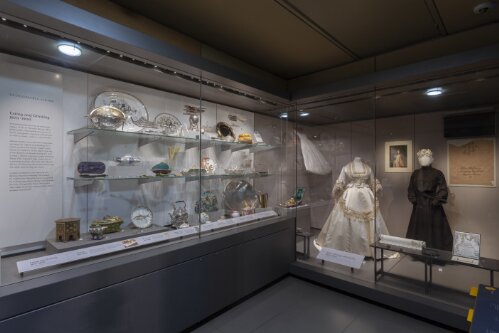
Electroplated goods (silver over a nickel alloy) sold well and became commonplace in Victorian households as a cheaper and hard-wearing substitute for silver.(27/03/2003) |
| Credit line | Given by Elkington & Co. Ltd. |
| Object history | Manufactured by Elkington & Co., Birmingham |
| Production | Date mark for 1867 |
| Summary | Object Type The coffee pot was used to infuse ground coffee. Mrs Beeton's Book of Household Management, published in 1888 recommended adding 1/2 -1 tablespoonful of coffee for each person and 1/2 pint of water to every ounce of coffee put into the coffee pot to give a strong coffee which could be diluted with hot milk or cream. A small muslin bag was used as a filter. British households generally continued to prefer tea throughout the 19th century, but coffee was offered at most social gatherings in the home, from dinner parties to 'at home' tea parties, balls and suppers. The Victorian Tea Service A complete tea service in one pattern and material was just one option for the Victorian household. Those consumers who could afford it were more likely to purchase a silver teapot, tea kettle and stand, milk jug and sugar bowl, as well as a coffee pot, to use with porcelain cups and saucers. Domestic advice manuals advised the housewife to buy equipment and cutlery as the minimum quantity of silver that a respectable household should own. Electroplated nickel silver (a cheaper, plated alternative ) was an accepted substitute for silver. In 1869 the manufacturers Elkington & Co. advertised similar coffee pots in their catalogue for £ 6 6s (£6.30). Apart from the tea kettle, the coffee pot was the most expensive item for serving hot drinks. The Manufacturer Elkington & Co., who made this coffee pot, became the largest and most successful silversmithing business in England in the 19th century, supplying the top end of the domestic market as well as the emerging hotel, restaurant and travel trade. The firm was founded in Birmingham by George Richard Elkington (1801-1865) and his cousin Henry Elkington (about 1801-1852), who with the capital from other business partners exploited the development of the new manufacturing processes of electroplating (depositing silver on a base metal by the action of an electric current ), electrogilding (gilding by use of electricity ) and electrotyping (a form of electronic casting to form the whole object ). This coffee pot was made by the electroplating method. By marketing electroplate as a cheaper substitute for silver and by selling the patents for all the new techniques Elkingtons revolutionised the silver and plating trades throughout the world. |
| Collection | |
| Accession number | M.241-1984 |
About this object record
Explore the Collections contains over a million catalogue records, and over half a million images. It is a working database that includes information compiled over the life of the museum. Some of our records may contain offensive and discriminatory language, or reflect outdated ideas, practice and analysis. We are committed to addressing these issues, and to review and update our records accordingly.
You can write to us to suggest improvements to the record.
Suggest feedback
You can write to us to suggest improvements to the record.
Suggest feedback
| Record created | March 27, 2003 |
| Record URL |
Download as: JSONIIIF Manifest
