Snuff Box
ca. 1750 (made)
| Artist/Maker | |
| Place of origin |
Object Type
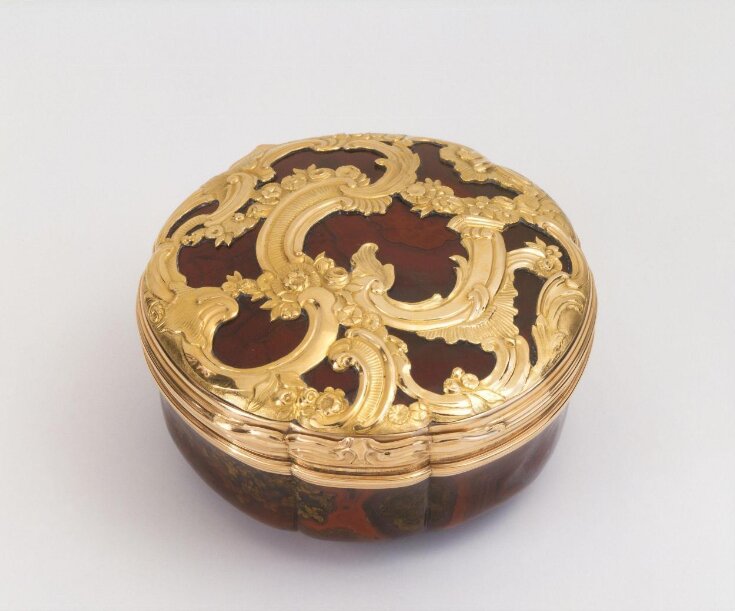
The essential ingredient of snuff is powdered tobacco. A pinch of snuff is held to the nose and sharply inhaled. Throughout the 18th century the snuff box was a fashionable accessory for the well-dressed man, a partner to his sword, his watch and his shoe buckles. Boxes were made of many materials, from horn, tortoiseshell and hardstone to silver and gold. This example is made of jasper, a hardstone, mounted in gold.
Materials & Making
The use of hardstones is particularly associated with German craftsmen. There were many of them in 18th-century London, and it may be that it was a German who prepared the jasper base and the lid (the latter now replaced). These would have been mounted in the workshop of a box maker, where there were specialists in the art of hinge- and rim-making. Making the tightly-fitting rim and a smoothly-opening hinge (known in the trade as a 'joint') were highly-skilled tasks. The chasing of the scrolls, shells and flowers on the gold mounts of the lid would have been executed by another specialist, a chaser, who modelled the gold with a hammer and steel tools. The open goldwork on the lid is often described as cagework because the stone is held within a cage (in French … cage).
Design & Designing
The swirling gold scrolls and foliage of the lid show full-blooded asymmetry in the High Rococo style created in France in the late 1720s. The use of asymmetry spread to London silver and gold during the 1730s.
The essential ingredient of snuff is powdered tobacco. A pinch of snuff is held to the nose and sharply inhaled. Throughout the 18th century the snuff box was a fashionable accessory for the well-dressed man, a partner to his sword, his watch and his shoe buckles. Boxes were made of many materials, from horn, tortoiseshell and hardstone to silver and gold. This example is made of jasper, a hardstone, mounted in gold.
Materials & Making
The use of hardstones is particularly associated with German craftsmen. There were many of them in 18th-century London, and it may be that it was a German who prepared the jasper base and the lid (the latter now replaced). These would have been mounted in the workshop of a box maker, where there were specialists in the art of hinge- and rim-making. Making the tightly-fitting rim and a smoothly-opening hinge (known in the trade as a 'joint') were highly-skilled tasks. The chasing of the scrolls, shells and flowers on the gold mounts of the lid would have been executed by another specialist, a chaser, who modelled the gold with a hammer and steel tools. The open goldwork on the lid is often described as cagework because the stone is held within a cage (in French … cage).
Design & Designing
The swirling gold scrolls and foliage of the lid show full-blooded asymmetry in the High Rococo style created in France in the late 1720s. The use of asymmetry spread to London silver and gold during the 1730s.
Object details
| Categories | |
| Object type | |
| Materials and techniques | Jasper (the lid plaque replaced), mounted in gold |
| Dimensions |
|
| Gallery label | British Galleries:
British craftsmen copied French Rococo products most closely when creating luxury goods. The entire category of 'toys' (small personal accessories like this box) sold by specialist 'toymen' was inspired by French and German examples. Hubert Gravelot (1699-1773) and William de la Cour (active from 1740, died in 1767), both of whom worked in Britain, made designs for boxes of this type.(27/03/2003) |
| Credit line | Bequeathed by Henry L. Florence |
| Object history | Probably made in London |
| Summary | Object Type The essential ingredient of snuff is powdered tobacco. A pinch of snuff is held to the nose and sharply inhaled. Throughout the 18th century the snuff box was a fashionable accessory for the well-dressed man, a partner to his sword, his watch and his shoe buckles. Boxes were made of many materials, from horn, tortoiseshell and hardstone to silver and gold. This example is made of jasper, a hardstone, mounted in gold. Materials & Making The use of hardstones is particularly associated with German craftsmen. There were many of them in 18th-century London, and it may be that it was a German who prepared the jasper base and the lid (the latter now replaced). These would have been mounted in the workshop of a box maker, where there were specialists in the art of hinge- and rim-making. Making the tightly-fitting rim and a smoothly-opening hinge (known in the trade as a 'joint') were highly-skilled tasks. The chasing of the scrolls, shells and flowers on the gold mounts of the lid would have been executed by another specialist, a chaser, who modelled the gold with a hammer and steel tools. The open goldwork on the lid is often described as cagework because the stone is held within a cage (in French … cage). Design & Designing The swirling gold scrolls and foliage of the lid show full-blooded asymmetry in the High Rococo style created in France in the late 1720s. The use of asymmetry spread to London silver and gold during the 1730s. |
| Collection | |
| Accession number | M.230-1917 |
About this object record
Explore the Collections contains over a million catalogue records, and over half a million images. It is a working database that includes information compiled over the life of the museum. Some of our records may contain offensive and discriminatory language, or reflect outdated ideas, practice and analysis. We are committed to addressing these issues, and to review and update our records accordingly.
You can write to us to suggest improvements to the record.
Suggest feedback
You can write to us to suggest improvements to the record.
Suggest feedback
| Record created | March 27, 2003 |
| Record URL |
Download as: JSONIIIF Manifest
