Sugar Caster
1762-1763 (hallmarked)
| Artist/Maker | |
| Place of origin |
Object Type
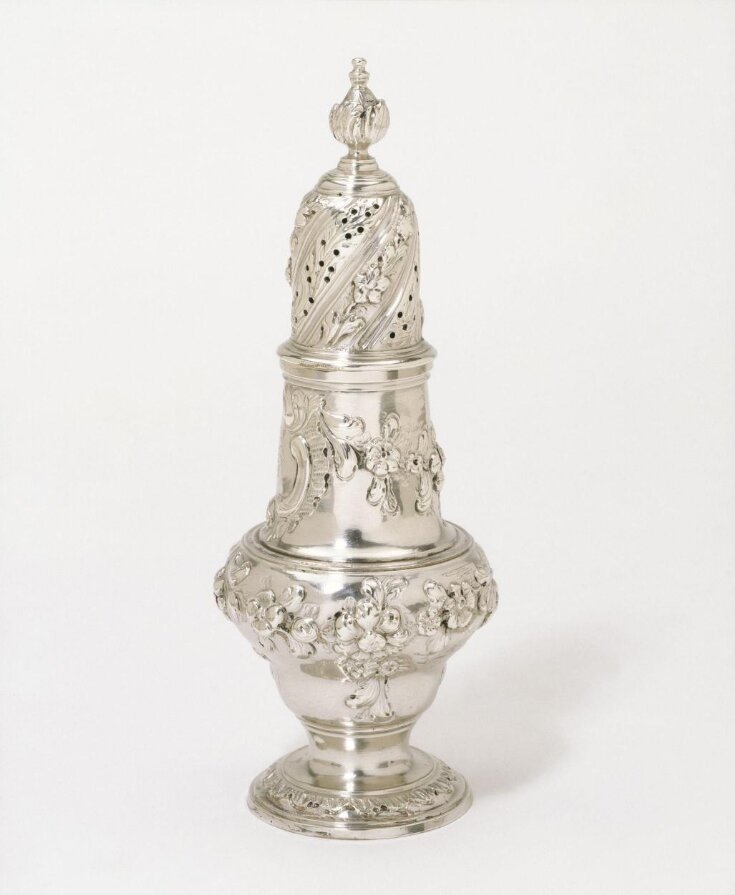
Sets of casters developed in the late 17th century. The sugar caster was usually larger than the other vessels. Most casters have a pierced top, as here, for sprinkling the condiments. On the grandest tables, the sets of casters would be grouped around an epergne (an ornamental table piece, often with several bowls) displaying fruit, so that the guests could help themselves to the condiments.
Design
Casters were made in a variety of styles reflecting the fashionable taste of the time. Most have an upright, vertical form, such as a cylinder, vase or pear shape, which can be easily held. The cover is generally in the form of a dome. The plain or octagonal pear-shaped casters, from which this caster derives, first made their appearance in 1700-1710.
Trading
Casters could be bought singly, as a set of three or six, or as part of a centrepiece set. In 1750 the goldsmith George Wickes supplied a set of silver casters to a Mr Mead for £13 9s 2d, but he also made a silver vase caster for the Hon. Arthur Hill for £14 11s 6d. The high cost of the vase caster must reflect elaborate and expensive decoration.
Sets of casters developed in the late 17th century. The sugar caster was usually larger than the other vessels. Most casters have a pierced top, as here, for sprinkling the condiments. On the grandest tables, the sets of casters would be grouped around an epergne (an ornamental table piece, often with several bowls) displaying fruit, so that the guests could help themselves to the condiments.
Design
Casters were made in a variety of styles reflecting the fashionable taste of the time. Most have an upright, vertical form, such as a cylinder, vase or pear shape, which can be easily held. The cover is generally in the form of a dome. The plain or octagonal pear-shaped casters, from which this caster derives, first made their appearance in 1700-1710.
Trading
Casters could be bought singly, as a set of three or six, or as part of a centrepiece set. In 1750 the goldsmith George Wickes supplied a set of silver casters to a Mr Mead for £13 9s 2d, but he also made a silver vase caster for the Hon. Arthur Hill for £14 11s 6d. The high cost of the vase caster must reflect elaborate and expensive decoration.
Object details
| Categories | |
| Object type | |
| Parts | This object consists of 2 parts.
|
| Materials and techniques | Silver, embossed and engraved |
| Dimensions |
|
| Marks and inscriptions | Engraved with a swan rising from a coronet |
| Gallery label | British Galleries:
This sugar caster is typical of the fashionable dining objects owned by wealthy families in the late 18th century. It was placed in a prominent postion on the table and used to accompany a rich dessert. Casters were also used for sprinkling salt, pepper, mustard powder and other spices on food.(27/03/2003) |
| Credit line | Bequeathed by W. J. Johnson |
| Object history | Made in London by John Delmestre (active from 1755) |
| Summary | Object Type Sets of casters developed in the late 17th century. The sugar caster was usually larger than the other vessels. Most casters have a pierced top, as here, for sprinkling the condiments. On the grandest tables, the sets of casters would be grouped around an epergne (an ornamental table piece, often with several bowls) displaying fruit, so that the guests could help themselves to the condiments. Design Casters were made in a variety of styles reflecting the fashionable taste of the time. Most have an upright, vertical form, such as a cylinder, vase or pear shape, which can be easily held. The cover is generally in the form of a dome. The plain or octagonal pear-shaped casters, from which this caster derives, first made their appearance in 1700-1710. Trading Casters could be bought singly, as a set of three or six, or as part of a centrepiece set. In 1750 the goldsmith George Wickes supplied a set of silver casters to a Mr Mead for £13 9s 2d, but he also made a silver vase caster for the Hon. Arthur Hill for £14 11s 6d. The high cost of the vase caster must reflect elaborate and expensive decoration. |
| Collection | |
| Accession number | M.1677&A-1944 |
About this object record
Explore the Collections contains over a million catalogue records, and over half a million images. It is a working database that includes information compiled over the life of the museum. Some of our records may contain offensive and discriminatory language, or reflect outdated ideas, practice and analysis. We are committed to addressing these issues, and to review and update our records accordingly.
You can write to us to suggest improvements to the record.
Suggest feedback
You can write to us to suggest improvements to the record.
Suggest feedback
| Record created | March 27, 2003 |
| Record URL |
Download as: JSONIIIF Manifest
