The Islington cup
Cup
1802-1803 (hallmarked)
1802-1803 (hallmarked)
| Artist/Maker | |
| Place of origin |
Object Type
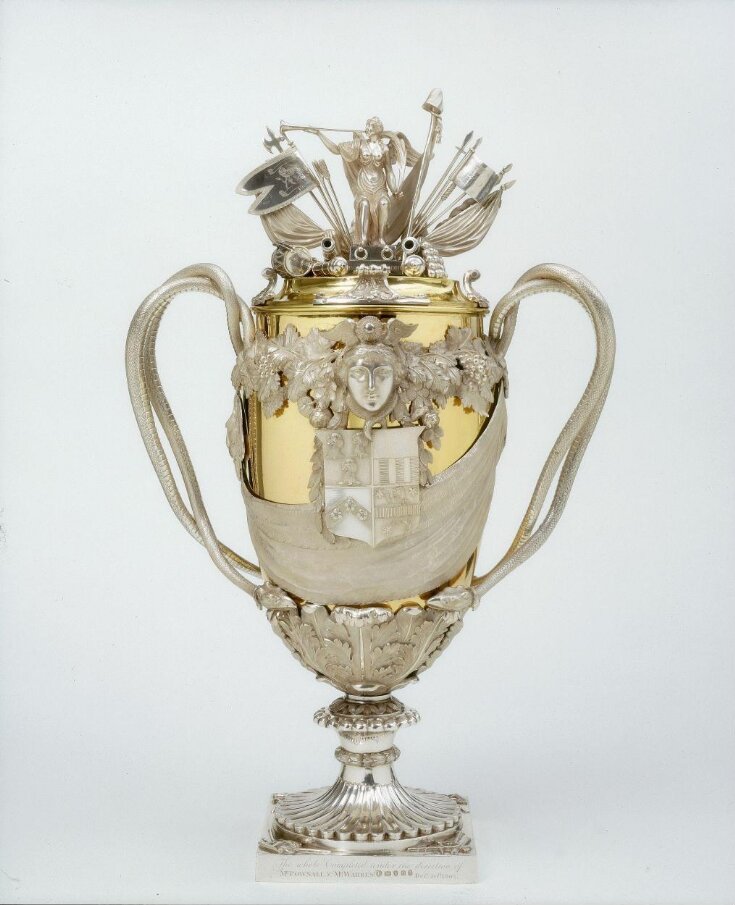
The Islington cup is a piece of presentation silver. Gifts of silver to mark important events or rites of passage, to reward service or excellence, to enter societies and institutions and as diplomatic presents had a longstanding and honourable tradition in Britain. To increase the compliment, the form of the gift was often, as here, unusually lavish, elaborate and fashionable. The ornament might reflect the preferences and associations of the new owner. For example, on this cup the instruments on the base refer to the recipient's interest in astronomy, while the arts of war on the cover are linked to his regimental duties. The cup was expected to be displayed, but the unusually well-preserved surfaces of matt silver against gilt show that it has been stored in its lined case and rarely handled.
People
An inscription on the reverse records the presentation of the cup to Alexander Aubert (1730-1805), the officer commanding the Loyal Islington Volunteers, in gratitude for his leadership. This regiment, formed in 1797, was one of many part-time local forces raised in response to the threat of French invasion during the Revolutionary War. It never saw active service, but had a membership of 314 when, with peace declared, it disbanded in 1801. It was at this point that the cup was commissioned from the silversmith Joseph Preedy.
The particular importance of this cup for art historians is that the inscriptions on the base record the names of the other contributors to its design and manufacture that often lie unknown behind the silversmith's mark. The cup's designer, John Thurston (1774-1822), worked as a book illustrator and exhibited at the Royal Academy; the modeller, Edmund Coffin, was a sculptor of church monuments; and the engraver, John Roper, made city plans. According to a report in The Times for 1803 the cup cost 250 guineas, and it was presented to Aubert on the second anniversary of the disbanding of the regiment. Aubert, a director of the London Assurance Company, owned one of the finest observatories in Britain at Highbury House, Islington, hence the allusions to astronomy on the cup's base.
The Islington cup is a piece of presentation silver. Gifts of silver to mark important events or rites of passage, to reward service or excellence, to enter societies and institutions and as diplomatic presents had a longstanding and honourable tradition in Britain. To increase the compliment, the form of the gift was often, as here, unusually lavish, elaborate and fashionable. The ornament might reflect the preferences and associations of the new owner. For example, on this cup the instruments on the base refer to the recipient's interest in astronomy, while the arts of war on the cover are linked to his regimental duties. The cup was expected to be displayed, but the unusually well-preserved surfaces of matt silver against gilt show that it has been stored in its lined case and rarely handled.
People
An inscription on the reverse records the presentation of the cup to Alexander Aubert (1730-1805), the officer commanding the Loyal Islington Volunteers, in gratitude for his leadership. This regiment, formed in 1797, was one of many part-time local forces raised in response to the threat of French invasion during the Revolutionary War. It never saw active service, but had a membership of 314 when, with peace declared, it disbanded in 1801. It was at this point that the cup was commissioned from the silversmith Joseph Preedy.
The particular importance of this cup for art historians is that the inscriptions on the base record the names of the other contributors to its design and manufacture that often lie unknown behind the silversmith's mark. The cup's designer, John Thurston (1774-1822), worked as a book illustrator and exhibited at the Royal Academy; the modeller, Edmund Coffin, was a sculptor of church monuments; and the engraver, John Roper, made city plans. According to a report in The Times for 1803 the cup cost 250 guineas, and it was presented to Aubert on the second anniversary of the disbanding of the regiment. Aubert, a director of the London Assurance Company, owned one of the finest observatories in Britain at Highbury House, Islington, hence the allusions to astronomy on the cup's base.
Object details
| Categories | |
| Object type | |
| Parts | This object consists of 3 parts.
|
| Title | The Islington cup (popular title) |
| Materials and techniques | Silver, parcel-gilt, chased and engraved |
| Brief description | The Islington Cup, silver, parcel-gilt, London hallmarks for 1802-3, designed by John Thurston, modelled by Edmund Coffin, mark of Joseph Preedy. |
| Physical description | The Islington Cup, silver, parcel-gilt, 49 x 31 x 21.5 cm, London date hallmark. |
| Dimensions |
|
| Marks and inscriptions |
|
| Gallery label | British Galleries:
This silver cup was offered as a reward for service to the nation. It was presented to Alexander Aubert, commanding officer of the Loyal Islington Volunteers, a local London regiment formed in 1797 in response to the threat from France.(27/03/2003) |
| Credit line | Purchased with Art Fund support, and the assistance of the Associates of the V&A, the Worshipful Company of Goldsmiths, the Islington Cup Appeal and the citizens of the London Borough of Islington |
| Object history | Designed by John Thurston (1774-1822); modelled by Edmund Coffin (born in 1761); made in London by Joseph Preedy; inscription engraved by John Roper The Volunteers were a local, part-time force formed in response to the threat from post-Revolutionary France. They never saw active service and disbanded in 1801, at which point the cup was commissioned. Unusually, the foot is engraved with the names of the designer, John Thurston, and modeller, Edmund Coffen, as well as the silversmith. The design has been assembled with some care. While celebrating the arts of war on the cover, with the particular accoutrements of the Corps, the head of Mercury and astronomical instruments on the base refer to Aubert's interest in astronomy. He had a magnificent observatory at Highbury House, Islington, from where he observed the transit of Venus on 3 June 1769, also commemorated on the cup by an engraved chart. The lion's skin wrapped around the body of the cup was a symbol of the strength and unity of the Corps. The monumental nature of the composition was devised solely for display. The cup would have been kept largely in its case, to preserve the finish of the contrasting surfaces - matt silver against gilt. " Neg._No: HG 1390 case;HG 1394 mks; HG 1398 base; HG 1393 lid; HG 1392 inscr.; HG 1391 cup; HG 1395 det; HG 1396 det; HG 1397 det |
| Historical context | The cup was presented to Alexander Aubert on 20 January 1803. Aubert was an important commercial figure, a friend and champion of the engineer John Smeaton, and the owner of one of the best private observatories in Britain. The decoration at the foot of the cup alludes to his observation of the transit of Venus in 1769. The cup was later in the possession of William DuCann Luard (b.1862) and descended in the Luard family as it was sold by Commander William Blaise Luard, OBE RN rtd FIN Sotheby's Gleneagles 26 August 1971 lot 144 (information from NACF Annual Report, 1987) |
| Subjects depicted | |
| Association | |
| Summary | Object Type The Islington cup is a piece of presentation silver. Gifts of silver to mark important events or rites of passage, to reward service or excellence, to enter societies and institutions and as diplomatic presents had a longstanding and honourable tradition in Britain. To increase the compliment, the form of the gift was often, as here, unusually lavish, elaborate and fashionable. The ornament might reflect the preferences and associations of the new owner. For example, on this cup the instruments on the base refer to the recipient's interest in astronomy, while the arts of war on the cover are linked to his regimental duties. The cup was expected to be displayed, but the unusually well-preserved surfaces of matt silver against gilt show that it has been stored in its lined case and rarely handled. People An inscription on the reverse records the presentation of the cup to Alexander Aubert (1730-1805), the officer commanding the Loyal Islington Volunteers, in gratitude for his leadership. This regiment, formed in 1797, was one of many part-time local forces raised in response to the threat of French invasion during the Revolutionary War. It never saw active service, but had a membership of 314 when, with peace declared, it disbanded in 1801. It was at this point that the cup was commissioned from the silversmith Joseph Preedy. The particular importance of this cup for art historians is that the inscriptions on the base record the names of the other contributors to its design and manufacture that often lie unknown behind the silversmith's mark. The cup's designer, John Thurston (1774-1822), worked as a book illustrator and exhibited at the Royal Academy; the modeller, Edmund Coffin, was a sculptor of church monuments; and the engraver, John Roper, made city plans. According to a report in The Times for 1803 the cup cost 250 guineas, and it was presented to Aubert on the second anniversary of the disbanding of the regiment. Aubert, a director of the London Assurance Company, owned one of the finest observatories in Britain at Highbury House, Islington, hence the allusions to astronomy on the cup's base. |
| Bibliographic references |
|
| Collection | |
| Accession number | M.12 to B-1987 |
About this object record
Explore the Collections contains over a million catalogue records, and over half a million images. It is a working database that includes information compiled over the life of the museum. Some of our records may contain offensive and discriminatory language, or reflect outdated ideas, practice and analysis. We are committed to addressing these issues, and to review and update our records accordingly.
You can write to us to suggest improvements to the record.
Suggest feedback
You can write to us to suggest improvements to the record.
Suggest feedback
| Record created | March 27, 2003 |
| Record URL |
Download as: JSONIIIF Manifest
