Automaton Clock
ca. 1780 (made)
| Artist/Maker | |
| Place of origin |
Object Type
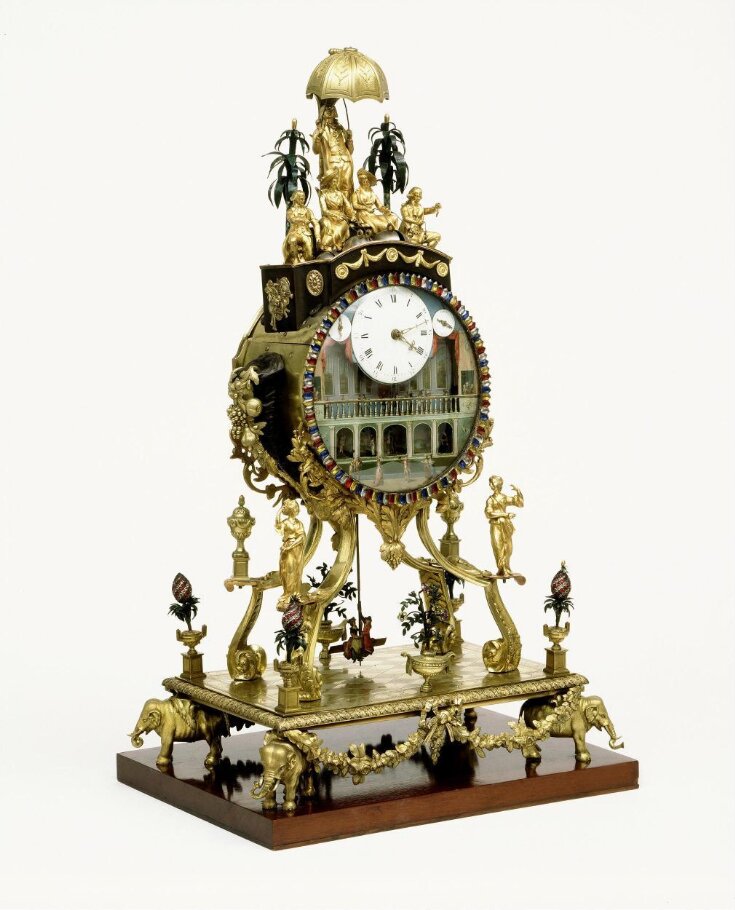
This musical clock by William Carpenter is typical of the kind of elaborate exotic time-piece made in London for export to the East in the late 18th century. Turkey, China and India were the principal destinations for these clocks.
Ownership & Use
The measurement of time was only one small feature of these clocks. This clock offered a choice of six tunes - two dances, two jigs, a song and a march. The figures dressed in 18th-century costume mounted on the clock, hold bells. The standing figures chime the quarters and strike the hours; the seated figures play the tunes on bells below their feet. These clocks were eagerly bought by Eastern rulers and merchants and were thought of as interesting toys. Examples can still be found in Indian, Turkish and Chinese palace museums.
Design
The area below the dial is pierced with the design of a palace with two storeys. The lower classical arcade is painted to show a landscape in the background. The upper storey shows scenes from a masked ball set in a ball-room. As the music plays, rows of costumed figures move from left to right. It has been suggested that this clock was made for an Indian client.
The Maker
William Carpenter worked in London's Soho district from about 1770 to 1805. He specialised in the manufacture of musical clocks and automata of this type.
This musical clock by William Carpenter is typical of the kind of elaborate exotic time-piece made in London for export to the East in the late 18th century. Turkey, China and India were the principal destinations for these clocks.
Ownership & Use
The measurement of time was only one small feature of these clocks. This clock offered a choice of six tunes - two dances, two jigs, a song and a march. The figures dressed in 18th-century costume mounted on the clock, hold bells. The standing figures chime the quarters and strike the hours; the seated figures play the tunes on bells below their feet. These clocks were eagerly bought by Eastern rulers and merchants and were thought of as interesting toys. Examples can still be found in Indian, Turkish and Chinese palace museums.
Design
The area below the dial is pierced with the design of a palace with two storeys. The lower classical arcade is painted to show a landscape in the background. The upper storey shows scenes from a masked ball set in a ball-room. As the music plays, rows of costumed figures move from left to right. It has been suggested that this clock was made for an Indian client.
The Maker
William Carpenter worked in London's Soho district from about 1770 to 1805. He specialised in the manufacture of musical clocks and automata of this type.
Object details
| Categories | |
| Object type | |
| Materials and techniques | Clock case, mechanised figures and bells of gilt brass, with enamelled and glass paste decoration |
| Brief description | Carpenter clock, automaton clock made for the Chinese market |
| Dimensions |
|
| Marks and inscriptions | Signed 'WILL.M CARPENTER LONDON' |
| Gallery label | British Galleries:
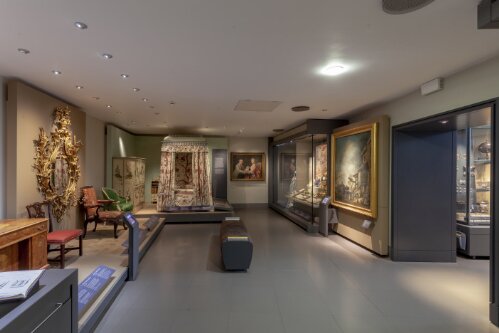
British clockmakers were respected worldwide for their skills in producing fine precision work. Clocks like this one, with elaborate gadgetry and rich decoration, were mostly produced for the Asian market. In China they had a novelty value and were collected as status symbols. Many such clocks were owned by the Chinese Emperor.(27/03/2003) |
| Credit line | Lt. Col. G. B. Croft-Lyons Bequest |
| Object history | Made in London by William Carpenter (active 1770-1805) |
| Summary | Object Type This musical clock by William Carpenter is typical of the kind of elaborate exotic time-piece made in London for export to the East in the late 18th century. Turkey, China and India were the principal destinations for these clocks. Ownership & Use The measurement of time was only one small feature of these clocks. This clock offered a choice of six tunes - two dances, two jigs, a song and a march. The figures dressed in 18th-century costume mounted on the clock, hold bells. The standing figures chime the quarters and strike the hours; the seated figures play the tunes on bells below their feet. These clocks were eagerly bought by Eastern rulers and merchants and were thought of as interesting toys. Examples can still be found in Indian, Turkish and Chinese palace museums. Design The area below the dial is pierced with the design of a palace with two storeys. The lower classical arcade is painted to show a landscape in the background. The upper storey shows scenes from a masked ball set in a ball-room. As the music plays, rows of costumed figures move from left to right. It has been suggested that this clock was made for an Indian client. The Maker William Carpenter worked in London's Soho district from about 1770 to 1805. He specialised in the manufacture of musical clocks and automata of this type. |
| Collection | |
| Accession number | M.1108-1926 |
About this object record
Explore the Collections contains over a million catalogue records, and over half a million images. It is a working database that includes information compiled over the life of the museum. Some of our records may contain offensive and discriminatory language, or reflect outdated ideas, practice and analysis. We are committed to addressing these issues, and to review and update our records accordingly.
You can write to us to suggest improvements to the record.
Suggest feedback
You can write to us to suggest improvements to the record.
Suggest feedback
| Record created | March 27, 2003 |
| Record URL |
Download as: JSONIIIF Manifest
