Nutmeg Grater
1800-1850 (made)
| Artist/Maker | |
| Place of origin |
Object Type
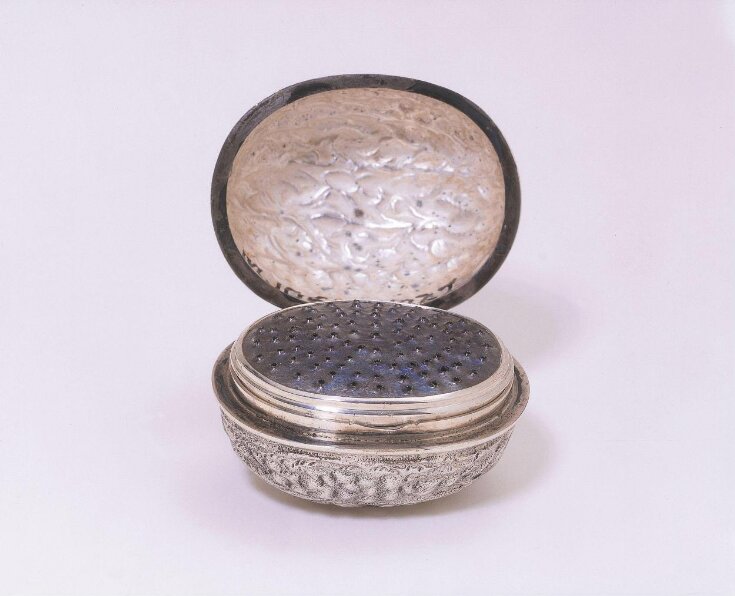
This portable container in the shape of a walnut was used to carry and grate nutmeg. An expensive and fragrant spice, nutmeg is the commercial name of the seed kernel of an evergreen tree, Myristica fragrans. It was imported into England from the East Indies, especially from islands that now form part of Indonesia. Initially nutmeg was believed to offer protection against the plague, but by the mid 17th century it was more commonly used to flavour food and drink. It was an important ingredient of punch and hot mulled wine.
Design & Use
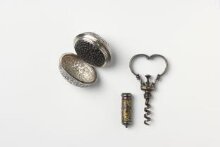
Nutmeg graters first appeared in the mid 17th century, with greater refinement in dining and a wider ownership of silver for the table. They were either carried in the pocket or included in a travelling canteen that might also contain cutlery, a beaker and a corkscrew. The graters reached the height of their popularity in the next century. Cheaper, thinner gauge silver, new manufacturing techniques and greater prosperity led to an enormous growth in items of small personal silver. Nutmeg graters were then made in a variety of forms, from cylindrical, circular or oval boxes to more unusual designs such as hearts or shells, to express the owner's taste and individuality.
This portable container in the shape of a walnut was used to carry and grate nutmeg. An expensive and fragrant spice, nutmeg is the commercial name of the seed kernel of an evergreen tree, Myristica fragrans. It was imported into England from the East Indies, especially from islands that now form part of Indonesia. Initially nutmeg was believed to offer protection against the plague, but by the mid 17th century it was more commonly used to flavour food and drink. It was an important ingredient of punch and hot mulled wine.
Design & Use
Nutmeg graters first appeared in the mid 17th century, with greater refinement in dining and a wider ownership of silver for the table. They were either carried in the pocket or included in a travelling canteen that might also contain cutlery, a beaker and a corkscrew. The graters reached the height of their popularity in the next century. Cheaper, thinner gauge silver, new manufacturing techniques and greater prosperity led to an enormous growth in items of small personal silver. Nutmeg graters were then made in a variety of forms, from cylindrical, circular or oval boxes to more unusual designs such as hearts or shells, to express the owner's taste and individuality.
Delve deeper
Discover more about this object

Object details
| Categories | |
| Object type | |
| Materials and techniques | Silver |
| Brief description | Nutmeg grater, silver, made in England, 1800-50 |
| Physical description | Nutmeg shaped. Silver, hinged lids and grater |
| Dimensions |
|
| Marks and inscriptions | unmarked |
| Credit line | Gift of Guy and Rupert Oswald Smith |
| Object history | Made in England |
| Summary | Object Type This portable container in the shape of a walnut was used to carry and grate nutmeg. An expensive and fragrant spice, nutmeg is the commercial name of the seed kernel of an evergreen tree, Myristica fragrans. It was imported into England from the East Indies, especially from islands that now form part of Indonesia. Initially nutmeg was believed to offer protection against the plague, but by the mid 17th century it was more commonly used to flavour food and drink. It was an important ingredient of punch and hot mulled wine. Design & Use Nutmeg graters first appeared in the mid 17th century, with greater refinement in dining and a wider ownership of silver for the table. They were either carried in the pocket or included in a travelling canteen that might also contain cutlery, a beaker and a corkscrew. The graters reached the height of their popularity in the next century. Cheaper, thinner gauge silver, new manufacturing techniques and greater prosperity led to an enormous growth in items of small personal silver. Nutmeg graters were then made in a variety of forms, from cylindrical, circular or oval boxes to more unusual designs such as hearts or shells, to express the owner's taste and individuality. |
| Bibliographic reference | Philippa Glanville and Sophie Lee, eds., The Art of Drinking, V&A Publications, London, 2007, p. 109 |
| Collection | |
| Accession number | M.1065-1927 |
About this object record
Explore the Collections contains over a million catalogue records, and over half a million images. It is a working database that includes information compiled over the life of the museum. Some of our records may contain offensive and discriminatory language, or reflect outdated ideas, practice and analysis. We are committed to addressing these issues, and to review and update our records accordingly.
You can write to us to suggest improvements to the record.
Suggest feedback
You can write to us to suggest improvements to the record.
Suggest feedback
| Record created | March 27, 2003 |
| Record URL |
Download as: JSONIIIF Manifest
