
Panel
ca. 1537 (made)
| Artist/Maker | |
| Place of origin |
From the middle of the 14th century, it became more common for people in England who had the right to bear coats of arms and badges to display them in their palaces and in public institutions such as churches and guildhalls.
These displays of heraldic alliances could be constructed as paintings (on woodwork and on walls in fresco), on cloths, as stone sculpture and in stained glass.
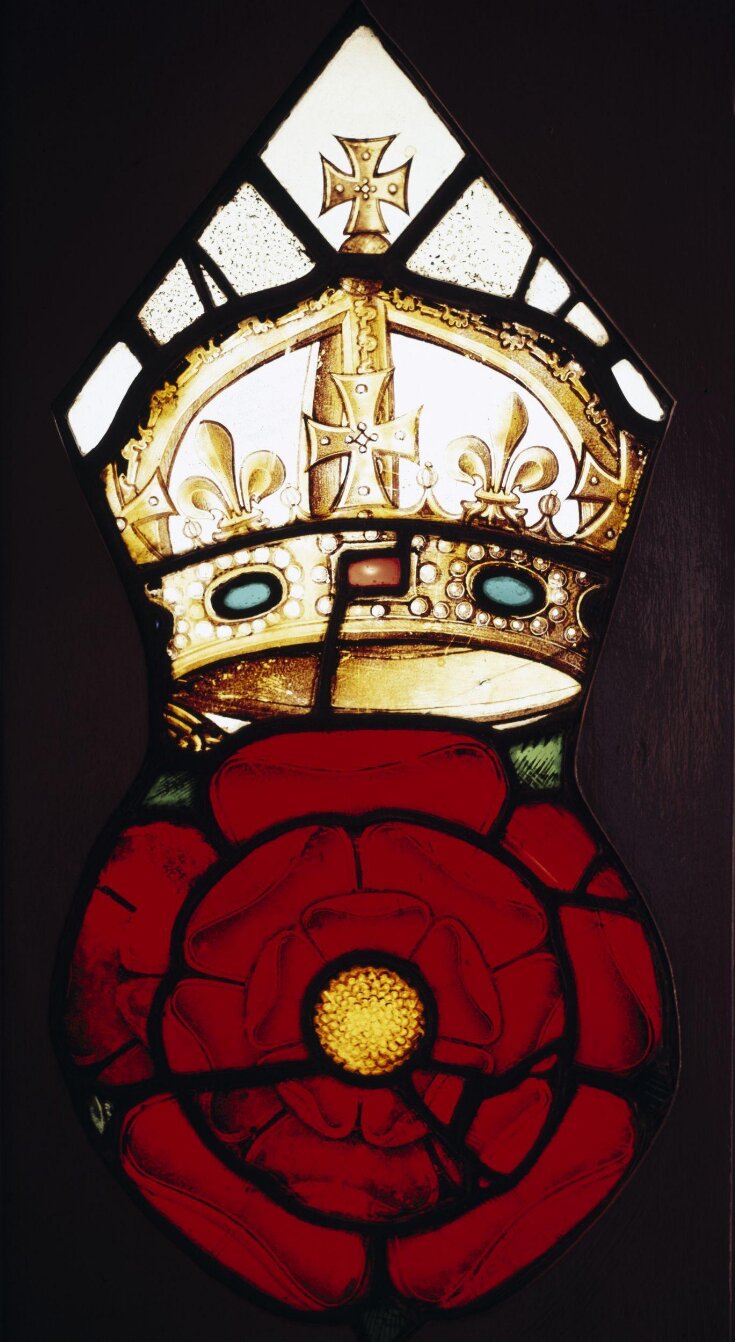
This stained glass panel displays a crowned red rose. The crowned red rose is known as the ‘Red Rose of Lancaster’ and was a personal badge of Henry VII, the first Tudor king, and was used by his descendents. Badges were used to display one’s familial connections, sometimes with a strong overt political message. Henry VII came to the throne after his supporters killed King Richard III at the Battle of Bosworth Field in 1485. Bosworth Field was the final battle in what has become known as the ‘Wars of the Roses’. The name derives from the fact that the two leading families in these struggles, the Yorkists and the Lancastrians each had badges consisting of a rose, later a crowned rose. The Yorkists bore a white rose, the Lancastrians a red rose.
Richard III was descended from the Yorkists; Henry Tudor from the Lancastrians. Both families descend from the offspring of King Edward III (1327-1377). Edward’s eldest son, John of Gaunt, had been made 1st Duke (second creation) of Lancaster and another son, Edmund Langley, 1st Duke of York.
Henry Tudor’s claim to the English crown on the Lancastrian side stems from his descent from the Beauforts, the illegitimate offspring of John of Gaunt and his mistress, Katherine Swynford. Although these offspring were legitimised by Parliament in 1397, the Yorkist Richard III’s claim to the throne was much stronger. Henry consolidated his hold on the crown by marrying Elizabeth of York, daughter of Edward IV and niece of Richard III.
King’s College Chapel in Cambridge, begun by Henry VI and continued by Henry VII, has a wealth of armorial glass in its windows. Much of this glass depicts the personal badges of Henry VII and his consort, Elizabeth of York, including individual panels of the crowned red rose of Lancaster and the crowned white rose of York. Surviving evidence from the windows of Henry VII’s Chapel in Westminster Abbey (destroyed in the Second World War) also show these badges.
Henry VII’s descendents continued to use the badges of the Houses of Lancaster and York. Henry VIII combined the two roses (red outer petals and white inner petals) as a single rose, known as the ‘Tudor Rose’. The panel displayed here is said to have come from Henry VIII’s Nonsuch Palace which he began building in 1538 as, according to legend, a celebration of the birth of his son, the future Edward VI. Nonsuch was not completed at the time of Henry’s death in 1547. It was sold to the Earls of Arundel in 1556 who completed the building only to have it revert to the crown at the end of the century. In 1670 the Stuart King Charles II gave the palace to his mistress, the Countess of Castlemaine who had it pulled down in the 1680s. We have no surviving evidence of armorial windows for Nonsuch Palace but it would be surprising if none had been planned.
These displays of heraldic alliances could be constructed as paintings (on woodwork and on walls in fresco), on cloths, as stone sculpture and in stained glass.
This stained glass panel displays a crowned red rose. The crowned red rose is known as the ‘Red Rose of Lancaster’ and was a personal badge of Henry VII, the first Tudor king, and was used by his descendents. Badges were used to display one’s familial connections, sometimes with a strong overt political message. Henry VII came to the throne after his supporters killed King Richard III at the Battle of Bosworth Field in 1485. Bosworth Field was the final battle in what has become known as the ‘Wars of the Roses’. The name derives from the fact that the two leading families in these struggles, the Yorkists and the Lancastrians each had badges consisting of a rose, later a crowned rose. The Yorkists bore a white rose, the Lancastrians a red rose.
Richard III was descended from the Yorkists; Henry Tudor from the Lancastrians. Both families descend from the offspring of King Edward III (1327-1377). Edward’s eldest son, John of Gaunt, had been made 1st Duke (second creation) of Lancaster and another son, Edmund Langley, 1st Duke of York.
Henry Tudor’s claim to the English crown on the Lancastrian side stems from his descent from the Beauforts, the illegitimate offspring of John of Gaunt and his mistress, Katherine Swynford. Although these offspring were legitimised by Parliament in 1397, the Yorkist Richard III’s claim to the throne was much stronger. Henry consolidated his hold on the crown by marrying Elizabeth of York, daughter of Edward IV and niece of Richard III.
King’s College Chapel in Cambridge, begun by Henry VI and continued by Henry VII, has a wealth of armorial glass in its windows. Much of this glass depicts the personal badges of Henry VII and his consort, Elizabeth of York, including individual panels of the crowned red rose of Lancaster and the crowned white rose of York. Surviving evidence from the windows of Henry VII’s Chapel in Westminster Abbey (destroyed in the Second World War) also show these badges.
Henry VII’s descendents continued to use the badges of the Houses of Lancaster and York. Henry VIII combined the two roses (red outer petals and white inner petals) as a single rose, known as the ‘Tudor Rose’. The panel displayed here is said to have come from Henry VIII’s Nonsuch Palace which he began building in 1538 as, according to legend, a celebration of the birth of his son, the future Edward VI. Nonsuch was not completed at the time of Henry’s death in 1547. It was sold to the Earls of Arundel in 1556 who completed the building only to have it revert to the crown at the end of the century. In 1670 the Stuart King Charles II gave the palace to his mistress, the Countess of Castlemaine who had it pulled down in the 1680s. We have no surviving evidence of armorial windows for Nonsuch Palace but it would be surprising if none had been planned.
Object details
| Categories | |
| Object type | |
| Materials and techniques | Clear and coloured glass, leaded, with painted and stained decoration |
| Brief description | Clear and coloured glass, leaded, painted in brown/black pigment and silver stain. Depicting a crowned red rose (the Lancastrian Rose). Said to have come from Nonsuch Palace in Surrey. English, about 1537. |
| Physical description | The Lancastrian rose in red glass, with yellow stamens and green leaf-lips, under a crown with jewels inlaid in red and green glass. |
| Dimensions |
|
| Gallery label |
|
| Credit line | Bought |
| Object history | Said to have come from the Palace of Nonsuch, Surrey. Bought from Arthur L. Radford and formerly in the collection of Richard Cockle Lucas. Was on loan to the museum between 11 July 1892 and was returned on 11 February 1898. Was again on loan to the museum from 12 January 1915. |
| Historical context | Was said to have come from Nonsuch Palace by the vendor. Letter in RP from Peter Miln, Kingsmead School, to C&G: I am...doubtful about the description of the rose as a "Tudor rose". I may...be wrong, but I have the impression that it is more likely to be the Lancastrian rose, often used by Henry VII. The Union rose of York and Lancaster occurs much more frequently in the arms and other heraldic usages of Henry VIII, who was himself a product of that union....Henry VII used the red rose as part of his standard...The fact that a cluster of five smaller petals occurs within the five outer petals is not significant, since there are various forms of depicting heraldic roses. It is the tincture that is important... |
| Subjects depicted | |
| Summary | From the middle of the 14th century, it became more common for people in England who had the right to bear coats of arms and badges to display them in their palaces and in public institutions such as churches and guildhalls. These displays of heraldic alliances could be constructed as paintings (on woodwork and on walls in fresco), on cloths, as stone sculpture and in stained glass. This stained glass panel displays a crowned red rose. The crowned red rose is known as the ‘Red Rose of Lancaster’ and was a personal badge of Henry VII, the first Tudor king, and was used by his descendents. Badges were used to display one’s familial connections, sometimes with a strong overt political message. Henry VII came to the throne after his supporters killed King Richard III at the Battle of Bosworth Field in 1485. Bosworth Field was the final battle in what has become known as the ‘Wars of the Roses’. The name derives from the fact that the two leading families in these struggles, the Yorkists and the Lancastrians each had badges consisting of a rose, later a crowned rose. The Yorkists bore a white rose, the Lancastrians a red rose. Richard III was descended from the Yorkists; Henry Tudor from the Lancastrians. Both families descend from the offspring of King Edward III (1327-1377). Edward’s eldest son, John of Gaunt, had been made 1st Duke (second creation) of Lancaster and another son, Edmund Langley, 1st Duke of York. Henry Tudor’s claim to the English crown on the Lancastrian side stems from his descent from the Beauforts, the illegitimate offspring of John of Gaunt and his mistress, Katherine Swynford. Although these offspring were legitimised by Parliament in 1397, the Yorkist Richard III’s claim to the throne was much stronger. Henry consolidated his hold on the crown by marrying Elizabeth of York, daughter of Edward IV and niece of Richard III. King’s College Chapel in Cambridge, begun by Henry VI and continued by Henry VII, has a wealth of armorial glass in its windows. Much of this glass depicts the personal badges of Henry VII and his consort, Elizabeth of York, including individual panels of the crowned red rose of Lancaster and the crowned white rose of York. Surviving evidence from the windows of Henry VII’s Chapel in Westminster Abbey (destroyed in the Second World War) also show these badges. Henry VII’s descendents continued to use the badges of the Houses of Lancaster and York. Henry VIII combined the two roses (red outer petals and white inner petals) as a single rose, known as the ‘Tudor Rose’. The panel displayed here is said to have come from Henry VIII’s Nonsuch Palace which he began building in 1538 as, according to legend, a celebration of the birth of his son, the future Edward VI. Nonsuch was not completed at the time of Henry’s death in 1547. It was sold to the Earls of Arundel in 1556 who completed the building only to have it revert to the crown at the end of the century. In 1670 the Stuart King Charles II gave the palace to his mistress, the Countess of Castlemaine who had it pulled down in the 1680s. We have no surviving evidence of armorial windows for Nonsuch Palace but it would be surprising if none had been planned. |
| Bibliographic references |
|
| Collection | |
| Accession number | C.456-1919 |
About this object record
Explore the Collections contains over a million catalogue records, and over half a million images. It is a working database that includes information compiled over the life of the museum. Some of our records may contain offensive and discriminatory language, or reflect outdated ideas, practice and analysis. We are committed to addressing these issues, and to review and update our records accordingly.
You can write to us to suggest improvements to the record.
Suggest feedback
You can write to us to suggest improvements to the record.
Suggest feedback
| Record created | June 9, 1998 |
| Record URL |
Download as: JSONIIIF Manifest
